














By Karim Were
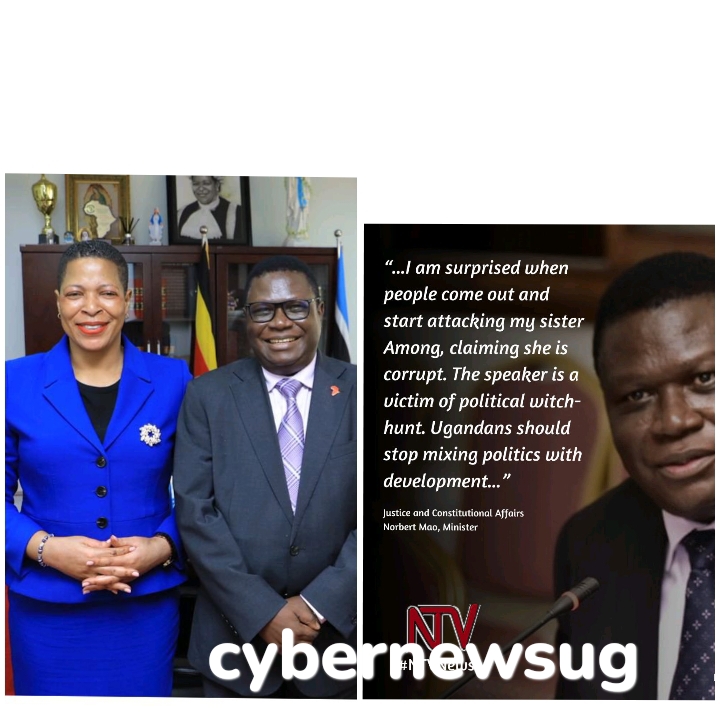
Uganda’s fast-changing political alliances are once again under the spotlight after Justice and Constitutional Affairs Minister Norbert Mao found himself under intense public scrutiny over his shifting stance toward Speaker Anita Annet Among.
What began as a growing battle over the leadership of Uganda’s incoming 12th Parliament has now evolved into a wider national conversation about political consistency, opportunism, and accountability within the country’s ruling elite.
Social media users have revived old video clips from March 2024 showing Mao strongly defending Among at a time when she faced mounting corruption allegations and international criticism. Speaking during celebrations marking the 122nd anniversary of Namilyango College, Mao dismissed accusations against the Speaker as unfair political attacks.
At the time, he portrayed Among as a generous and selfless leader, arguing that much of her income was spent supporting religious institutions, education initiatives, and vulnerable communities rather than accumulating personal wealth.
But as the race for the Speakership intensifies ahead of the official opening of the new Parliament, Mao’s tone has changed dramatically.
The Democratic Party president has recently emerged as one of Among’s sharpest critics, publicly questioning the source of her wealth and linking international sanctions against her to alleged corruption rather than Uganda’s controversial anti-gay legislation.
In several public appearances, Mao has accused Parliament of fueling corruption and misuse of public resources, arguing that Uganda requires new leadership capable of restoring public trust in the institution.
While positioning himself as a reform-minded figure, Mao has repeatedly stated that his loyalty to Uganda outweighs personal friendships or political relationships.
His remarks, however, have triggered a wave of criticism online, with opponents accusing him of abandoning principles for political convenience. Archived videos of his earlier praise for Among have circulated widely, fueling accusations of hypocrisy and selective morality.
For many observers, the controversy reflects a broader pattern in Ugandan politics where leaders fiercely defend allies while politically aligned, only to reverse positions after relationships deteriorate or political interests shift.
The fallout between Mao and Among reportedly deepened during the recent ruling party retreat in Kyankwanzi, where tensions emerged over the role of non-NRM actors in key political positions. Mao later accused the Speaker of arrogance and disrespect toward President Yoweri Museveni, who previously endorsed cooperation arrangements between the ruling NRM and the Democratic Party.
Political analysts say the dispute is less about personal disagreements and more about influence, survival, and positioning ahead of a new parliamentary term expected to shape Uganda’s political direction in the coming years.
Supporters of Mao argue that leaders are allowed to reconsider their views when circumstances change or new information emerges. Critics, however, insist that his latest statements contradict his earlier defense of Among and weaken the credibility of his anti-corruption message.
Beyond the individuals involved, the saga also demonstrates how digital media is reshaping political accountability in Uganda. In an era of viral clips and online archives, past statements are increasingly difficult for public figures to escape.
As the Speakership contest gains momentum, the growing rift between Mao and Among is turning into more than a political disagreement. It is becoming a public test of trust, consistency, and the authenticity
of Uganda’s political leadership.