























By Karim Were
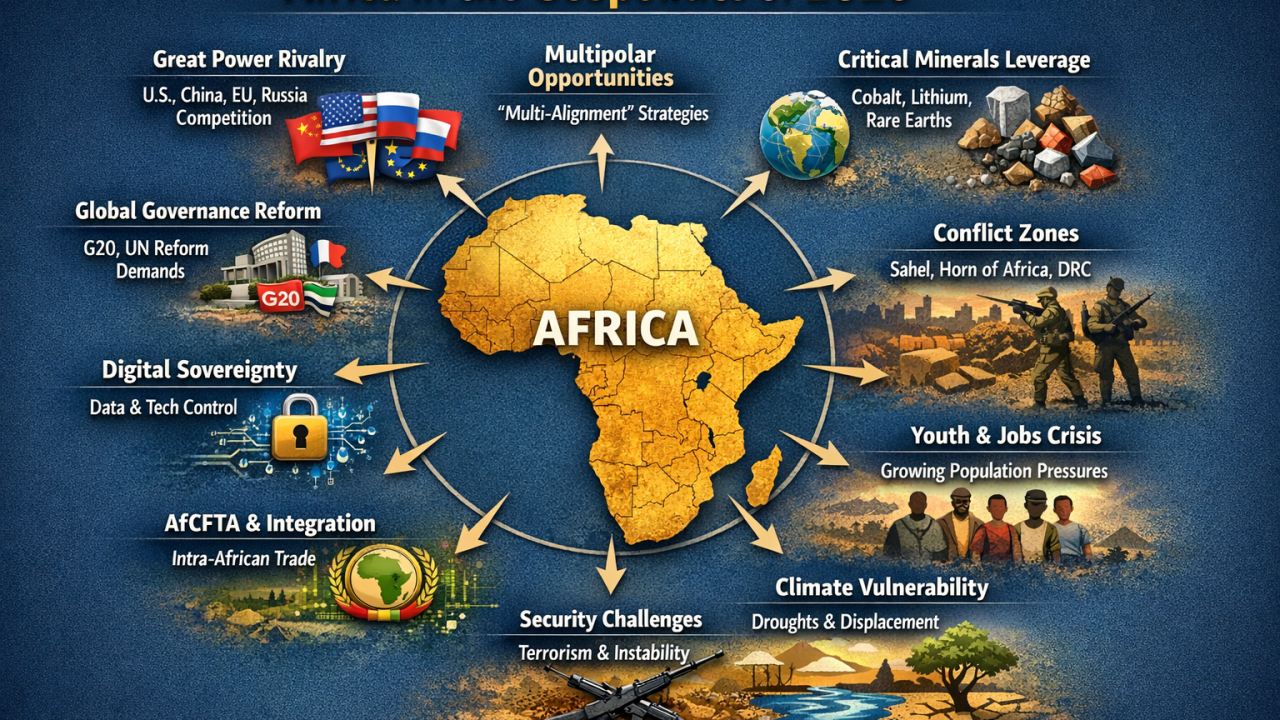
Africa is becoming an increasingly important arena — and increasingly an actor — in global geopolitics as major powers compete for access to markets, critical minerals, strategic infrastructure, energy resources and diplomatic partnerships across the continent.
The shift is being driven by several developments: the African Union’s permanent membership in the Group of 20 major economies, the growing role of African states in BRICS, rising demand for the continent’s critical minerals, expanding South-South trade and efforts by African governments to secure greater value from their natural resources.
The changes come as the international system becomes more fragmented, with the United States, China, Russia, European countries, India and Gulf states seeking stronger economic and strategic relationships with African countries.
For Africa, the emerging competition presents both an opportunity and a risk. Greater geopolitical attention could bring investment, infrastructure, technology and new markets. But African governments also face pressure to ensure that competition among external powers does not reproduce the continent’s historic dependence on exporting raw materials while importing higher-value manufactured goods.
The African Union has increasingly argued that Africa must move from being primarily a supplier of commodities to becoming a participant in global value chains.
That objective is becoming more important as demand rises for minerals needed for electric vehicles, batteries, renewable energy, advanced technology and defence industries.
A stronger seat at the global table
One of the clearest signs of Africa’s changing geopolitical position is its permanent membership in the G20.
The African Union became a permanent G20 member in 2023, giving the continent a formal seat in one of the world’s most influential economic forums.
The AU has since been working to coordinate the positions of its member states so that the bloc can use that position to influence international economic policy rather than simply participate in discussions.
At an AU G20 retreat held in Equatorial Guinea in April 2026, Equatorial Guinea’s Foreign Minister Simeón Oyono Esono Angüe described the permanent membership as a significant milestone but cautioned that securing a seat was only the beginning.
The real test, he said, was whether Africa could use the platform to advance continental priorities and produce tangible results for its people.
Advertisment

The AU itself has similarly emphasized coordination.
In April 2026, the organization said it was preparing for engagement with the United States’ 2026 G20 presidency by aligning African priorities under Agenda 2063 and developing a strategic roadmap for participation in G20 processes.
The importance of that coordination is considerable.
Africa is not a single political or economic entity. Its 55 countries have different national interests, economic structures and foreign-policy priorities.
A fragmented approach could therefore limit the continent’s negotiating power, while greater coordination could allow African countries to bargain collectively on issues such as debt, trade, climate finance, infrastructure, technology and critical minerals.
BRICS gives African countries another platform
Africa’s influence is also being strengthened through the expansion of BRICS.
The grouping now includes South Africa, Egypt and Ethiopia alongside Brazil, Russia, India, China, Indonesia, Iran, Saudi Arabia and the United Arab Emirates, according to the BRICS’ official platform.
The presence of three African countries gives the continent a stronger voice within a forum that increasingly presents itself as a platform for Global South cooperation.
At the 2026 BRICS summit in New Delhi, leaders discussed international governance, trade, technology and geopolitical conflicts while promoting a greater role for developing countries in global decision-making.
Chinese President Xi Jinping pushed for expanded economic and technological cooperation within what is increasingly described as a broader “Greater BRICS” grouping. Proposals included cooperation on artificial intelligence, trade and finance.
The summit also demonstrated the political diversity within the grouping.
African members have relationships with both Western and non-Western powers and therefore occupy a potentially important position in efforts to create a more multipolar international system.
South Africa, Egypt and Ethiopia do not necessarily share identical positions on every international issue, but their participation gives African perspectives greater visibility in discussions involving global finance, development, trade and international institutions.
Critical minerals are changing Africa’s strategic importance
Perhaps nowhere is Africa’s geopolitical importance more evident than in the competition over critical minerals.
The global energy transition is increasing demand for cobalt, copper, lithium, graphite, manganese, nickel and other minerals used in batteries, electric vehicles, power networks and advanced technologies.
The International Energy Agency says critical minerals have moved to the centre of energy, economic and national-security policy because of concerns over supply concentration and the growing use of export restrictions. (IEA)
Africa possesses significant deposits of many of these resources.
That has attracted growing interest from the United States, China, Europe, Gulf states, India and other international partners.
But African governments are increasingly demanding more than mining agreements.
The question is becoming whether the continent can process minerals domestically, manufacture products from them and capture a larger share of the resulting economic value.
The African Union has made value addition a central element of its commodities strategy, which seeks to transform Africa from a raw-material supplier into a participant in global value chains.
In January 2026, AU Commissioner for Economic Development, Trade, Tourism, Industry and Minerals Francisca Tatchouop Belobe described Africa as the “heartbeat of the global energy transition” and called for greater African ownership of mineral value chains.
The AU said Africa produces more than 70% of the world’s cobalt but captures less than 3% of the value of the battery market, illustrating the gap between resource ownership and industrial value creation.
That gap is becoming a geopolitical issue.
Countries that control mineral extraction, processing and manufacturing can exercise greater influence over global supply chains than countries that simply export unprocessed ore.
The Democratic Republic of Congo illustrates the stakes
The Democratic Republic of Congo is at the centre of this emerging mineral competition.
The country is a major producer of copper and cobalt, two resources increasingly important to global technology and energy industries.
In September 2026, Congo established a task force to accelerate implementation of its strategic minerals partnership with the United States, according to Reuters.
The initiative is part of Kinshasa’s effort to attract Western investment and diversify its mineral partnerships while reducing dependence on Chinese financing.
The development illustrates the broader geopolitical competition surrounding African resources.
China has established a major presence in African mining and infrastructure over several decades. Western governments are now seeking stronger partnerships to secure supply chains for strategically important minerals.
For African governments, the competition can create negotiating opportunities.
Rather than choosing a single external partner, countries can potentially seek competing investment offers from different powers.
But the benefits depend heavily on the terms of individual agreements.
The challenge is ensuring that investment produces infrastructure, employment, technology transfer, tax revenue and industrial capacity rather than simply expanding exports of raw materials.
Trade is becoming more South-South
Africa’s geopolitical importance is also being strengthened by changing trade patterns.
UN Trade and Development reported in January that more than half of Africa’s exports now go to developing markets.
It said South-South merchandise exports had risen dramatically over the previous three decades, reaching about $6.8 trillion globally by 2025.
The trend reflects the growing importance of China, India, the Gulf states, Southeast Asia and other emerging markets in Africa’s commercial relationships.
This diversification matters because it gives African economies more options.
Historically, many African countries were heavily dependent on trade with Europe and North America. Increasing trade with other developing economies means African governments have a wider range of potential buyers, investors and suppliers.
The African Continental Free Trade Area could reinforce that trend.
A more integrated African market could enable businesses to produce goods for consumers across the continent rather than relying primarily on exports outside Africa.
Greater intra-African trade would also give the continent more bargaining power in negotiations with external partners.
Strategic geography adds another advantage
Africa’s geopolitical relevance is not limited to resources.
The continent occupies strategically important positions along major shipping routes linking the Atlantic, Indian Ocean and Mediterranean worlds.
The Horn of Africa is particularly significant.
Djibouti, located near the Bab el-Mandeb Strait, has become a major concentration point for international military and maritime activity.
China maintains its only officially acknowledged overseas military base in Djibouti, while American, French, Italian and Japanese military facilities are also located in the country.
Reuters reported in September 2026 that satellite imagery showed China had upgraded infrastructure at its Djibouti base, including communications and surveillance-related facilities. The developments underline the strategic importance of the location for operations around the Red Sea, Gulf of Aden and wider African and Middle Eastern region.
The situation demonstrates why African geography matters to global powers.
The continent sits alongside major maritime routes and is close to some of the world’s most strategically sensitive waterways.
As conflicts and disruptions affect global shipping, the security of these routes becomes increasingly important to international trade.
The United States and Europe seek stronger African partnerships
The growing geopolitical competition has encouraged Western governments to strengthen their economic relationships with Africa.
In January 2026, the African Union Commission and the United States announced the creation of a Strategic Infrastructure and Investment Working Group.
The initiative is intended to identify opportunities involving infrastructure, digital transformation, critical minerals, energy networks, trade and health security.
The approach reflects a broader shift in how major powers engage with Africa.
Infrastructure and investment are increasingly being treated not only as development issues but also as components of economic and national security.
Europe is similarly seeking to strengthen access to African markets and strategic supply chains while competing with Chinese and other international investors.
For African governments, the challenge is to turn that competition into long-term development rather than becoming an arena where external powers compete primarily for strategic advantages.
Africa wants greater control over its resources
The debate over minerals has also contributed to a broader push for economic sovereignty.
Several African countries have introduced measures intended to encourage domestic processing or restrict exports of unprocessed resources.
The International Energy Agency reported that countries around the world introduced numerous new export restrictions on critical minerals, while Africa has also seen policy changes involving cobalt and other resources. (IEA)
The African Union’s African Green Minerals Strategy seeks to strengthen the continent’s ability to benefit from the energy transition through local value addition and industrial development.
In 2025, an African mining forum called for a high-level African critical-minerals diplomacy initiative aimed at improving continental coordination and bargaining power.
Such policies could significantly alter Africa’s position in the global economy if they are supported by reliable electricity, transport infrastructure, financing, technical skills and regional integration.
But without those foundations, restrictions on raw-material exports could also discourage investment or shift production elsewhere.
The risks behind the opportunity
Africa’s growing geopolitical importance does not automatically translate into greater prosperity.
The continent continues to face infrastructure gaps, political instability in some regions, high borrowing costs and limited domestic processing capacity.
The critical-minerals sector illustrates the problem.
The IEA estimates that global supply chains for several important minerals remain highly concentrated. It also warns that projected supply gaps could persist for minerals such as copper, while cobalt faces additional risks following policy changes in the Democratic Republic of Congo.
Africa therefore has significant leverage, but converting geological wealth into industrial power will require sustained investment.
There is also a risk that geopolitical competition could deepen divisions among African states if individual countries pursue competing external alliances without sufficient continental coordination.
For this reason, institutions such as the AU and AfCFTA are becoming increasingly important.
A continent balancing multiple powers
Africa’s emerging geopolitical strategy is unlikely to involve choosing one global power over another.
Instead, many African governments are pursuing a policy of diversification.
China remains a major economic partner. The United States continues to be an important source of investment, trade and security cooperation. European countries remain significant economic partners, while Russia, India, Turkey and Gulf states have expanded their engagement across different sectors.
African governments increasingly have incentives to maintain relationships with several of these powers simultaneously.
That approach can increase bargaining power, but it requires diplomatic flexibility.
It also requires African states to define their own priorities rather than allowing external competition to determine the continent’s agenda.
What Africa’s rise could mean for the global order
Africa’s growing role comes at a time when the global system is becoming more multipolar.
The expansion of BRICS, growing South-South trade, competition over critical minerals and calls for reform of global institutions all point toward a world in which developing countries are seeking greater influence.
At the 2026 BRICS summit, Indian Prime Minister Narendra Modi argued for a greater role for the Global South in shaping international rules, while leaders discussed reforms to global governance and stronger cooperation among developing economies.
For Africa, the opportunity is significant.
The continent has natural resources, a rapidly growing population, major agricultural potential, strategic maritime positions and a large future consumer market.
But its geopolitical influence will ultimately depend on whether those advantages can be converted into productive capacity.
That means investing in manufacturing, infrastructure, education, digital technology, energy and regional trade.
Conclusion
Africa is no longer simply a passive arena in the competition among global powers.
Its permanent G20 membership, expanded role in BRICS, strategic geography, growing markets and control of minerals essential to the global energy and technology transitions are giving African governments new sources of diplomatic and economic leverage.
The central challenge is whether the continent can use that leverage collectively and strategically.
If African countries succeed in coordinating their policies, developing regional value chains and negotiating investment agreements that promote local processing and industrialisation, the current geopolitical competition could become a catalyst for economic transformation.
If they remain primarily exporters of raw materials while competing individually for foreign investment, much of the value created by Africa’s strategic resources could continue to accrue elsewhere.
The emerging geopolitical order therefore presents Africa with a choice — not necessarily between China, the United States, Europe, Russia or other powers, but between remaining largely a supplier to global industries and becoming a more influential producer, investor and rule-maker in the international economy.
That transition will determine whether Africa’s growing geopolitical importance becomes a lasting source of influence or merely another cycle of international competition over the continent’s resources.
**Source: