

























By Karim Were
NEW DELHI** — Thousands of young protesters took to the streets of India’s capital, New Delhi, this week in one of the largest anti-government demonstrations in recent years, using social media to document the events as they unfolded despite a heavy police crackdown.
The demonstrations were organised by supporters of the **Cockroach Janta Party (CJP)**, a youth-led movement that emerged from protests over alleged examination irregularities and has since broadened its campaign to demand greater government accountability.
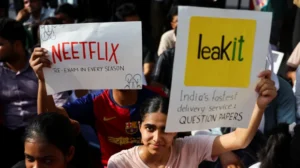
Protesters marched towards Parliament calling for the resignation of Education Minister Dharmendra Pradhan over allegations of examination paper leaks and recruitment irregularities. The minister has rejected the calls, accusing opposition groups of exploiting students for political purposes.
Police responded by deploying tear gas and batons to disperse demonstrators, while authorities temporarily suspended mobile internet services around the protest area. Officials said several police officers were injured during the unrest, while protesters claimed many demonstrators were beaten during the operation.
Advertisiment 
Despite the restrictions, participants resumed sharing videos and photographs once internet services were restored, with social media platforms quickly filling with personal accounts of the protests.
Many of the videos combined footage of the demonstrations with humour, including light-hearted commentary and satirical clips recorded before and after clashes with police. Protesters said the content was not intended to trivialise the violence but rather to help them cope with fear and preserve memories of the day’s events.
Digital media experts say the trend reflects changing forms of civic participation among younger generations, who increasingly integrate political engagement with their everyday use of social media.
Professor Joyojeet Pal of the University of Michigan said many young people no longer separate political activity from their daily online lives, making smartphones a natural part of demonstrations.
Payal Arora, a digital anthropologist at Utrecht University, said recording protests has become an important way for participants to document events and create a public record.
“The act of capturing a protest is often an end in itself,” she observed, noting that many participants use digital platforms to ensure their experiences are remembered.
Researchers also argue that humour has historically played an important role in protest movements by strengthening solidarity, easing tension and helping participants cope with stressful situations.
The demonstrations are the latest in a series of youth-led protests in India highlighting concerns over governance, employment opportunities and education reforms.
As investigations into the protests continue, the events have also reignited debate over the role of social media in modern political activism, with digital platforms increasingly serving as tools for mobilisation, documentation and public engagement.