






















By Cybernewsug | News Desk
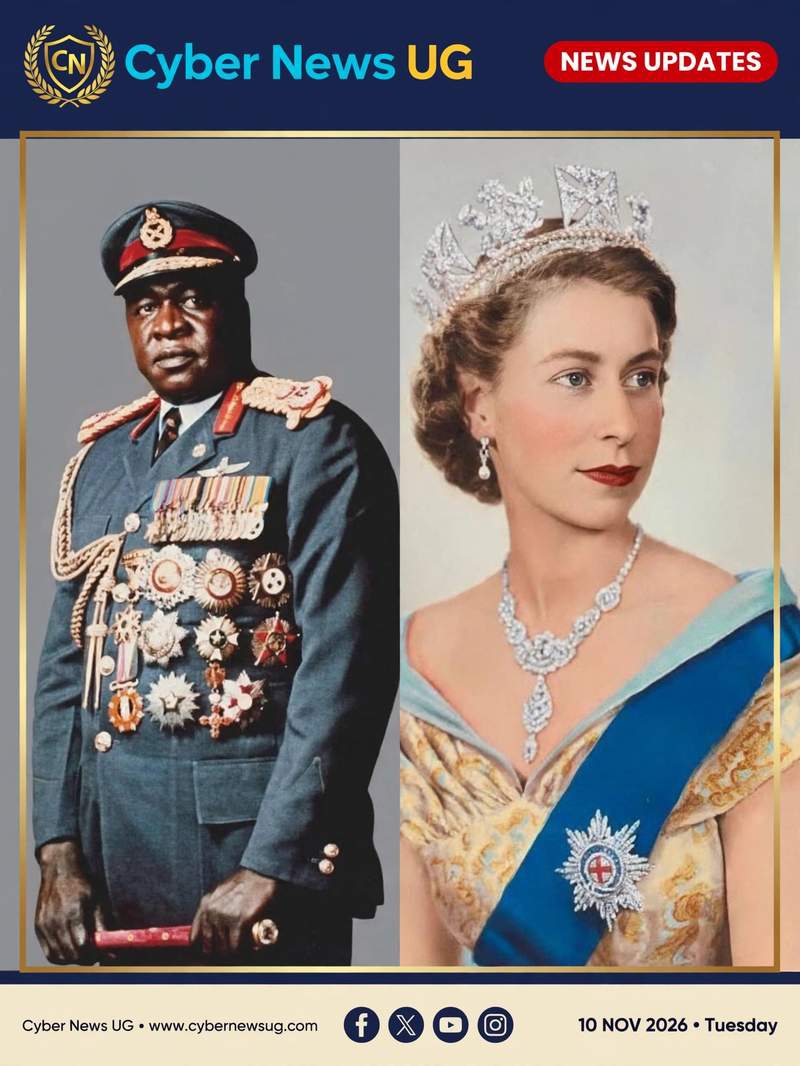
The former Ugandan president was known for his extraordinary communications with British royalty, but historical records tell a more complicated story than the viral claim about romantic letters to the late Queen.**

A story claiming that former Ugandan president Idi Amin once wrote love letters to Queen Elizabeth II, asking her to become his second wife, has resurfaced as a humorous reminder of the former leader’s unconventional personality and bold approach to international relations.
The anecdote contrasts Amin’s reported confidence in approaching one of the world’s most powerful monarchs with the hesitation some ordinary men experience when trying to approach women they admire.
However, while historical records confirm that Amin communicated with Queen Elizabeth II on several occasions, there is no independently verified evidence in the available archival material establishing that he proposed marriage to her or asked her to become his second wife.
Documents preserved by Britain’s National Archives show that Amin sent formal correspondence to the Queen, including a January 10, 1972 letter in which he wished her a happy New Year and invited her to Uganda’s tenth independence anniversary celebrations.
The correspondence provides a documented historical connection between the former Ugandan president and the British monarch, although it does not support the romantic interpretation circulating in the anecdote.
## Amin’s documented correspondence with Queen Elizabeth II
Amin seized power in Uganda in January 1971 after overthrowing President Milton Obote in a military coup.
His government initially maintained relations with Britain, Uganda’s former colonial power, despite growing political tensions and international criticism of his administration.
One of the documented communications between Amin and Queen Elizabeth II is a letter dated January 10, 1972, written from State House in Entebbe.
In the letter, Amin wished the Queen a happy New Year and expressed hope that relations between Uganda and Britain would continue to improve.
He also invited her to attend Uganda’s tenth independence anniversary celebrations scheduled for October 9, 1972, accompanied by her husband, Prince Philip, and other members of the royal family.
The letter was formally addressed to Her Majesty at Buckingham Palace and concluded with Amin expressing his highest consideration and esteem.
The document is preserved by Britain’s National Archives and provides direct evidence of official correspondence between the two figures.
It does not, however, contain a marriage proposal or a request for the Queen to become Amin’s wife.
#Amin’s unusual relationship with the British monarchy
Amin’s fascination with Britain was not entirely surprising.
Before becoming president, he had served in the King’s African Rifles, a British colonial military regiment, and developed connections with the British military establishment.
His military career exposed him to British traditions, ceremonial practices and institutions, elements that continued to feature prominently in his public image after taking power.
He frequently invoked his military background and British decorations, sometimes using them in communications with foreign leaders.
However, his relationship with Britain became increasingly complicated as his government adopted confrontational positions towards London.
In 1972, Amin ordered the expulsion of Uganda’s Asian population, including thousands of people with British citizenship or connections to Britain.
The decision created a major diplomatic and humanitarian crisis and placed considerable pressure on relations between Kampala and London.
Despite the deteriorating relationship, Amin continued making unusual diplomatic gestures and statements directed at British institutions.
#The 1975 message that attracted international attention
In January 1975, French newspaper *Le Monde* reported that Amin had sent Queen Elizabeth II a message announcing his intention to visit Britain.
The report said Amin informed the Queen that he planned to travel to Britain from August 4 and expected arrangements to be made for his stay.
He reportedly requested visits to Scotland, Wales and Northern Ireland, expressing interest in meeting people campaigning for independence from the British political and economic system.
The report also described Amin’s intention to meet British Asians who had been expelled from Uganda in 1972.
His message attracted considerable attention because he appeared to be announcing a visit without first securing an official invitation.
The British authorities were reportedly cautious about the proposed visit, particularly given the strained diplomatic relationship between the two countries.
The episode illustrated Amin’s willingness to communicate directly with the British monarchy and make demands that other heads of state might have handled through conventional diplomatic channels.
It is important to distinguish this documented episode from the claim that he was romantically pursuing the Queen. The reported 1975 communication concerned a proposed visit and political matters, not marriage.
#Amin and the Queen’s Silver Jubilee
Amin’s communications with British institutions continued to attract attention in the years that followed.
In February 1977, he sent a message to Commonwealth Secretary-General Sir Shridath Ramphal indicating that he intended to attend the Commonwealth meeting and celebrations marking Queen Elizabeth II’s Silver Jubilee.
According to a report published by Uganda’s *New Vision*, Amin said he would personally attend the celebrations and arrive with a delegation of approximately 250 people.
He also expressed expectations of receiving a high level of recognition during the proposed visit.
The message was unusual, particularly because it suggested that Amin intended to attend major British celebrations despite the strained relations between his government and the United Kingdom.
The episode further demonstrates that his interest in the British monarchy and international recognition was not limited to one formal letter.
However, these communications should be understood within the context of diplomacy and Amin’s political personality rather than treated as proof of a romantic relationship.
#What is known about the love-letter claim?
The claim that Amin wrote love letters asking Queen Elizabeth II to become his second wife remains unverified.
The National Archives’ published correspondence confirms that he addressed the Queen formally and communicated his admiration and respect through official language.
Historical reporting also documents his attempts to engage the British monarch and secure opportunities to visit Britain.
But the available documents do not establish that these communications were romantic in nature.
Amin’s colourful public statements and unconventional diplomatic conduct have contributed to numerous stories about his personality. Some accounts may contain elements of truth, while others become exaggerated as they circulate across generations and social media platforms.
For a claim involving a historical figure and a member of the British royal family, the distinction between documented correspondence and popular anecdote is particularly important.
Without an authenticated letter, archival reference or reliable historical account confirming the alleged marriage proposal, the story should not be presented as established fact.
#Amin’s complicated legacy
Idi Amin remains one of the most controversial figures in Uganda’s modern history.
His eight-year rule, from 1971 to 1979, was marked by authoritarianism, political repression, economic upheaval and widespread human rights abuses.
His government was responsible for the persecution and killing of large numbers of Ugandans, while the expulsion of the Asian community in 1972 had far-reaching economic and social consequences.
His administration also became internationally known for its unpredictable public statements and confrontational diplomatic conduct.
Amin was eventually overthrown in April 1979 following the Uganda-Tanzania War and spent the remainder of his life in exile in Saudi Arabia, where he died in August 2003.
His legacy therefore extends far beyond the unusual stories associated with his personality.
For historians, the surviving correspondence provides an opportunity to examine how he presented himself internationally and how Uganda’s relationship with Britain evolved during his presidency.
#Beyond the humour: Confidence and approaching relationships
The viral anecdote also carries a social message, using Amin’s reported boldness to challenge men who struggle to express romantic interest in women.
Its underlying joke is straightforward: if a former Ugandan president could communicate with the British monarch, why should an ordinary man be afraid of approaching a woman in his own community?
Although the historical premise about a marriage proposal remains unverified, the message about confidence is understandable.
Approaching someone respectfully, expressing genuine interest and accepting their response are ordinary parts of social interaction.
Confidence, however, should not be confused with entitlement. Respecting another person’s boundaries and accepting rejection are just as important as having the courage to initiate a conversation.
Ultimately, Amin’s documented correspondence with Queen Elizabeth II is an interesting chapter in Uganda’s diplomatic history. The alleged love letters may make for an entertaining anecdote, but the historical record currently supports a story of unusual political correspondence rather than a confirmed royal marriage proposal.
Source: