
























By Karim Were
The SC880 combines 5G connectivity, 4K recording, image stabilisation, infrared imaging and push-to-talk communication to strengthen real-time field evidence capture.
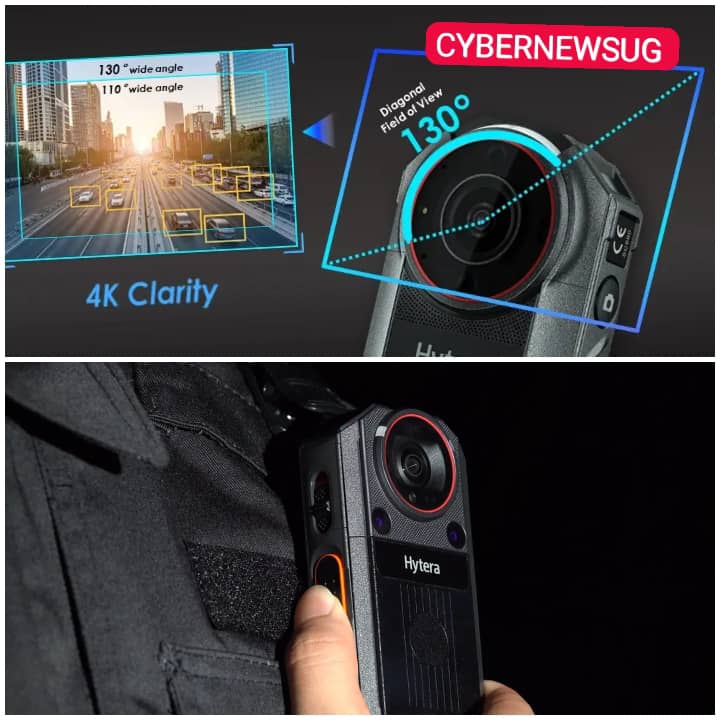
The Hytera SC880 Smart 5G Body Camera is designed to give frontline personnel a more advanced way to capture, transmit and manage video evidence by combining 5G connectivity with 4K ultra-high-definition recording and integrated communications.
According to product information provided by Hytera, the SC880 is built for situations where officers or field personnel need to record events while remaining connected to a command centre. Its combination of high-resolution video, image stabilisation, infrared capability and Push-to-Talk over Cellular (PoC) communications is intended to provide commanders with access to field information in real time.
The device is positioned as part of a broader move toward connected body-worn technology, where cameras are no longer used only to record incidents for later review but can also form part of a live communications and evidence-management system.
5G connectivity at the centre of the system
One of the defining features of the SC880 is its use of 5G connectivity.
Traditional body cameras can record footage locally, with video later transferred to a computer or evidence-management system. A connected 5G body camera can potentially shorten that process by allowing authorised users to transmit information from the field to command infrastructure much more quickly.
The SC880 is designed around this concept, using 5G to support real-time video dispatching between personnel in the field and command operations.
For organisations managing large numbers of personnel across different locations, the ability to receive information while an incident is unfolding can be particularly valuable.
Commanders may be able to assess visual information from the field and make decisions based on a broader understanding of an unfolding situation rather than relying solely on radio communications or verbal descriptions.
However, the actual performance of any 5G-enabled body camera will depend on network availability, coverage, bandwidth, configuration and the organisation’s communications infrastructure.
4K recording for evidence capture
The SC880 also features 4K ultra-high-definition recording.
Higher-resolution recording can provide greater visual detail than lower-resolution footage, potentially making it easier to review incidents, identify objects and preserve important visual information.
For body-worn cameras, image quality is particularly relevant because users may operate in rapidly changing environments. A camera mounted on a moving person can experience vibration, rapid movement and changes in lighting.
The SC880 addresses this challenge with image-stabilisation technology designed to reduce the effects of movement during recording.
The combination of 4K recording and stabilisation is intended to produce clearer footage that can subsequently be reviewed by investigators, supervisors or other authorised personnel.
The technology, however, should not be interpreted as a guarantee that every recording will be clear. Environmental conditions, movement, distance from the subject and available lighting can all influence the quality of recorded footage.
Designed for movement
Body-worn cameras operate under different conditions from conventional surveillance cameras.
A fixed security camera may remain in one position for hours, while a body camera moves with the person wearing it. Officers and other field workers can walk, run, enter buildings, respond to incidents or work in crowded environments.
This makes stabilisation an important component of body-worn camera design.
Hytera says the SC880 incorporates advanced image stabilisation to help maintain footage quality when the device is being used while the wearer is moving.
The feature is intended to make recordings easier to watch and analyse, particularly when events are developing quickly.
Infrared capability for low-light conditions
Another feature highlighted by the manufacturer is high-power infrared capability.
Low-light environments can present significant challenges for body-worn cameras. Incidents may occur at night, inside poorly illuminated buildings or in areas where artificial lighting is limited.
Infrared technology can assist cameras in capturing usable images in such conditions.
The SC880 is designed to use high-power infrared illumination to support recording when ambient light is insufficient.
This capability could be relevant to security, law enforcement, emergency response and other organisations whose personnel operate outside normal daylight hours.
As with any imaging technology, however, infrared recording has limitations. The usefulness of footage will depend on factors such as distance, environmental conditions and the characteristics of the scene being recorded.
Built-in Push-to-Talk communications
Beyond video recording, the SC880 incorporates Push-to-Talk over Cellular (PoC) communications.
PoC technology allows users to communicate over cellular networks using a push-to-talk model similar to the operational experience of a two-way radio.
The integration of communications into the same device can reduce the need for field personnel to carry separate equipment for video recording and voice communication.
For command teams, this can create a more integrated communications environment in which voice, video and other information can potentially be managed through a common platform.
This is particularly relevant to organisations that coordinate teams across large geographical areas.
Connecting the field to command
The SC880 is also designed to work with Hytera’s convergence platform.
The concept behind a convergence platform is to bring different forms of operational communication and information together rather than treating each channel as an isolated system.
In the case of a connected body camera, this can mean linking video captured by a field worker with communications and command functions.
The manufacturer describes the SC880 as providing commanders with a broader operational picture when real-time information is required.
Such systems can potentially help command personnel understand what is happening at multiple locations and respond more effectively to emerging situations.
However, the benefits depend on how an organisation deploys the technology, including its network infrastructure, command software, evidence-management procedures and data-security policies.
Evidence management and accountability
Body-worn cameras have increasingly become part of discussions about accountability and evidence management.
When properly implemented, body-worn cameras can provide an independent visual record of interactions and incidents. Recordings can assist investigations, internal reviews and legal proceedings where the footage is relevant and lawfully obtained.
At the same time, the use of body cameras creates responsibilities around privacy, data protection and access to recordings.
Organisations deploying such systems need clear policies covering when cameras should be activated, who can access recordings, how long footage should be retained and when information can be shared.
These considerations become even more important when cameras can transmit live video over mobile networks.
Real-time transmission can provide operational advantages, but it also means organisations must maintain appropriate cybersecurity and access controls to protect sensitive footage.
Implications for emergency and security operations
The SC880’s combination of recording and communications capabilities could have applications across several sectors.
Law-enforcement agencies could use body-worn cameras to document field interactions and transmit selected video to command centres.
Emergency-response organisations could potentially use the technology to give command teams visual information from difficult or rapidly changing environments.
Private security companies could use connected body cameras to improve communication between security personnel and control rooms.
Other field-based organisations may also find value in combining video documentation with real-time communication.
The suitability of the technology would ultimately depend on the operational requirements, legal environment and infrastructure of each organisation.
The changing role of body cameras
The development of products such as the SC880 reflects a broader transformation in the body-camera market.
Earlier generations of body-worn cameras were primarily focused on recording and storing video.
Modern systems increasingly combine cameras with cellular connectivity, location services, communications, remote management and cloud or centralised evidence systems.
This evolution mirrors a wider trend in public safety technology: moving from isolated devices toward connected systems capable of sharing information across an organisation.
The result is that a body camera can potentially become more than a recording device. It can serve as one component of a wider digital command-and-control environment.
Benefits and challenges
The potential benefits of the SC880 include higher-resolution video, improved recording during movement, low-light imaging, integrated voice communications and faster transmission of information.
For commanders, access to live information can potentially improve situational awareness.
For field personnel, combining multiple functions into one device could simplify equipment requirements.
But technology alone cannot guarantee better operational outcomes.
Successful deployment requires reliable connectivity, appropriate training, clear operating procedures and responsible evidence management.
Organisations must also consider data protection, privacy and cybersecurity risks associated with transmitting and storing video captured in public or sensitive environments.
Why real-time video matters
One of the most important differences between conventional recording and connected video is timing.
A recording that becomes available hours or days after an incident can be useful for investigation. Live or near-real-time video can potentially support decisions while an incident is still unfolding.
That distinction is particularly important for command teams managing emergencies.
A commander who can see what a field worker is seeing may be able to make more informed decisions than one relying entirely on verbal reports.
Nevertheless, real-time video should complement rather than automatically replace established command procedures. Network interruptions, equipment limitations or incomplete visual information can affect the usefulness of any live feed.
Data protection remains critical
The increased capabilities of connected body cameras also highlight the importance of responsible data governance.
Body-worn cameras can capture members of the public, private conversations, sensitive locations and other information unrelated to a specific incident.
Organisations therefore need safeguards to ensure that footage is collected and handled lawfully.
Access controls, encryption, retention policies and audit mechanisms can help reduce the risk of unauthorised disclosure or misuse.
The introduction of 5G connectivity makes these considerations particularly relevant because video can move rapidly between field devices and command infrastructure.
Conclusion
The Hytera SC880 Smart 5G Body Camera represents the continuing evolution of body-worn technology from a basic recording tool into a connected field communications device.
Its combination of 5G connectivity, 4K ultra-high-definition recording, image stabilisation, infrared capability and integrated PoC communications is designed to provide field personnel with a multifunctional device while giving command teams access to more timely visual information.
The technology could offer practical benefits for law enforcement, emergency response, security and other field-based operations. However, its effectiveness will depend not only on hardware capabilities but also on network infrastructure, training, operational procedures, cybersecurity and responsible management of recorded information.
As organisations increasingly seek faster access to information from the field, connected body cameras are likely to remain an important part of the wider public-safety technology landscape.
For the SC880, the central proposition is straightforward: bringing high-quality video and real-time communications closer together so that information captured in the field can reach authorised command personnel when it is needed most.
Source: