

























By Karim Were
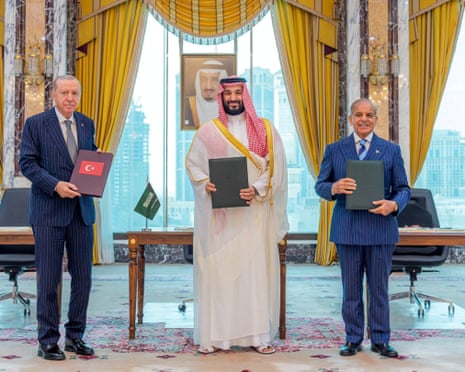
MECCA, Saudi Arabia — Saudi Arabia, Turkey and Pakistan have signed a joint defence agreement as tensions continue to escalate across the Middle East, creating a new security partnership among three influential Muslim-majority countries.
The agreement, signed in Mecca on Friday, provides that an armed attack against any one of the three countries will be regarded as an attack against all, according to a joint statement cited by Reuters.
The pact comes amid heightened regional tensions involving Iran, Israel and Gulf states, with missile attacks and disruptions to energy shipments contributing to a broader security and economic crisis.
The agreement was signed by Saudi Crown Prince Mohammed bin Salman, Turkish President Recep Tayyip Erdogan and Pakistani Prime Minister Shehbaz Sharif after nearly a year of negotiations, according to Reuters.
Although the three governments described the arrangement as defensive, the agreement represents a significant development in regional security cooperation.
# Three major powers join forces
The agreement brings together countries with considerable military, economic and diplomatic influence.
Turkey has one of the largest armed forces in the North Atlantic Treaty Organisation (NATO), while Saudi Arabia is one of the world’s leading oil exporters and home to Islam’s two holiest cities.
Pakistan, meanwhile, is the only nuclear-armed country among the three and has maintained longstanding military cooperation with Saudi Arabia.
The combination gives the new partnership considerable strategic weight, although the agreement does not yet provide detailed information on the exact military obligations that would arise if one of the countries came under attack.
Reuters reported that the joint statement did not specify the precise commitments each country had accepted or explain how far the agreement would bind them to particular military action.
That ambiguity could become important if the pact is tested by an actual military crisis.
# Regional tensions drive agreement
The agreement comes as the Middle East faces one of its most complicated security environments in years.
Iran and its allies have launched attacks against several Gulf states amid the wider conflict, while energy shipments have been disrupted and international concern has grown over the security of major maritime routes.
The situation has placed particular pressure on Saudi Arabia, whose economy depends heavily on oil exports and which is pursuing an ambitious programme of economic diversification.
Turkey and Pakistan have also expressed concerns about the wider regional instability and its potential consequences for their own security and economies.
Turkish officials stressed that the agreement was not directed against a particular country.
Turkish Vice President Cevdet Yilmaz said the pact was defensive, while a Turkish official said it did not cancel Ankara’s existing security agreements with other countries.
#What the agreement could mean
The pact could strengthen the ability of the three countries to coordinate their responses to regional security threats.
It could also increase diplomatic cooperation as they attempt to influence efforts to end conflicts affecting the Middle East.
Abdulaziz Sager, chairman of the Gulf Research Center, described the agreement as evidence of a growing willingness among regional powers to coordinate more closely on security matters.
However, the agreement does not automatically mean that the three countries will enter every future conflict together.
Its practical significance will depend on how the governments interpret their commitments and whether they develop mechanisms for joint military planning, intelligence sharing and crisis response.
# Saudi Arabia’s security concerns
For Saudi Arabia, the pact comes at a particularly sensitive moment.
Years of conflict in the region have threatened energy infrastructure and shipping routes while raising questions about the reliability of traditional security arrangements.
The kingdom has sought to strengthen its own defence capabilities while simultaneously pursuing diplomacy aimed at reducing regional tensions.
A broader security partnership could provide Riyadh with additional diplomatic and military options.
The country is also working to protect its economic transformation programme, which depends on stability, investment and reliable access to international markets.
#Turkey’s growing regional role
Turkey has increasingly sought to play an influential role in Middle Eastern diplomacy while maintaining its position as a major NATO member.
Ankara has maintained relationships with different regional actors and has frequently positioned itself as an independent diplomatic player.
The new agreement could therefore enhance Turkey’s role in discussions over regional security while allowing it to deepen defence ties with Saudi Arabia and Pakistan.
Turkey has already developed military and defence-industrial relationships with both countries, including cooperation involving naval equipment, aircraft and drones.
#Pakistan’s longstanding Saudi relationship
Pakistan has maintained close military ties with Saudi Arabia for decades.
Pakistani personnel have provided training and other forms of military assistance to Saudi forces, while the two countries have continued to cooperate on defence matters.
The new agreement formalises part of that broader relationship in a new regional context.
Pakistan has previously avoided suggestions that its nuclear weapons could automatically be extended to protect allies.
Officials have also rejected interpretations that the new arrangement is intended to create a nuclear or sectarian military bloc.
#Wider implications
The agreement could contribute to the emergence of a more regionally driven security system at a time when traditional alliances are being tested by multiple conflicts.
It also illustrates how countries in the region are increasingly seeking to build their own security partnerships rather than depending entirely on outside powers.
The pact could influence calculations in Tehran, Jerusalem and Washington, although Iran and Israel had not immediately issued public responses according to the Reuters report.
India has also said it is closely monitoring the development.
For now, the agreement remains largely a political and strategic commitment. Its long-term importance will depend on whether the three countries translate the agreement into concrete military cooperation and whether it contributes to deterrence or creates new tensions.
The pact nevertheless marks a notable shift in regional diplomacy, bringing together three powerful states at a moment when the Middle East is facing deep uncertainty.