
















By Karim Were
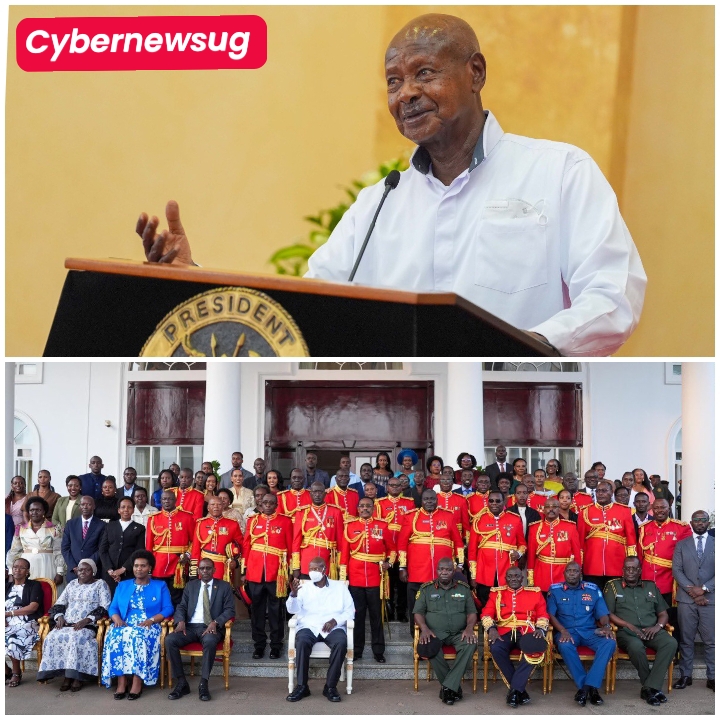
KAMPALA —President Yoweri Museveni has commended Uganda’s retiring military generals for their contribution to the Uganda People’s Defence Forces (UPDF) and the country’s peace and security.
Museveni said the army and the National Resistance Movement (NRM) had contributed to maintaining peace and security in Uganda, while identifying patriotism, modern military technology and the strength of the national economy among the factors supporting the country’s security.
“I congratulate the retiring Generals for the great contribution they have made to the UPDF,” Museveni said.
He said Uganda’s security achievements should be understood as the result of several factors rather than the work of individual officers alone.
According to the President, ideological commitment to patriotism has been an important element in building the country’s security institutions.
#Museveni praises retiring officers
The President’s remarks come as a number of senior military officers reach retirement after years of service in the UPDF.
Retirement marks the end of active military careers but also provides an opportunity for the country to recognise the contribution of senior officers who have served in different capacities.
Museveni thanked the retiring generals for what he described as their “great contribution” to the UPDF.
The President did not, in the statement provided, list the individual officers being honoured or detail their respective years of service.
He nevertheless placed their contribution within the wider history of Uganda’s military and security development.
#Patriotism and military service
Museveni identified patriotism as one of the factors he believes has contributed to Uganda’s peace and security.
He linked the role of ideology to the ability of the army and the NRM to pursue national objectives.
For the UPDF, patriotism has been presented as part of the values expected of members of the armed forces, alongside discipline, professionalism and commitment to national service.
The President’s remarks therefore framed military service not only as a professional responsibility but also as part of a broader national project.
#Role of modern military technology
Museveni also pointed to modern military technology as another factor supporting Uganda’s security.
Military technology has become increasingly important to defence forces around the world, influencing areas such as communication, intelligence, surveillance, mobility and battlefield operations.
Modernisation can help armed forces respond to changing security threats and improve their operational capabilities.
For Uganda, investment in military technology has formed part of broader efforts to strengthen the UPDF’s capabilities.
The President’s comments placed such technological development alongside patriotism and economic capacity as elements contributing to national security.
#Economy and national security
Museveni also linked the country’s security capabilities to the strength of the national economy.
Maintaining a professional and technologically capable military requires resources for training, equipment, personnel and infrastructure.
A functioning economy provides governments with the fiscal capacity to finance national security institutions and other public services.
The President therefore argued that Uganda’s security achievements cannot be separated from the country’s economic foundation.
His remarks presented economic development and national security as interconnected areas of national policy.
#The UPDF’s role
The UPDF is Uganda’s national armed force and has responsibilities relating to the country’s defence and security.
Over the years, the force has undergone changes in structure, leadership, training and equipment.
Senior officers have played different roles in these processes, including command, training, administration and operational responsibilities.
The retirement of senior generals consequently represents both an end to individual military careers and part of the normal process of leadership transition within a professional armed force.
#Leadership transition
The departure of senior officers through retirement creates opportunities for younger commanders to assume greater responsibilities.
Military institutions rely on succession planning to ensure continuity when senior officers leave active service.
Such transitions can also bring new approaches to command and administration while preserving institutional experience.
The recognition of retiring generals by the President therefore carries significance for both the officers being honoured and the wider military institution.
#Uganda’s security history
Museveni’s comments also reflect his broader account of Uganda’s political and security history.
The NRM came to power in 1986 following the National Resistance Army’s armed struggle.
Since then, the government has placed considerable emphasis on security and the development of the UPDF.
The army has participated in domestic and regional security operations over the years, including missions beyond Uganda’s borders.
The President’s latest remarks link the country’s current security environment to the evolution of its military institutions and the factors he believes have supported their development.
#Balancing military and economic priorities
The connection between the economy and national defence is significant because governments must balance security expenditure with other national priorities.
Investment in defence competes for public resources alongside spending on health, education, infrastructure and social services.
A growing economy can provide greater fiscal space for these competing priorities.
At the same time, national security is often viewed as a prerequisite for stable economic activity because businesses and communities require a secure environment in which to operate.
Museveni’s remarks therefore highlight the relationship between security and economic stability.
#The importance of institutional experience
Retiring senior officers also leave behind institutional experience accumulated over decades of service.
Military leadership involves knowledge of command structures, operations, training and strategic planning.
Preserving institutional knowledge during leadership transitions can help ensure continuity.
The contribution of retiring generals can therefore extend beyond their specific appointments to the broader development of the armed forces.
#Recognition of service
Public recognition of military service can also reinforce the importance of professionalism and dedication within the armed forces.
For serving officers, seeing senior commanders recognised for their contribution can serve as an acknowledgement of the responsibilities associated with military service.
At the same time, retirement provides an opportunity for the institution to bring forward a new generation of leadership.
Museveni’s message combined appreciation for the retiring generals with an explanation of the broader factors he believes have enabled Uganda to maintain peace and security.
#Looking ahead
The retirement of senior officers is unlikely to end their contribution to public life.
Former military officers can continue to contribute to national development through advisory roles, public service and other areas of expertise, depending on their future assignments.
For the UPDF, the focus will remain on maintaining continuity while transferring responsibilities to new commanders.
The broader challenge for Uganda will be to sustain the institutions and policies that support peace and security while addressing emerging regional and national challenges.
#Conclusion
President Yoweri Museveni has praised retiring UPDF generals for their contribution to Uganda’s security and commended them for their years of military service.
He attributed the country’s security achievements to several factors, including what he described as an ideology of patriotism, modern military technology and the strength of the national economy.
The recognition comes as the UPDF undergoes a generational transition in its senior leadership.
While individual commanders have played important roles, the President’s remarks emphasise that national security depends on a combination of military professionalism, institutional capacity, technological development and economic strength.
The retirement of the generals therefore marks not only the conclusion of distinguished military careers but also another stage in the continuing evolution of Uganda’s defence forces.
**Source:🇺🇬Be Blessed