
















By Karim Were | Cybernewsug
The UPDF chief and Patriotic League of Uganda leader has called for respect for Christians and religious leaders as a dispute over alleged fake miracles, church accountability and public criticism intensifies online.
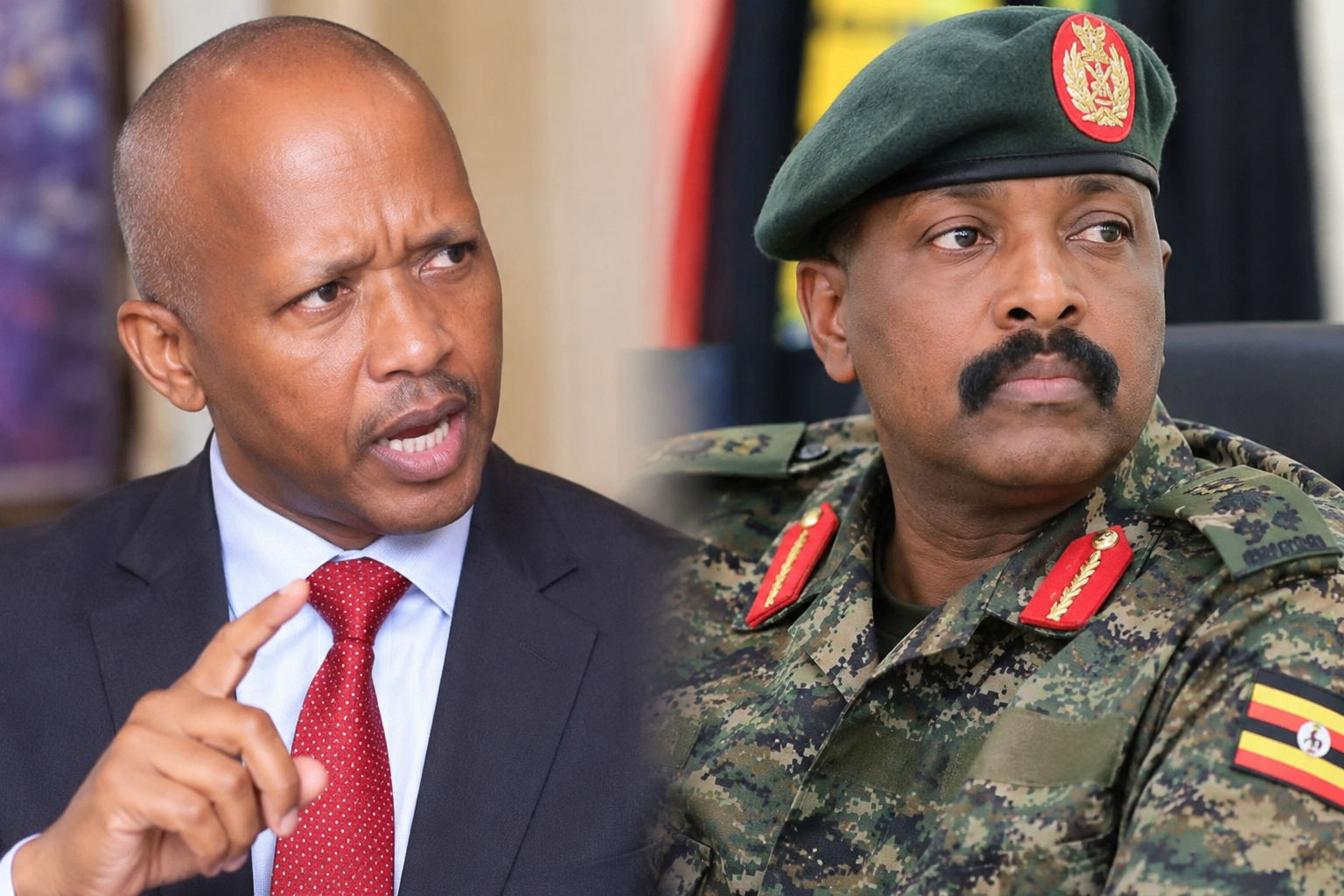
KAMPALA, October 17, 2026 — Gen Muhoozi Kainerugaba has entered the escalating public dispute between social commentator Frank Gashumba and Uganda’s evangelical pastors, calling for respect for Christians and religious leaders as debate over claims of miraculous healing and accountability within churches continues to attract attention on social media.
Muhoozi’s intervention, reported on Saturday, October 17, comes after days of exchanges involving Gashumba, prominent Pentecostal pastors and members of their families over allegations that some religious leaders make unsubstantiated miracle claims and exploit vulnerable believers.
The controversy has raised broader questions about religious freedom, freedom of expression, the responsibilities of religious leaders and the extent to which people who publicly claim extraordinary healing powers should be open to scrutiny.
According to a report by Pulse Uganda, Muhoozi called on Gashumba to apologise to Christians and distanced the Patriotic League of Uganda (PLU), which he leads, from the commentator’s criticism of pastors.
“Gashumba will apologize to Christians in the country. PLU has no problem with pastors in Uganda,” Muhoozi reportedly wrote in a social media post.
He also stressed the importance of discipline within the organisation, writing: “In PLU there is order. We do not tolerate chaos and disorder.”
Muhoozi further expressed personal support for Pastor Robert Kayanja of Miracle Centre Cathedral, who has been among the prominent religious figures responding to Gashumba’s criticism.
“Personally, I like Pastor Kayanja. I will attend one of his services one day,” Muhoozi reportedly stated.
The comments add a political dimension to a dispute that initially centred on the credibility of miracle claims and the conduct of some evangelical preachers.
How the dispute began
The controversy gained momentum after Gashumba publicly challenged pastors, prophets and other religious leaders who claim supernatural healing powers to demonstrate those abilities under conditions that could be independently assessed.
Gashumba has questioned claims that religious leaders can heal serious illnesses, arguing that anyone making such assertions should be prepared to demonstrate them in a hospital setting rather than rely solely on testimonies delivered during church services.
He initially offered Shs200 million before reportedly increasing the proposed reward to Shs500 million for a religious leader who could demonstrate the claimed healing of a critically ill patient under the conditions he proposed.
The challenge has become a central point of disagreement between Gashumba and sections of Uganda’s evangelical community.
Gashumba has maintained that his criticism targets religious leaders he believes misuse Christianity, rather than Christianity itself or the existence of God.
In earlier public remarks reported by Pulse Uganda, he said he had not denied the possibility of miracles but was concerned about people allegedly using religious authority to exploit poor believers.
His position has attracted support from some social media users who argue that religious leaders should be accountable for claims made to their congregations.
Others, however, have criticised his approach, arguing that faith and divine intervention should not be reduced to public wagers or contests designed to prove supernatural claims.
The dispute has consequently moved beyond the original challenge, becoming a wider argument about the relationship between religious belief, public accountability and the limits of criticism.
Muhoozi backs respect for religious leaders
Muhoozi’s reported comments have placed emphasis on respecting Christians and religious leaders amid the growing exchanges.
His intervention comes at a time when disagreements over Gashumba’s remarks have involved prominent personalities and their relatives, with some exchanges becoming increasingly personal.
By publicly expressing support for Kayanja and calling for an apology, Muhoozi has signalled that he considers the controversy to have implications beyond a disagreement between an individual commentator and particular pastors.
His remarks also bring the PLU into a debate that has largely unfolded through interviews, church sermons and social media posts.
However, the available reporting does not establish that Muhoozi has offered an independent assessment of the specific allegations concerning miracle claims or church finances. His reported statements primarily concern respect for Christians, his position on pastors and the conduct expected within the PLU.
The distinction is important because defending religious leaders against what they regard as unfair attacks does not, by itself, resolve questions about the evidence supporting particular claims of healing or the financial practices of individual churches.
Likewise, criticism of particular preachers should not automatically be interpreted as an attack on every evangelical church or its followers.
Kayanja rejects criticism of miracles
Pastor Kayanja has been among the religious leaders who have publicly challenged Gashumba’s position.
In remarks reported by Pulse Uganda earlier in the dispute, Kayanja rejected suggestions that the miracles associated with his ministry were fake.
“Our miracles aren’t fake. They are God-made,” he said, according to the publication.
Kayanja has argued that miracles are part of Christian faith and has criticised the suggestion that religious leaders should have their ministries judged through Gashumba’s proposed challenge.
The disagreement illustrates a fundamental difference in how the two sides approach the subject.
For believers, accounts of miraculous healing may be understood through faith, personal testimony and religious experience. For critics, particularly where claims involve serious illnesses or requests for money, questions of evidence and independent verification become central.
Neither public criticism nor a religious leader’s denial alone establishes whether a particular healing claim is genuine or false. Assessing individual cases requires reliable information about the circumstances, the medical condition involved and any available independent evidence.
The controversy therefore highlights the importance of separating personal religious convictions from claims that can be tested through medical records or other verifiable information.
Debate extends to church finances and accountability
Beyond miracle claims, Gashumba has questioned the financial relationship between some religious leaders and their followers.
He has accused certain preachers of taking advantage of people experiencing poverty, illness and other personal difficulties by offering promises of supernatural intervention.
These remain allegations directed at particular religious leaders and should not be treated as proven misconduct by the evangelical community as a whole.
The debate has nevertheless resonated with sections of the public concerned about the use of religious influence, especially when vulnerable people are encouraged to contribute money in the expectation of receiving blessings, healing or other benefits.
Religious institutions play significant roles in many Ugandan communities, providing spiritual guidance and, in some cases, education, charitable assistance and other forms of social support.
For that reason, allegations of exploitation can have consequences beyond individual churches. They may affect public confidence in religious institutions and raise questions about how congregations can distinguish responsible spiritual leadership from potentially misleading practices.
At the same time, churches rely on donations and other voluntary contributions to support their activities. Financial contributions alone do not establish wrongdoing, just as a religious leader’s popularity does not independently prove the validity of claims made in a ministry.
The relevant questions concern transparency, informed consent, the treatment of followers and whether specific representations made to the public can be substantiated.
A balanced discussion must therefore allow legitimate scrutiny of individual conduct without treating all religious fundraising or claims of spiritual experience as evidence of fraud.
Social media turns disagreement into a national debate
Social media has been central to the escalation of the dispute, enabling the participants and their supporters to respond directly to one another before large audiences.
The involvement of Gashumba’s daughter, media personality Sheilah Gashumba, and Pastor Kayanja’s son, Robert Kayanja Jr, has added a personal dimension to the controversy.
Nilepost reported on October 16 that Sheilah and Kayanja Jr had exchanged criticism online, widening the dispute beyond the original disagreement between their fathers.
The exchanges demonstrate how disputes involving public personalities can quickly spread across family networks, political affiliations and religious communities.
Social media offers an accessible platform for challenging powerful figures, questioning public claims and expressing religious convictions. However, it can also encourage confrontational language, the circulation of unverified allegations and the loss of important distinctions between criticism of an individual and criticism of an entire community.
In this case, the central issues include whether religious leaders should be accountable for claims they make, how those claims should be evaluated and whether public criticism can be conducted without insulting believers.
The debate also illustrates the influence of prominent political and social figures in shaping conversations that begin outside formal political institutions.
Religious freedom and freedom of expression
Uganda’s Constitution protects freedom of thought, conscience and belief, including religious belief, as well as freedom of expression, subject to applicable legal limitations.
These protections are relevant to both sides of the dispute.
Religious leaders and their followers are entitled to practise their faith and express their beliefs. Critics, meanwhile, have a legitimate interest in questioning public claims, including claims concerning health, financial contributions and the conduct of people who exercise influence over vulnerable communities.
Neither freedom should be treated as an automatic justification for harassment, threats or the deliberate spread of false information.
A responsible public debate requires participants to distinguish verifiable facts from allegations, avoid generalisations about entire religious communities and refrain from presenting disputed claims as established truth.
Where a preacher claims to have cured a serious medical condition, independent medical evidence may help establish what happened in that particular case. Such evidence would not, on its own, settle every theological question about faith or divine intervention, but it could help clarify the medical facts.
Similarly, allegations that a religious leader has misused donations or deceived followers require specific evidence rather than assumptions based on the person’s religious denomination or public profile.
What happens next?
Muhoozi’s reported call for Gashumba to apologise may increase pressure on the commentator to clarify his language and intentions. However, it remains unclear from the available reporting whether Gashumba will comply with the demand or whether the parties will seek a more direct resolution.
The broader disagreement is also unlikely to be settled simply by one side calling for respect or the other insisting on accountability.
For religious leaders, the controversy presents an opportunity to explain the basis of their claims, address concerns about financial transparency and demonstrate how their ministries protect vulnerable followers.
For critics, it presents a challenge to ensure that scrutiny remains evidence-based and does not become a blanket condemnation of Christians or evangelical churches.
For political and public figures, the episode highlights the influence their statements can have when disputes touch on faith, identity and public trust.
Ultimately, respect for religion and accountability for public claims need not be mutually exclusive. A person can defend the right of Christians to worship freely while also supporting fair investigation of credible allegations of deception or exploitation.
Equally, a person can question a preacher’s claims without dismissing the faith of millions of believers.
As the debate continues, the most constructive outcome would be a shift away from personal attacks towards verifiable evidence, transparent conduct and respectful engagement.
Muhoozi’s intervention has added a prominent voice to the dispute, but the central questions about miracle claims, church accountability and responsible public criticism remain unresolved.
Source: