






















By Karim Were
Uganda’s Vice President Maj. (Rtd) Jessica Alupo has arrived in New Delhi, India, to represent President Yoweri Museveni at the 18th BRICS Summit, bringing Uganda into high-level discussions on trade, investment, development, technology and the priorities of the Global South.
The summit is being held at Bharat Mandapam on September 12 and 13, 2026, under India’s chairship of BRICS and the theme “Building for Resilience, Innovation, Cooperation and Sustainability.” Alupo is leading Uganda’s delegation as the country participates as a BRICS Partner Country.
Her visit places Uganda alongside leaders and senior representatives from BRICS member states, partner countries and international organisations at a time when the expanded grouping is seeking to strengthen cooperation among emerging economies and increase the voice of the Global South in international affairs.
Indian government information shows that Alupo arrived in New Delhi on September 11 and was received at Indira Gandhi International Airport by India’s Minister of State for Skill Development and Entrepreneurship, Jayant Chaudhary.
She is scheduled to participate in the summit programme at Bharat Mandapam, while Prime Minister Narendra Modi is scheduled to hold a bilateral meeting with her on September 13.
Alupo represents Museveni
Alupo’s principal role at the summit is to represent President Museveni and communicate Uganda’s position on issues under discussion among BRICS members and partner countries.
Uganda became a BRICS Partner Country in January 2025, giving Kampala a new diplomatic and economic platform through which to engage major emerging economies.
The partnership is particularly important for Uganda because BRICS brings together countries with substantial markets, investment capacity, technology capabilities and influence in international institutions.
Uganda has increasingly sought to use international forums to attract investment, expand export opportunities and deepen cooperation in areas such as infrastructure, energy, agriculture, manufacturing, technology and human capital development.
Alupo’s participation therefore comes against the background of Uganda’s broader efforts to position itself as an investment destination and strengthen commercial relationships beyond traditional markets.
Meeting with Narendra Modi
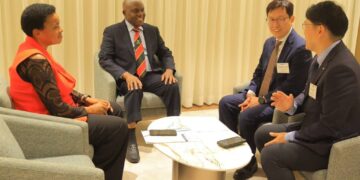
One of the most significant engagements on Alupo’s programme is her scheduled bilateral meeting with Indian Prime Minister Narendra Modi.
The meeting is scheduled to take place at Bharat Mandapam on September 13, according to the published programme for Modi’s bilateral engagements during the summit.
The talks are expected to provide an opportunity for Uganda and India to discuss issues of mutual interest alongside the wider BRICS agenda.
India and Uganda have maintained longstanding diplomatic relations, with cooperation extending across trade, investment, education, health, pharmaceuticals, agriculture, capacity building and other areas.
For Kampala, closer engagement with New Delhi could help support efforts to expand trade and attract Indian investment into sectors identified as priorities for Uganda’s economic transformation.
India is also an important commercial and development partner for many African countries, making the bilateral relationship significant beyond the immediate BRICS meeting.
Modi’s planned meeting with Alupo is part of a wider series of bilateral engagements being held alongside the summit.
The Indian prime minister is scheduled to meet several leaders from Africa, Asia and other regions, reflecting New Delhi’s effort to use its 2026 BRICS chairship to strengthen relations with both member and partner countries.
Uganda’s place in the expanded BRICS framework
Uganda is not a full BRICS member. It participates as one of the grouping’s Partner Countries.
This distinction is important because the BRICS framework has expanded considerably in recent years.
The original BRIC grouping brought together Brazil, Russia, India and China before South Africa joined, transforming it into BRICS.
The group has since expanded to include countries such as Egypt, Ethiopia, Iran, Indonesia, Saudi Arabia and the United Arab Emirates.
Alongside the full members, BRICS now works with a group of partner countries, including Uganda.
The expanded structure has given countries outside the core membership additional opportunities to participate in discussions and cooperation programmes without becoming full members.
For Uganda, the partner status provides access to a diplomatic network that includes some of the world’s largest emerging economies.
It also gives Kampala another platform from which to advocate for greater representation of developing countries in global institutions and international economic decision-making.
India’s fourth BRICS chairship
India is hosting the 18th BRICS Summit as part of its fourth term as chair of the grouping.
The 2026 chairship is built around the theme “Building for Resilience, Innovation, Cooperation and Sustainability.”
The theme reflects India’s stated emphasis on practical cooperation in areas including economic development, innovation, sustainability and resilience.
The summit also comes in a significant year for BRICS, which marks two decades since the establishment of the original BRIC grouping in 2006.
The expanded organisation now represents a substantial share of the world’s population and global economic output, increasing its importance in debates over international trade, development finance, technology, energy and global governance.
For developing countries such as Uganda, the growing role of BRICS presents both opportunities and challenges.
On one hand, closer cooperation can open new markets, financing opportunities, investment relationships and technology partnerships.
On the other, Uganda must balance its engagement across different international partnerships while ensuring that new agreements produce measurable benefits for the domestic economy.
Trade and investment opportunities
Economic diplomacy is expected to remain an important component of Uganda’s participation.
Uganda has been seeking to attract investment into sectors capable of generating employment, expanding exports and increasing domestic production.
These include agriculture and agro-processing, energy, infrastructure, minerals, manufacturing, tourism and technology.
India’s large economy and extensive private sector make it a potentially important source of investment and technology for Uganda.
Indian businesses already have interests in several African markets, including sectors such as pharmaceuticals, manufacturing, financial services, telecommunications and consumer goods.
Uganda’s participation in the BRICS framework could therefore complement its existing bilateral engagement with India.
For Kampala, the broader objective is not simply diplomatic visibility but translating international relationships into investment, trade and development outcomes.
A wider Global South agenda
Alupo’s participation also comes as BRICS increasingly presents itself as a platform for the Global South.
Many developing countries have called for reforms to international institutions to give greater weight to emerging economies and developing states.
Issues such as reform of global financial institutions, access to development financing, technology transfer, climate financing, food security and fairer international trade are increasingly important to countries across Africa.
Uganda has traditionally supported greater representation of African countries in global decision-making institutions.
Participation in BRICS-related activities therefore gives Kampala an additional forum through which it can engage in discussions over the future structure of the international system.
The summit’s agenda also comes amid geopolitical tensions, economic fragmentation and uncertainty over global supply chains.
These developments have encouraged emerging economies to explore stronger forms of economic cooperation and alternative channels for trade and development finance.
Cuba and other partner-country engagements
Cuba is also participating in the New Delhi summit framework as a BRICS Partner Country, with Cuban Foreign Minister Bruno Rodríguez Parrilla among the senior representatives attending the gathering.
The presence of Cuba and other partner countries illustrates the increasingly broad diplomatic network surrounding BRICS.
Uganda and Cuba have maintained diplomatic relations and have cooperated in areas including health, education and other areas of development.
However, a specific bilateral meeting between Alupo and Rodríguez Parrilla during the New Delhi summit could not be independently confirmed from the official schedules and reliable reporting reviewed for this article.
Any such engagement would nevertheless fit within the broader diplomatic activity taking place on the sidelines of the summit, where partner countries have opportunities to strengthen bilateral relations.
Why the summit matters to Uganda
Uganda’s participation has significance beyond the two-day summit.
The country’s economy requires continued access to capital, technology, markets and development partnerships as the government pursues industrialisation and economic transformation.
BRICS countries collectively possess significant economic resources and large consumer markets.
Building stronger relationships with these economies could help Uganda diversify its trade and investment partnerships.
At the same time, participation gives Uganda an opportunity to promote its interests directly to policymakers and business communities from countries with growing influence in Africa.
The challenge will be turning diplomatic engagement into concrete agreements and investments.
Summit participation by itself does not guarantee new investment or increased exports. The long-term impact will depend on follow-up negotiations, private-sector engagement and the implementation of any agreements reached.
India-Uganda relations
Uganda and India have maintained warm diplomatic relations for decades.
India has been involved in Uganda’s development through trade, investment, education, health and technical cooperation.
Indian-origin communities have also played an important role in Uganda’s commercial history, contributing to sectors including manufacturing, trade and services.
The relationship has continued to evolve as both countries seek greater economic cooperation.
For Uganda, India represents an important Asian partner at a time when Kampala is pursuing stronger engagement with emerging economies.
For India, Uganda provides a gateway into the East African market and an important diplomatic partner on the African continent.
The Alupo-Modi meeting therefore carries significance beyond the BRICS agenda and could reinforce the broader bilateral relationship.
The broader BRICS picture
The New Delhi summit is bringing together leaders and representatives from the 11 full BRICS members and partner and outreach countries.
The grouping has become considerably more diverse than its original composition, encompassing countries from Africa, Asia, the Middle East and Latin America.
That diversity gives BRICS greater geographic reach but also creates the challenge of reconciling different national interests.

Member and partner countries do not necessarily share identical positions on international security, trade, energy or geopolitical questions.
The success of the grouping will therefore depend partly on its ability to identify areas where cooperation can produce practical results despite political differences.
India’s chairship has emphasised resilience, innovation, cooperation and sustainability as areas where such common ground can be developed.
What Uganda can gain
For Uganda, the immediate value of the summit lies in access.
Access to senior political leaders can help Kampala present its economic priorities directly.
Access to business and investment networks can create opportunities for private-sector partnerships.
And access to multilateral discussions can strengthen Uganda’s participation in debates affecting developing economies.
The country will also need to demonstrate what it can offer potential investors, including a stable business environment, reliable infrastructure, skilled labour, access to regional markets and clear investment policies.
Uganda’s participation in BRICS is therefore best viewed as part of a broader economic diplomacy strategy rather than as an isolated diplomatic event.
Conclusion
Vice President Jessica Alupo’s participation in the 18th BRICS Summit places Uganda at a major international forum at a time when emerging economies are seeking greater influence in global economic and political affairs.
Her scheduled meeting with Prime Minister Narendra Modi provides an important opportunity to strengthen Uganda-India relations, while the wider summit offers Kampala a platform to pursue trade, investment, technology and development partnerships.
Uganda’s status as a BRICS Partner Country gives it an additional channel for engagement with major emerging economies without being a full member of the bloc.
The lasting significance of the New Delhi visit, however, will ultimately be measured by what follows the summit — whether diplomatic discussions lead to increased investment, stronger trade, new technology partnerships and practical cooperation capable of contributing to Uganda’s economic transformation.
For Kampala, the message from New Delhi is therefore likely to extend beyond summit diplomacy: the growing influence of the Global South is creating new opportunities, but converting those opportunities into national gains will require sustained engagement and effective follow-through.
**Source