


















By Karim Were
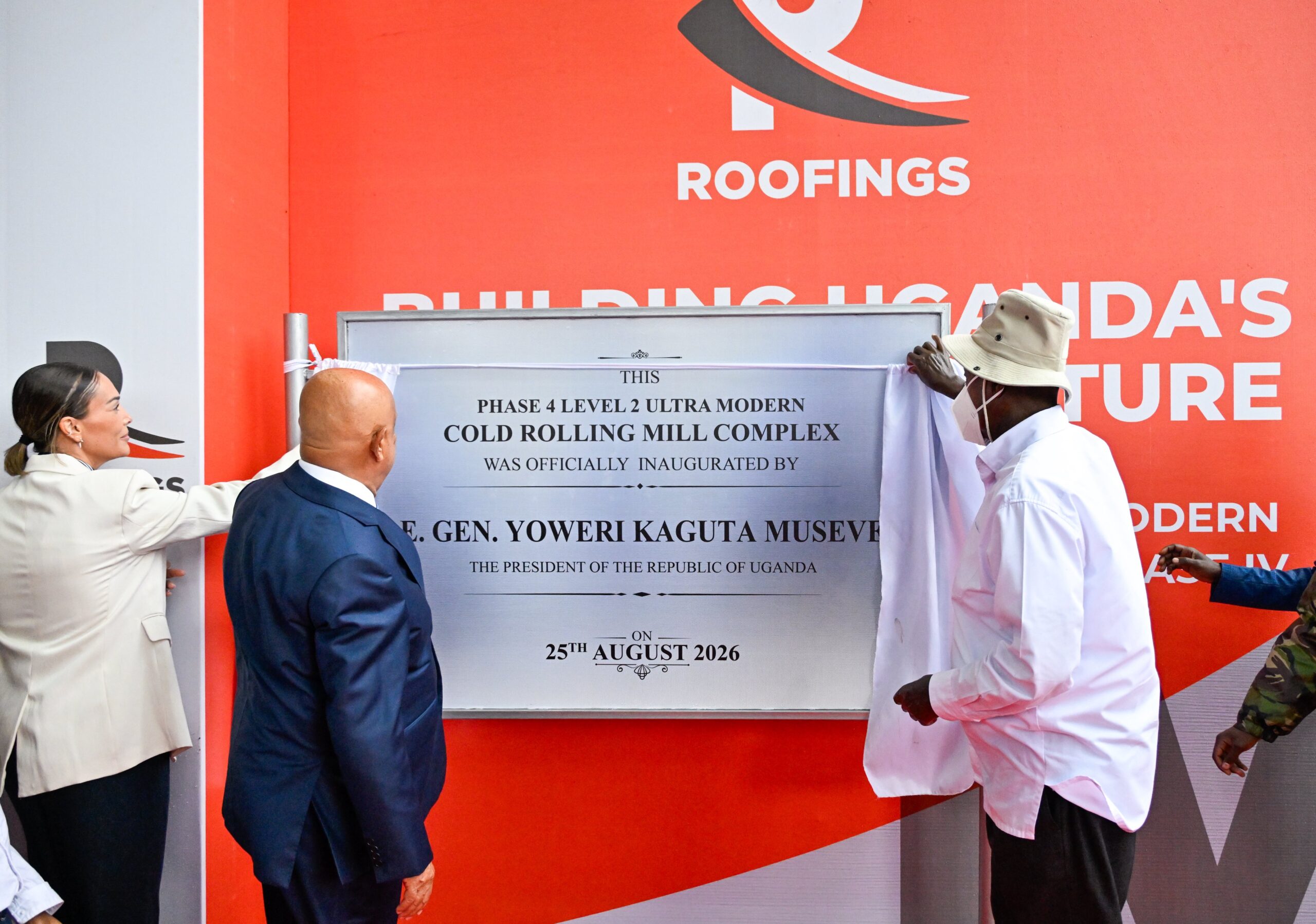
KAMPALA— President Yoweri Kaguta Museveni has commended Dr Sikander Lalani and Roofings Group for the inauguration of Phase IV Level 2 of the Ultra Modern Rolling Mill Complex, describing the investment as a significant step in Uganda’s industrialisation journey.
President Museveni said the new facility supports the National Resistance Movement (NRM) Government’s long-standing economic vision of building an independent, integrated and self-sustaining economy.
The President said the investment would strengthen local value addition, create employment opportunities and reduce Uganda’s dependence on imported intermediate products.
“I congratulate Dr. Sikander Lalani and Roofings Group on the inauguration of Phase IV Level 2 of the Ultra Modern Rolling Mill Complex,” Museveni said.
He said industrial investments of this nature are important to Uganda’s efforts to transform its economy from dependence on imported products towards greater domestic production.
#Investment strengthens industrialisation
Museveni linked the Roofings investment to the economic objectives outlined by the NRM when it came to power in 1986.
He said the movement’s **Ten-Point Programme** included the development of an independent, integrated and self-sustaining economy.
According to the President, Uganda’s industrialisation agenda requires investments that can convert locally available resources into finished and intermediate products within the country.
The expansion of steel-processing capacity, he said, is part of that broader transformation.
The President argued that increasing domestic production would enable Uganda to retain more value within the economy while creating opportunities for employment and industrial skills development.
#Iron ore resources
Museveni also pointed to Uganda’s abundant iron ore resources as an opportunity to develop a competitive steel industry.
He said the country possesses high-grade iron ore that should be utilised to support industrial development.
“Uganda has abundant iron ore resources, including high-grade iron ore, and we must use these resources to build a competitive steel industry,” he said.
The President’s remarks underline the Government’s ambition to strengthen the link between Uganda’s natural resources and domestic industrial production.
Rather than exporting raw materials and importing finished products, the strategy seeks to increase processing and manufacturing within Uganda.
#Local value addition
The President said the Roofings investment would contribute to local value addition by increasing the country’s capacity to manufacture steel products domestically.
Value addition involves processing raw materials into products with greater economic value before they reach consumers or other industries.
For an economy such as Uganda’s, increased local processing can support industrial linkages between producers, manufacturers, transporters, distributors and other businesses.
The steel industry also supplies materials used in construction, manufacturing, infrastructure and other economic activities.
#Jobs and economic opportunities
Museveni also highlighted employment as one of the benefits associated with industrial investment.
Large manufacturing facilities can create direct employment while generating indirect opportunities through suppliers and service providers.
The expansion of steel production can therefore contribute to the development of industrial skills and provide opportunities for Ugandans to participate in manufacturing-related activities.
The President said the investment creates employment opportunities for Ugandans while supporting the country’s wider economic transformation agenda.
#Reducing import dependence
Another key issue raised by the President was Uganda’s dependence on imported intermediate products.
Intermediate products are goods used as inputs in the production of other goods and services.
Increasing domestic production of such materials can help reduce the amount of foreign exchange spent on imports while strengthening local supply chains.
Museveni said the Roofings investment was an important step towards reducing this dependence.
The development of a stronger domestic steel industry could also support other sectors that require steel products, particularly construction and manufacturing.
#NRM’s economic vision
Museveni placed the investment within the historical context of the NRM’s economic programme.
When the NRM took power in 1986, it outlined the Ten-Point Programme, which included the objective of creating an independent and self-sustaining economy.
The President said the industrialisation agenda being pursued today is consistent with that vision.
Over the years, Uganda has sought to expand manufacturing, promote value addition and attract private investment as part of its economic transformation strategy.
The Government has also encouraged investors to establish industries that process locally available raw materials.
#Building a competitive steel industry
Museveni said Uganda should move beyond simply possessing mineral resources and instead develop the capacity to process them competitively.
A competitive steel industry would require reliable access to raw materials, energy, transport infrastructure, technology, skilled workers and markets.
The development of rolling mills and other processing facilities represents one component of the steel value chain.
The President’s remarks suggest that Uganda’s long-term objective is to build an integrated industry capable of taking advantage of the country’s mineral resources while supplying domestic and regional markets.
#Industrialisation and economic transformation
Industrialisation remains central to Uganda’s efforts to transform its economy.
Manufacturing can increase productivity, create employment and provide markets for locally produced raw materials.
It can also support the development of technical skills and encourage investment in infrastructure and technology.
Museveni’s support for the Roofings expansion reflects the Government’s emphasis on private-sector investment as a driver of industrial growth.
The President said such investments should contribute to an economy that is increasingly capable of producing the goods required by its population and other markets.
#Regional opportunities
Uganda’s growing industrial capacity also has potential implications beyond its domestic market.
As an East African Community member, Uganda has access to a regional market comprising millions of consumers.
A competitive steel industry could therefore serve both domestic demand and regional markets if production meets appropriate standards and remains competitive on price and quality.
Regional industrialisation can also encourage the development of cross-border supply chains and trade.
#The road ahead
While celebrating the new investment, the President’s remarks also pointed to the need for Uganda to continue developing its industrial base.
The availability of iron ore provides an important starting point, but turning mineral resources into a competitive steel industry requires sustained investment and supportive infrastructure.
The Government and private sector will also need to address issues such as energy costs, transport, technology, skills and access to markets.
For Uganda to fully benefit from its natural resources, increased domestic processing will remain important.
#Conclusion
The inauguration of Phase IV Level 2 of Roofings Group’s Ultra Modern Rolling Mill Complex has been welcomed by President Museveni as a significant milestone in Uganda’s industrialisation journey.
The President said the investment advances the NRM’s long-standing objective of building an independent, integrated and self-sustaining economy by increasing local value addition, creating employment and reducing dependence on imported intermediate products.
With Uganda possessing significant iron ore resources, Museveni said the country must harness them to build a competitive steel industry.
The expansion of domestic steel production, he argued, can help Uganda move further along the path from a largely raw-material-based economy towards one capable of processing its resources and producing more of the goods needed at home and in regional markets.
**Source🇺🇬 Be Blessed