


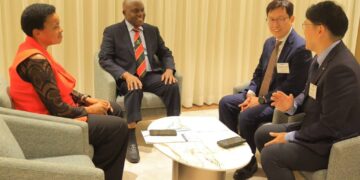























By Our Staff Businge Emmanuel.
Businge Emmanuel says monitoring teams are visiting government schools to enforce the no-fees policy while addressing challenges such as staffing, furniture and classroom shortages.
FORT PORTAL. The Resident District City Commissioner (DRCC) for Fort Portal, Businge Emmanuel, has warned headteachers of government schools against charging learners unauthorised fees, as the city authorities intensify monitoring of schools to ensure compliance with the government’s no-fees policy.
The monitoring exercise, led by officials from the Office of the Resident City Commissioner, is targeting government schools across Fort Portal City. Authorities say the initiative is intended to ensure that learners are not denied access to education because of fees or other compulsory charges.
Businge said the government’s position is that learners attending government schools should not be required to pay school fees. He, however, acknowledged that several schools face operational challenges that can put pressure on administrators and parents.
Among the challenges identified during the monitoring exercise are inadequate furniture, staffing shortages, high pupil-teacher ratios, limited classroom space and concerns regarding the general welfare of learners.
#Monitoring government schools
The DRCC said the monitoring team has already visited several schools in Fort Portal City to assess compliance with the government directive.
Schools visited include Buhinga Primary School, Njara, Kamengo, St Peter and Paul and St Mary’s Kinyamasika Primary School, all within Central Division.
The inspections are intended to establish whether schools are complying with the policy and to identify challenges that may require government attention.
Businge said school administrators should not use the challenges facing their institutions as a basis for imposing compulsory charges on parents.
Instead, he urged school authorities to work through established government and school management structures to communicate their needs and seek appropriate solutions.
The monitoring exercise also provides authorities with an opportunity to understand the conditions under which government schools are operating.
#Voluntary contributions
While emphasising the no-fees policy, Businge explained that parents may make contributions to schools, provided such contributions are genuinely voluntary and properly authorised.
According to the DRCC, any proposed parental contribution should be supported by minutes from a general meeting of the Parent-Teacher Association (PTA).
This distinction is important because a voluntary contribution should not become a compulsory payment that effectively prevents a child from attending school.
The monitoring team is therefore expected to examine how schools communicate financial requests to parents and whether such requests comply with the government’s position.
School administrators and management committees have also been encouraged to maintain transparency when discussing the financial needs of their institutions with parents.
#Schools face operational challenges
The monitoring exercise has also highlighted the difficulties facing some government schools in Fort Portal.
Businge acknowledged that inadequate furniture remains a concern in some schools, with shortages potentially affecting the learning environment.
Staffing gaps are another challenge. Where schools have insufficient teachers, the resulting pupil-teacher ratios can make classroom management and effective teaching more difficult.
The DRCC also pointed to shortages of classroom blocks as another issue requiring attention.
These challenges, he said, need to be addressed through increased government support and improved planning rather than through compulsory charges imposed on parents.
Businge expressed optimism that the challenges could be addressed as more government resources become available.
The remarks reflect a broader challenge facing public education systems: ensuring that policies guaranteeing access to education are matched by sufficient funding, infrastructure and human resources.
#Balancing policy with school needs
The debate over school charges comes against the background of efforts to make basic education accessible to children regardless of their families’ financial circumstances.
Government schools provide an important pathway to education for many families, particularly those who may not be able to afford the costs associated with private education.
However, schools also require money to maintain infrastructure, provide basic services and meet operational needs.
This creates a difficult balance for school administrators. Where government funding is perceived as insufficient, schools may face pressure to seek additional support from parents.
For parents, however, compulsory payments can create barriers to attendance and may place additional pressure on household incomes.
The Fort Portal monitoring exercise is therefore aimed at ensuring that the implementation of the no-fees policy does not become undermined by unofficial or compulsory charges.
#Call for compliance
Businge urged headteachers to comply with the government policy and ensure that learners are not subjected to unauthorised fees.
He also encouraged parents to understand the difference between voluntary support and compulsory charges.
The authorities’ approach suggests that enforcement will need to be accompanied by dialogue with school administrators and communities, particularly where schools can demonstrate genuine resource shortages.
Rather than simply identifying violations, the monitoring exercise could help authorities document infrastructure and staffing needs and communicate them to relevant government agencies.
This could help distinguish between deliberate attempts to impose unauthorised charges and situations in which schools are struggling with legitimate resource constraints.
#Role of parents and school management
Parents remain an important part of the management of government schools through structures such as PTAs and school management committees.
The requirement for properly recorded PTA decisions on voluntary contributions is intended to promote transparency and ensure that parents have an opportunity to participate in decisions affecting their children’s education.
However, voluntary contributions must remain voluntary. A contribution should not become a condition for admission, continued attendance or participation in learning.
Clear communication between schools, parents and local authorities can therefore help reduce misunderstandings and disputes over school finances.
Authorities can also use monitoring visits to explain government policy directly to school administrators and communities.
#Wider education concerns
The situation in Fort Portal also illustrates the relationship between education policy and the availability of public resources.
A no-fees policy can remove one important financial barrier for families, but access to quality education also depends on adequate classrooms, teachers, furniture, learning materials and other facilities.
Where those resources are inadequate, the quality of education can be affected even when learners are able to attend school without paying tuition.
For this reason, the challenges identified by the Fort Portal monitoring team remain relevant to both local and national education planning.
Addressing staffing shortages, classroom deficits and inadequate furniture would help schools implement the no-fees policy while maintaining an environment conducive to learning.
#Continued monitoring expected
The Office of the DRCC is expected to continue monitoring government schools in Fort Portal City as part of efforts to ensure compliance with the policy.
The visits will also give local authorities an opportunity to document the challenges facing individual schools.
For school administrators, the message from the city authorities is clear: operational difficulties should be communicated through the appropriate government and school management channels rather than resolved through compulsory fees.
For parents, the monitoring exercise offers an avenue through which concerns about unauthorised charges can be raised with local authorities.
The effectiveness of the initiative will ultimately depend on sustained monitoring, adequate government funding and cooperation among school administrators, parents, teachers and local leaders.
Ensuring that children can attend government schools without facing unauthorised financial barriers remains central to the broader goal of expanding access to education.
As Fort Portal continues the monitoring exercise, attention is likely to remain focused not only on compliance with the no-fees policy but also on whether the underlying challenges facing government schools receive the resources required to improve learning conditions.
Source: