

















By Staff Reporter
CDF escalates public dispute with Water and Environment Minister over remarks made in Parliament on political disagreements and violence
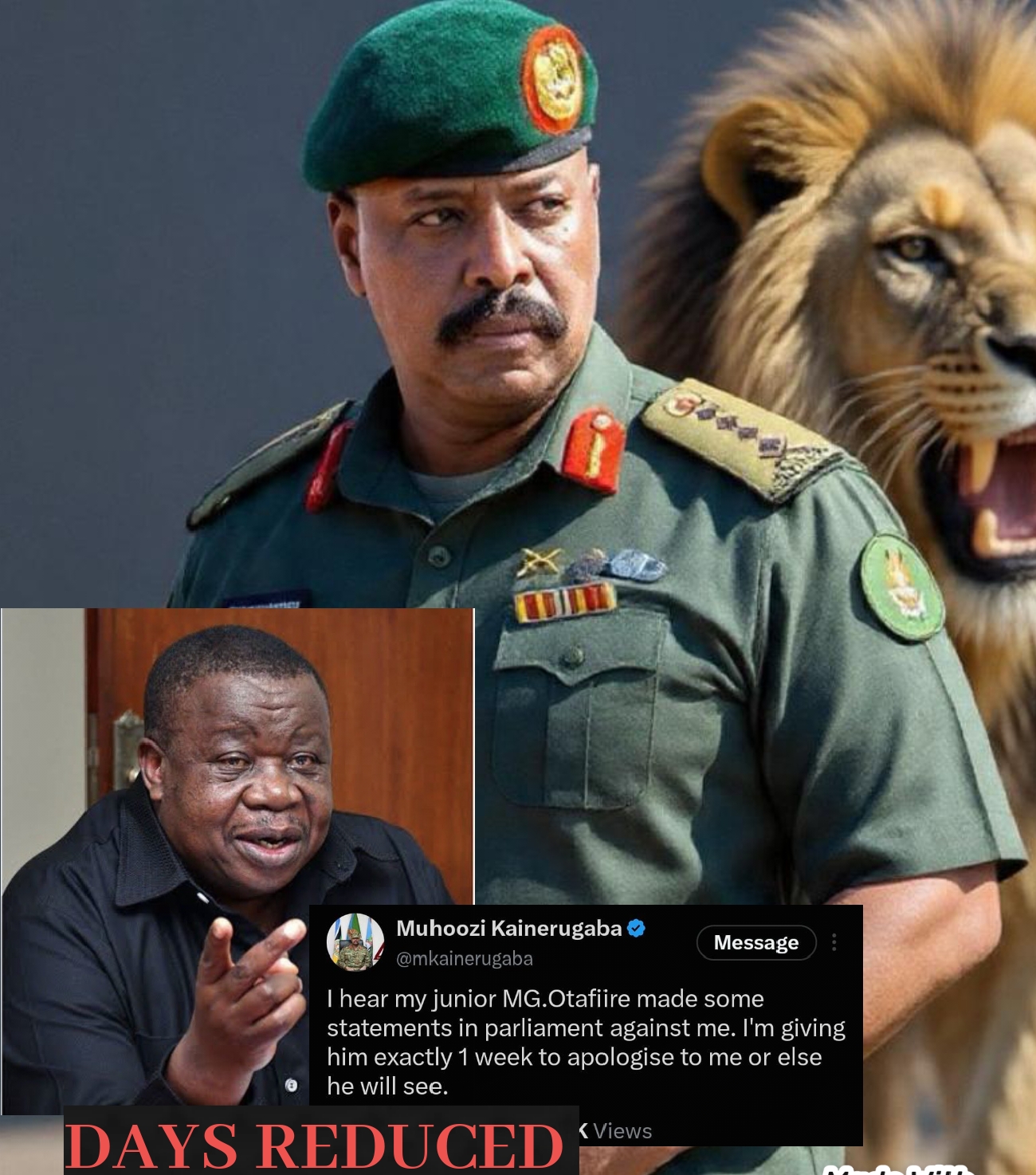
KAMPALA. Chief of Defence Forces Gen Muhoozi Kainerugaba has shortened the deadline he gave Water and Environment Minister Maj Gen (Rtd) Kahinda Otafiire to apologise over remarks the CDF says were directed at him, escalating a public dispute between two senior figures in Uganda’s military and political establishment.
Gen Kainerugaba initially gave Otafiire one week to apologise following comments the minister made in Parliament on September 30 about political tolerance and the dangers of using violence to resolve disagreements.
However, in a follow-up post on October 2, Gen Kainerugaba said the initial period was too long and reduced it to three days.
“One week is too long, he has 3 days to apologise,” Gen Kainerugaba said in the post, according to reports published Friday.
The CDF’s initial message had stated: “I hear my junior MG. Otafiire made some statements in parliament against me. I’m giving him exactly 1 week to apologise to me or else he will see.”
The remarks have triggered debate because Otafiire did not mention Gen Kainerugaba by name during his parliamentary address.
#Otafiire’s parliamentary remarks
The dispute follows an address Otafiire delivered to Parliament on September 30 while presenting a statement on the performance of the Water and Environment sector for the 2025/26 financial year.
After presenting the ministerial report, Otafiire spoke about political disagreements, tolerance and the importance of resolving disputes without violence.
He told MPs that disagreement was a normal part of human relations and that the important issue was how differences were handled.
“Disagreement is not a problem, but how to resolve the contradiction is the problem,” Otafiire said.
He then addressed the question of violence, saying: “The hallmark of civilisation is how people resolve contradiction without violence.”
Otafiire added that when a general preferred violence as a means of resolving problems, it presented a problem.
“The greatest generals I know of are those who resolve problems without shooting a bullet,” he said.
The remarks were made as part of a wider appeal for political tolerance and peaceful management of disagreements. Parliament’s own report confirms that Otafiire addressed the House on September 30 while presenting the ministry’s performance report. ([Parliament of Uganda][1])
#Otafiire did not name Muhoozi
Although Gen Kainerugaba interpreted the remarks as being against him, the available record of Otafiire’s address does not show that the minister directly mentioned the CDF by name.
Otafiire instead spoke generally about political actors, the ruling National Resistance Movement and the opposition.
He urged Ugandans to tolerate different political views and said the country had a shared national interest regardless of political affiliation.
“We are in one country; we are in one political dispensation, and we must learn to tolerate each other,” he told Parliament.
He also appealed to members of the ruling NRM to recognise the role of the opposition in a political system.
According to Otafiire, those who win elections should be “magnanimous in victory”, while those who lose should respect the winners but retain the right to be heard.
He described the opposition as a “mirror of reflection” for the ruling party, arguing that political competition can provide an opportunity for government to examine its own performance. ([New Vision]
#Public interpretation of the remarks
The absence of a direct reference to Gen Kainerugaba has become one of the central issues in the debate surrounding the exchange.
Some commentators have interpreted Otafiire’s remarks as a general statement about political tolerance rather than a direct criticism of the CDF.
Others have linked them to wider discussions about the role of security agencies in political affairs and recent allegations concerning the treatment of opposition activists.
However, it remains unconfirmed that Otafiire intended his comments specifically for Gen Kainerugaba.
Gen Kainerugaba’s own posts indicate that he regarded the remarks as sufficiently personal to warrant an apology.
The latest three-day deadline therefore shifts the dispute from an interpretation of a parliamentary speech into a direct public confrontation between the two generals.
#A history of differences
The latest exchange comes against a background of previous public differences between Gen Kainerugaba and Otafiire.
Both men have extensive military backgrounds, although they now occupy different roles in Uganda’s political and security structures.
Gen Kainerugaba is the serving Chief of Defence Forces of the Uganda People’s Defence Forces, while Otafiire is a retired major general and a senior National Resistance Movement politician who serves as Minister of Water and Environment.
Their public disagreements have previously included political questions surrounding Gen Kainerugaba’s ambitions and his role in Uganda’s political affairs.
Recent reporting has also highlighted differences between the two over political succession and the Patriotic League of Uganda, which Gen Kainerugaba chairs. ([ChimpReports][3])
The latest disagreement is therefore being viewed within a broader history of exchanges between two figures who have played prominent roles in Uganda’s political and military establishment.
#Debate over political tolerance
At the heart of Otafiire’s parliamentary intervention was a call for political tolerance.
He argued that disagreement itself should not be regarded as a crisis.
Instead, he said the manner in which political and social contradictions are resolved determines whether they escalate into conflict.
Otafiire said governments depend on information and intelligence to understand what their adversaries intend to do and to prevent disputes from reaching the point of confrontation.
His argument was that effective leadership should seek ways of preventing conflict rather than waiting until disagreements become violent.
The message was also directed at political parties and supporters.
Otafiire said Uganda belonged to everyone regardless of political persuasion and urged political actors to respect different viewpoints.
His remarks have attracted attention partly because they were delivered by a veteran military officer who participated in Uganda’s liberation struggle and has held several senior government positions.
#The wider political context
The exchange comes at a time when questions about political tolerance, security operations and the conduct of political actors have generated public discussion in Uganda.
Recent allegations involving the treatment of opposition activists have added to scrutiny of security institutions, although individual allegations require independent investigation and should not be treated as established facts without evidence.
Parliament has also been discussing issues surrounding missing persons and allegations of abuses involving security agencies.
Against this backdrop, Otafiire’s remarks about resolving contradictions without violence have attracted considerable attention.
The CDF’s response has added another dimension by making the dispute personal and public.
#What happens next?
With Gen Kainerugaba now giving Otafiire three days to apologise, attention is likely to focus on whether the minister will respond and, if so, how.
It remains unclear whether Otafiire will apologise, clarify that his parliamentary remarks were general, or reject the demand.
No response from Otafiire to the shortened deadline was included in the information available for this report.
The language used by Gen Kainerugaba in his initial post — that Otafiire would “see” if he did not apologise — has also attracted attention. The exact consequences intended by the CDF were not specified in the post.
It would therefore be premature to assume what action, if any, would follow the expiration of the deadline.
#Significance for Uganda’s political discourse
The dispute has broader significance because both men are senior figures with military backgrounds, while Uganda’s political system continues to feature former and serving military officers in prominent public roles.
Otafiire’s central message in Parliament was that political disagreements should be managed peacefully and that political competition should not destroy the country’s shared interests.
Gen Kainerugaba’s response, meanwhile, shows that he viewed the minister’s remarks as sufficiently serious to warrant a demand for an apology.
The contrasting positions have generated a public discussion about political speech, hierarchy, military leadership and the appropriate way for senior officials to handle disagreements.
For now, the disagreement remains a public exchange, with no indication in the available information of any formal disciplinary proceedings against Otafiire.
The immediate question is whether the three-day deadline will result in an apology, a clarification or a further public response from the minister.
Whatever the outcome, the episode has placed renewed attention on Otafiire’s call for political tolerance and peaceful dispute resolution — a message that now sits at the centre of a dispute involving the country’s serving military chief.
Source: