






















By Our Reporter
The Minister of Water and Environment reflected on the crucifixion of Jesus, using modern nuclear weapons to question humanity’s continuing capacity for violence.
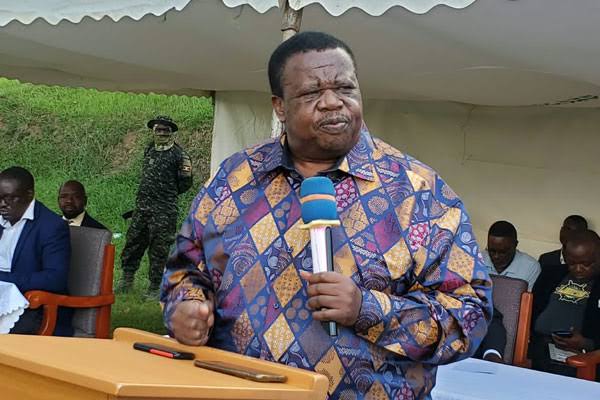
KAMPALA, Uganda — Gen. Kahinda Otafiire has previously used a church gathering to reflect on the crucifixion of Jesus Christ, asking whether Christ would want to return to a world that has developed weapons capable of causing destruction on an unprecedented scale.
The remarks, which have resurfaced in public discussion, were attributed to Otafiire during a requiem Mass for his former UPDF comrade, the late Maj. Gen. Levi Karuhanga, at St Luke Church in Ntinda.
According to reporting by The Independent and The Observer, Otafiire questioned the Christian teaching about the Second Coming and said that, if he were Jesus, he would not return to a world in which humanity had become even more capable of violence.
“Personally, I am not sure about the so-called second coming of Jesus Christ. What I am sure of is that Jesus will not find me alive,” Otafiire was quoted as saying.
He then framed his argument as a hypothetical question.
“If I were Jesus, I would not return, because if you people stoned him to death, then what would you do to him now that the world is full of nuclear weapons?” he said, according to the published accounts.
In the version of the remarks supplied for this article, Otafiire is also quoted as saying: “The man was here, you beat him with sticks and whips. Now, they have nuclear weapons.”
The comments were presented as a rhetorical reflection on violence, faith and the evolution of destructive technology rather than as a formal theological position or government policy.
A reflection on the crucifixion
At the centre of Otafiire’s remarks was the Christian account of Jesus’ suffering and death.
The New Testament Gospels describe Jesus being arrested, subjected to physical punishment and eventually crucified by Roman authorities.
For Christians, the crucifixion is one of the defining events of the faith. Jesus’ death is understood within Christian theology in relation to salvation, while his resurrection is regarded as central to the Christian belief in victory over death.
Otafiire’s observation focused on the apparent contradiction between Jesus’ teachings and the violence inflicted upon him.
“After doing everything good, they just nailed him to the cross,” he said in the remarks provided.
The statement presents the crucifixion as an example of humanity responding to a message of goodness with violence.
His subsequent reference to nuclear weapons moved the discussion from biblical history to the modern world.
From the cross to nuclear weapons
The comparison between the Roman-era execution of Jesus and modern nuclear weapons was intended to underline the dramatic increase in humanity’s capacity to inflict harm.
Crucifixion was an extremely violent form of execution used in the ancient Roman world. Nuclear weapons, by contrast, emerged only in the 20th century and introduced a fundamentally different scale of destructive power.
The first use of nuclear weapons in warfare occurred in 1945, when the United States used atomic bombs against Hiroshima and Nagasaki in Japan during the Second World War.
Since then, nuclear weapons have become a central issue in international security.
States possessing nuclear arsenals have developed doctrines of deterrence based on the threat of devastating retaliation, while other governments and international organisations have pursued arms-control and non-proliferation agreements.
Otafiire’s argument was therefore not simply about weapons.
It was about what humanity’s technological progress says about its moral development.
If people have developed increasingly powerful tools for destroying one another, his rhetorical question asks, has human behaviour become more peaceful in proportion to that technological advancement?
“What would I be coming to do?”
The supplied version of Otafiire’s remarks captures the rhetorical nature of his argument.
“If I were him, what would be coming to do here? What would I be coming to do? To get more beatings?”
The question links the suffering described in the Gospels with the possibility of renewed suffering in the modern world.
The minister’s point appears to be that humanity has not necessarily outgrown the behaviour that led to Jesus’ execution.
Instead, technological development has potentially increased the consequences of human conflict.
The observation is particularly striking because nuclear weapons can affect populations far beyond the immediate combatants.
A conventional conflict can already cause extensive humanitarian suffering. Nuclear warfare could produce consequences on an even larger scale.
That makes Otafiire’s comparison a broader warning about humanity’s responsibility for the technologies it creates.
The remarks were made in a religious setting
The setting of the comments is important.
The remarks were reportedly made at St Luke Church in Ntinda during a requiem Mass for Maj. Gen. Levi Karuhanga, a senior UPDF officer and former colleague of Otafiire.
The setting provided a religious framework for reflections on death, faith and the meaning of human life.
Otafiire has previously made other public comments about religion and the role of churches in Ugandan society.
In 2019, for example, Daily Monitor reported that he urged religious leaders to resist being used by politicians for selfish interests and instead concentrate on promoting the welfare of society.
In 2022, Otafiire also attracted attention after telling worshippers at a thanksgiving ceremony in Bushenyi that people should work rather than depend solely on prayer for economic improvement. Daily Monitor and other Ugandan outlets reported the remarks.
His history of speaking candidly at religious gatherings provides context for the comments about Jesus.
Otafiire and religious debate
Otafiire’s comments about the Second Coming appear to have been intended to provoke thought rather than establish a theological doctrine.
Christian denominations generally teach that Jesus Christ will return, although interpretations differ over the timing and circumstances of the Second Coming.
The New Testament contains several passages concerning Christ’s return, and the doctrine has been an important part of Christian teaching throughout the history of the church.
Otafiire’s statement that he would not return if he were Jesus should therefore be understood as a hypothetical personal reflection.
It should not be presented as a change in Christian doctrine or as an official position of the Ugandan government.
The published accounts also describe the remarks as humorous or provocative, reinforcing the importance of considering the setting and tone in which they were delivered.
Why nuclear weapons became part of the argument
The reference to nuclear weapons gives the remarks a contemporary international dimension.
The development of nuclear weapons changed the way states think about war.
Before the nuclear age, military conflicts could be devastating but were generally constrained by the destructive capabilities of conventional weapons.
Nuclear technology changed that calculation.
A single nuclear weapon can destroy a large urban area, while radioactive contamination and other effects can persist long after an explosion.
The possibility of nuclear conflict has consequently shaped international diplomacy for decades.
Governments have negotiated treaties aimed at limiting proliferation and reducing nuclear risks, while nuclear-armed states have maintained arsenals as part of their national-security strategies.
Otafiire’s church reflection can therefore be read as a moral question about this contradiction: humanity has developed extraordinary scientific capabilities, but some of its most sophisticated technologies are also capable of extraordinary destruction.
The moral question behind the humour
Although the wording was provocative, the underlying issue is serious.
The minister’s argument raises a question that has been considered by religious thinkers, philosophers, scientists and political leaders for generations: does technological progress necessarily mean moral progress?
Human societies have developed vaccines, computers, satellites, advanced transportation and communication systems.
At the same time, they have developed weapons capable of killing large numbers of people within a very short period.
The two developments have occurred within the same civilisation.
That contradiction has long generated debates about the responsibilities of scientists, political leaders and societies.
Otafiire’s comments place that debate within a Christian framework by asking listeners to consider what the world would look like to Jesus if he returned after centuries of human technological development.
The crucifixion and the message of peace
The Christian account of Jesus’ life contains repeated teachings concerning forgiveness, love, mercy and reconciliation.
The Gospel accounts also portray Jesus as responding to hostility without leading an armed rebellion against Roman authority.
The crucifixion consequently became, in Christian theology, both an account of suffering and a central symbol of sacrifice and redemption.
Otafiire’s comments emphasise the suffering component.
His description of Jesus being beaten, whipped and nailed to the cross invites listeners to compare that ancient violence with conflicts in the modern world.
The comparison is not intended to suggest that Roman punishment and nuclear warfare are historically equivalent.
Rather, it highlights a continuing pattern of human beings using violence against others.
A broader warning about humanity
The remarks also fit into a broader discussion about war and peace.
Uganda, like many countries, has experienced periods of political violence and armed conflict since independence.
Otafiire himself is a veteran of Uganda’s armed struggle and has held senior military and political positions.
His career has therefore included direct involvement in questions of security, conflict and the use of force.
That background adds another layer to his reflection on violence.
However, the available material does not indicate that the remarks were intended as a policy statement about Uganda’s military position or nuclear weapons.
Uganda does not possess nuclear weapons and is party to international nuclear non-proliferation frameworks.
The comments were instead delivered as a moral and religious observation.
Otafiire’s current government role
Otafiire currently serves as Uganda’s Minister of Water and Environment.
He previously served as Minister of Internal Affairs and has held several senior government portfolios.
His public statements therefore frequently attract attention because he combines a long military background with a prominent political role.
That context is relevant when reporting on his remarks, but it does not automatically turn comments made during a church service into government policy.
The distinction between a minister speaking in an official capacity and a minister offering personal reflections at a religious gathering remains important.
In this case, the information available identifies the comments as remarks delivered during a church-related event rather than a formal government communication.
Why the comments continue to attract attention
Otafiire’s remarks have resurfaced because they combine three subjects that continue to generate public interest: Christianity, violence and nuclear weapons.
Each subject carries significant historical and contemporary importance.
Christianity remains one of the world’s largest religions, with the life, death and resurrection of Jesus at its centre.
Violence continues to affect societies through wars, terrorism, political conflict and crime.
Nuclear weapons remain a major international-security concern more than eight decades after their first use.
The combination of the three creates a powerful rhetorical question about the direction of human civilisation.
It also demonstrates how religious teachings can be used to examine modern political and technological challenges.
The importance of context
The comments should nevertheless be reported with appropriate context.
They are not evidence that Otafiire rejects Christianity, nor do they establish that he believes Jesus will not return.
The available reporting shows that he expressed uncertainty about the Second Coming and then used a hypothetical scenario involving Jesus and nuclear weapons to make a point about humanity’s violent behaviour.
Similarly, the remarks should not be interpreted as an official government statement concerning nuclear policy.
No such policy announcement was contained in the material provided.
The safest and most accurate interpretation is that Otafiire was using a provocative hypothetical during a religious gathering to challenge his audience to think about violence and morality.
Faith and responsibility in the modern world
The deeper issue raised by the remarks is whether religious values can influence the way societies use technological power.
Technology itself is neither inherently peaceful nor inherently destructive.
Its consequences depend largely on how people, institutions and governments choose to use it.
Nuclear energy, for example, has civilian applications, while nuclear weapons are designed for military purposes.
The broader lesson is that scientific advancement creates responsibilities alongside opportunities.
Otafiire’s question about Jesus returning to a world with nuclear weapons can therefore be understood as a challenge to humanity to consider whether its moral capacity has developed alongside its technological capabilities.
Conclusion
Gen. Kahinda Otafiire’s reflection on Jesus and nuclear weapons offers a striking example of how religious narratives can be used to discuss modern questions about violence and human responsibility.
Speaking during a requiem Mass for his late UPDF colleague Maj. Gen. Levi Karuhanga at St Luke Church in Ntinda, Otafiire questioned the idea of Jesus returning to a world that had continued to embrace violence while developing weapons of unprecedented destructive power.
“If I were Jesus, I would not return,” he was quoted as saying, before referring to the nuclear weapons available in the modern world.
The remarks should be understood as a rhetorical reflection rather than a formal theological doctrine or government policy.
Their broader significance lies in the question behind the humour: as humanity’s ability to destroy has grown, has its ability to live peacefully grown at the same pace?
That question remains relevant not only to Christians but to governments, communities and individuals confronting a world where technological power carries increasingly significant moral responsibilities
Source: