





















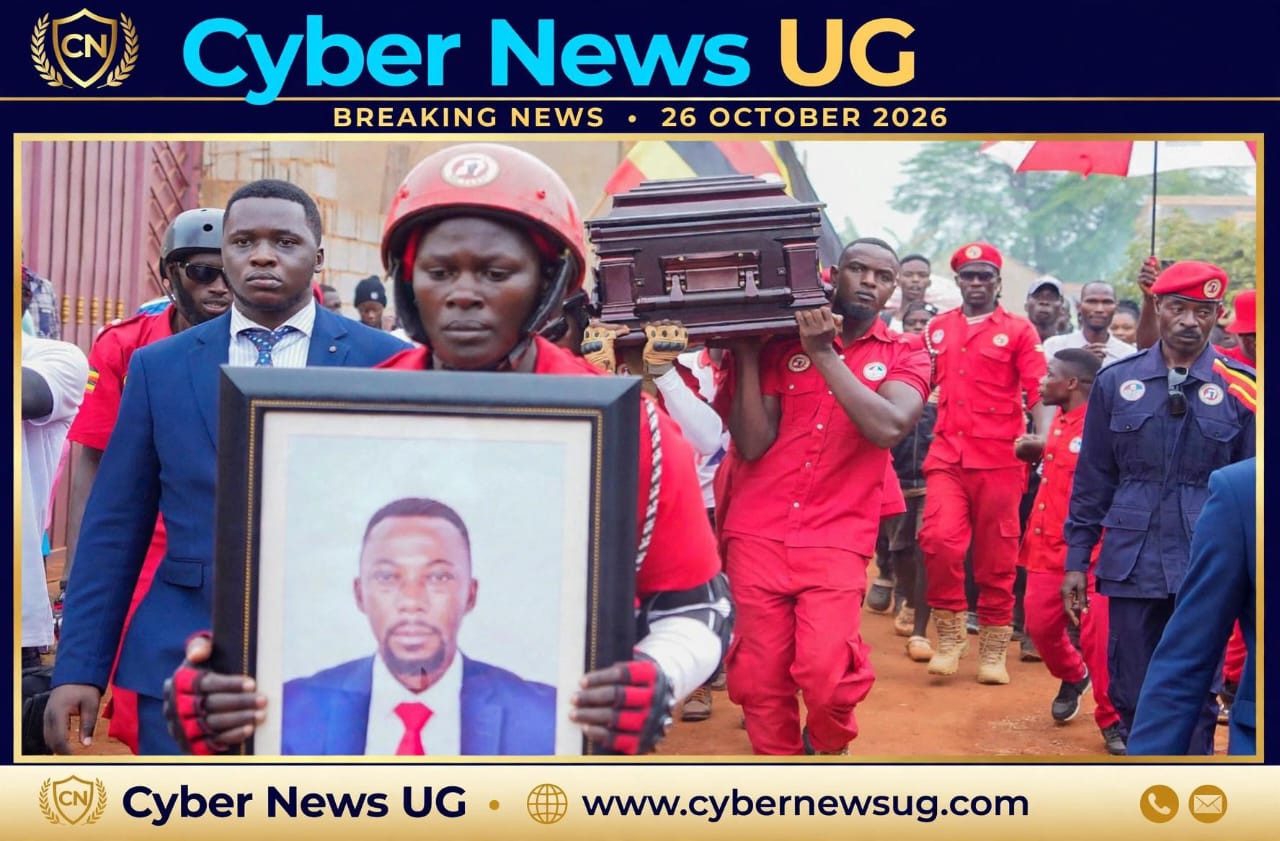
Police say the suspects allegedly attacked Kibuku County MP Herbert Kinobere and other mourners, damaged his vehicle’s tyres and threw stones during the burial of former Busiro South MP Charles Matovu in Wakiso District.
Police in Uganda have arrested 20 suspected National Unity Platform (NUP) activists accused of attacking Kibuku County Member of Parliament Herbert Kinobere and other mourners during the burial of former Busiro South MP Charles Matovu in Wakiso District on Sunday, October 25, 2026.
The incident reportedly occurred at Kungu-Lutale along Nakawuka Road, where hundreds of mourners had gathered to pay their last respects to the former legislator. According to police spokesperson Kituuma Rusoke, the suspects allegedly targeted people they identified as supporters of the ruling National Resistance Movement (NRM), objecting to their presence at the funeral of an opposition politician.
Police said the alleged attackers threw stones at several mourners and deflated the tyres of Kinobere’s vehicle. The 20 suspects were arrested and detained in connection with the incident, with police indicating that they would be taken to court in accordance with the law.
The arrests place renewed attention on political tensions and the need to protect public safety at funerals and other gatherings, where people from different political backgrounds may assemble to mourn, pay tribute and support bereaved families.
Police Describe Events at the Funeral
Speaking about the incident, Rusoke said the confrontation arose after a group of people allegedly opposed the presence of NRM supporters at Matovu’s burial.
“A group of NUP political activists allegedly opposed the presence of NRM supporters. They attacked mourners and one of them was MP Kinobere, they deflated his car tyres and pelted stones on a number of mourners who they did not approve of,” Rusoke said.
According to the police account, the alleged violence was directed at mourners based on their perceived political affiliation. The account suggests that disagreements over the presence of supporters from different political camps escalated into a confrontation.
However, the allegations have not been independently established in the information available for this report. The suspects’ individual roles, the circumstances that preceded the confrontation and whether anyone sustained injuries were not detailed in the police statement provided.
The arrest of the suspects represents the immediate police response to the reported incident. Their detention does not, by itself, establish criminal responsibility, which must be determined through the applicable legal process.
Twenty Suspects Detained as Police Promise Legal Action
Rusoke said police officers intervened during the incident and attempted to secure people who had fled the scene.
“Police intervened and tried to secure those who had run away. We made 20 arrests. They are in police custody and they will be arraigned in court and dealt with in accordance with the law,” he said.
The police spokesperson did not provide the names of the arrested individuals or specify the charges they would face. Further details about their identities, the evidence collected and the timing of their court appearance were not included in the information provided.
The next steps in the case are expected to depend on police investigations and the decisions of the relevant prosecuting authorities. Any charges, if filed, would need to be considered by a competent court.
The arrests also leave questions about the sequence of events leading to the confrontation, including whether there had been earlier disagreements among mourners and whether additional security measures were in place before the incident.
Those questions remain unresolved based on the details currently available.
Funeral Gathering Becomes Scene of Political Confrontation
Matovu’s burial had brought together hundreds of mourners at Kungu-Lutale along Nakawuka Road in Wakiso District. Funerals of prominent political figures can attract relatives, community members, political colleagues, supporters and public officials, sometimes bringing together people who hold opposing political views.
In such settings, tensions can emerge when participants disagree over political symbols, speeches, the presence of particular individuals or the conduct of rival supporters. However, the specific circumstances that triggered Sunday’s confrontation have not been fully established.
Police allege that the people involved objected to the presence of NRM supporters at the burial because the deceased was a former opposition legislator. If established through investigations and court proceedings, such conduct would raise concerns about the freedom of mourners to attend a funeral without intimidation or violence because of their political affiliations.
At the same time, responsibility for the alleged attack must be assessed on the evidence relating to each suspect. Political affiliation alone is not proof that an individual participated in a criminal act.
The incident also highlights the importance of distinguishing between the actions of particular individuals and the wider membership or supporters of a political organisation. The police allegations concern 20 suspects; they do not, on their own, establish that the NUP as an organisation directed or endorsed the alleged violence.
Political Differences and the Right to Mourn
Uganda’s political landscape includes competing parties and movements whose supporters participate in elections, public meetings, demonstrations and community events. Funerals involving political figures can carry additional significance because they provide an opportunity for public tributes, expressions of solidarity and interaction among political leaders.
The burial of a former opposition MP would naturally be expected to attract people who knew him personally, worked with him or supported his political activities. Other mourners may attend because of family relationships, community ties or respect for the deceased, regardless of their political affiliation.
The reported confrontation raises a broader question about whether political differences are being managed peacefully at public gatherings.
A funeral is primarily an occasion to honour the deceased and support the bereaved. Violence, intimidation or the deliberate obstruction of mourners can disrupt that purpose and create fear among people attending for personal, social or political reasons.
Maintaining order at such gatherings requires both effective security arrangements and restraint from participants. Police may need to intervene where violence threatens public safety, while organisers and political leaders can help reduce tensions by discouraging confrontational behaviour.
The facts of the Wakiso incident will need to be established through investigation rather than assumptions based on party affiliation.
Police Investigations and the Importance of Due Process
The decision to arrest 20 suspects indicates that police are pursuing individuals believed to have been involved in the confrontation. The authorities have said the suspects remain in custody and are expected to be arraigned in court.
The legal process is important in determining what happened and whether the evidence supports criminal charges against particular individuals. Investigators may need to establish the conduct of each suspect, examine available witness accounts and assess any other evidence relevant to the alleged attack.
The reported damage to Kinobere’s vehicle is another aspect that may require clarification. Police said the vehicle’s tyres were deflated, but the information provided does not establish the extent of any damage, the cost of repairs or whether a formal complaint relating to the vehicle has been filed.
Similarly, although police said stones were thrown at several mourners, no confirmed information was provided about injuries, medical treatment or the number of people directly affected.
These details should not be assumed without confirmation from police, the affected individuals or other reliable sources.
The suspects, like any other people accused of an offence, are entitled to due process. Their arrest and detention should not be treated as a final determination of guilt. A court will assess the evidence and apply the relevant law if charges are brought.
What Remains Unclear
Several important details remain unconfirmed in the account of the incident.
These include whether any mourners sustained injuries, whether other property was damaged, the specific charges being considered and whether the suspects have legal representation. The information provided also does not include a response from the NUP, Kinobere or the organisers of Matovu’s burial.
Obtaining responses from the affected MP, the suspects’ representatives and the relevant political organisations would help establish a fuller account of the confrontation.
A detailed account of the events before, during and after the alleged attack would also help clarify whether the confrontation was spontaneous or followed an earlier dispute. No conclusion on those questions can be drawn from the police statement alone.
The absence of these details does not negate the seriousness of the allegations, but it underscores the need for further reporting and verification.
Implications for Public Safety and Political Tolerance
The incident comes amid broader concerns about how political differences can affect public gatherings. When people fear being attacked because of their political identity, they may be discouraged from attending community events or interacting peacefully with people who support other parties.
Preventing such incidents requires accountability where offences are established, as well as efforts to encourage peaceful political participation. Security agencies have a responsibility to respond to credible threats and investigate reported violence impartially, while political actors and their supporters should avoid incitement and intimidation.
Organisers of large public gatherings can also help by communicating with security personnel, establishing clear arrangements for crowd management and encouraging participants to respect one another.
The case may provide an opportunity for authorities to establish the facts, determine individual responsibility and communicate the outcome of investigations transparently. Such steps can help reinforce public confidence in the handling of politically sensitive incidents.
It is equally important that the investigation remains evidence-based and does not lead to collective blame against people who share a political affiliation with the suspects.
Conclusion
Police have arrested 20 suspected NUP activists following allegations that they attacked Kibuku County MP Herbert Kinobere and other mourners during the burial of former Busiro South MP Charles Matovu in Wakiso District on October 25, 2026.
Police spokesperson Kituuma Rusoke said the suspects allegedly objected to the presence of NRM supporters, threw stones at mourners and deflated Kinobere’s vehicle tyres. He said the suspects were in custody and would be taken to court in accordance with the law.
The allegations now require investigation and, where charges are brought, judicial scrutiny. The suspects’ guilt has not been established by the arrests.
Beyond the immediate case, the incident highlights the importance of protecting mourners, preventing political intimidation and ensuring that public gatherings remain peaceful spaces for people of different political backgrounds. The eventual outcome of the investigation will be important in establishing accountability while upholding due process and the rule of law.
Source: