













By Karim Were
President Museveni says Uganda wants to acquire road equipment directly from Japan and expand cooperation in infrastructure, petroleum and private-sector investment.
KAMPALA. President Yoweri Kaguta Museveni has called for deeper economic cooperation between Uganda and Japan, urging the Japanese government to support the country in acquiring road construction equipment directly and encouraging more Japanese companies to invest in Uganda.
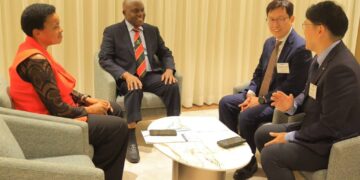
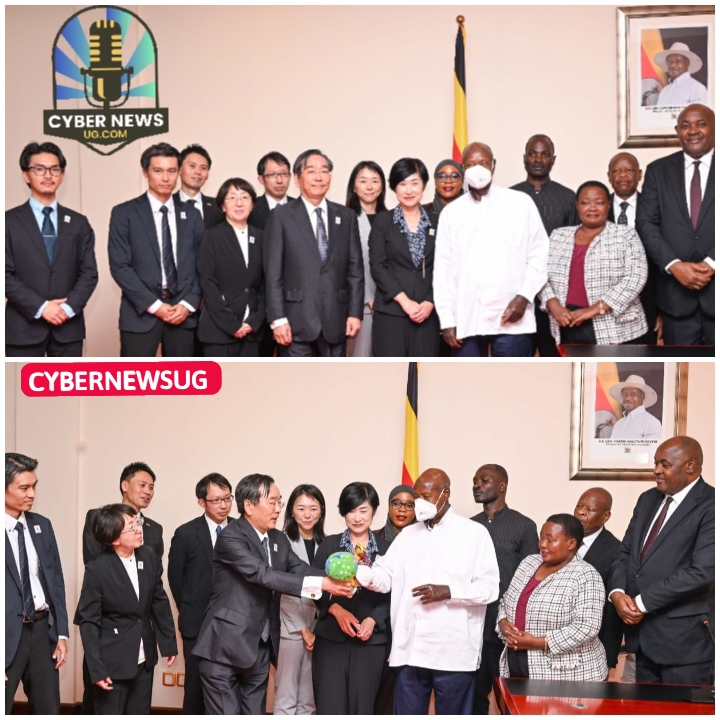
President Museveni made the remarks after meeting Ambassador Takahashi Misako, Japan’s Assistant Minister for African Affairs, and her delegation. He thanked Japan for its longstanding support to Uganda, particularly in infrastructure development.
The President cited the Kampala Flyover, the cable-stayed bridge in Jinja and other infrastructure projects as examples of Japanese support to Uganda.
Museveni said Uganda now wants to strengthen its cooperation with Japan by accessing road equipment directly through government-to-government arrangements rather than relying on intermediaries.
We want to acquire road equipment directly through the Japanese Government, without middlemen,” the President said.
He said every urban centre should have access to its own road maintenance equipment instead of depending on equipment shared across an entire district.
#Push for better road maintenance
The request for direct access to road equipment comes as Uganda continues to expand and maintain its road network, including roads in rapidly growing urban centres.
Museveni argued that providing equipment closer to communities would improve the country’s ability to maintain roads and respond to infrastructure needs.
Under the proposed approach, urban authorities would have equipment available for routine maintenance rather than waiting for machinery to be transported from elsewhere.
The President did not provide details of the quantity or type of equipment Uganda is seeking from Japan, nor did he disclose the proposed financing arrangement.
Those details are expected to be addressed through discussions between the two governments if the proposal progresses.
The call also reflects Uganda’s broader interest in strengthening direct government-to-government cooperation on infrastructure projects.
#Japan’s contribution to Uganda’s infrastructure
Uganda and Japan have maintained development and economic relations for decades, with Japanese assistance supporting projects in infrastructure and other sectors.
Museveni specifically recognised Japanese involvement in major infrastructure developments, including the Kampala Flyover and the cable-stayed bridge in Jinja.
The Kampala Flyover forms part of efforts to improve traffic movement in the capital, while the Jinja bridge is an important component of transport infrastructure in eastern Uganda.
By highlighting these projects, Museveni said Uganda values Japan’s contribution to the country’s development and wants the relationship to expand beyond individual infrastructure projects.
The President’s remarks also come at a time when Uganda is seeking additional investment and partnerships as it pursues industrialisation and economic transformation.
#Museveni welcomes more Japanese investors
In addition to government-to-government cooperation, Museveni urged Japanese companies to consider Uganda as an investment destination.
He said Uganda wants to attract more foreign investment as part of its broader economic strategy.
“I also welcome more Japanese companies to invest in Uganda,” he said.
The President linked the appeal for investment to Uganda’s stated ambition of achieving broader prosperity.
“Our aim is global affluence, everybody to be rich. When Uganda and Japan prosper together, everybody benefits,” he said.
The remarks underline the government’s continued emphasis on attracting private capital, technology and expertise to support economic growth.
For Japanese investors, Uganda offers opportunities in areas such as infrastructure, manufacturing, agriculture, energy, logistics and services. However, investment decisions are also influenced by factors including infrastructure quality, market access, financing, regulation and the overall business environment.
#Infrastructure cooperation and economic transformation
Uganda’s engagement with Japan comes as the government continues to prioritise infrastructure development as a foundation for economic growth.
Roads, bridges and urban transport infrastructure are considered important for connecting producers to markets, reducing transport costs and supporting the movement of goods and people.
For a landlocked country such as Uganda, efficient transport infrastructure is particularly important because much of the country’s international trade depends on regional transport corridors.
The government’s efforts to improve infrastructure have therefore been linked to wider plans for industrialisation, trade and regional integration.
The request for road equipment adds another dimension to this strategy by focusing not only on the construction of major projects but also on routine maintenance.
Poorly maintained roads can increase transport costs, affect travel times and undermine the benefits generated by major infrastructure investments.
#A broader Uganda-Japan partnership
The meeting with Ambassador Takahashi also provides an opportunity for Uganda and Japan to examine how their bilateral relationship can evolve.
Development cooperation has traditionally been an important component of Uganda-Japan relations, but the government is increasingly seeking partnerships that combine development assistance with trade and private investment.
Museveni’s appeal for more Japanese companies reflects this shift.
Greater Japanese investment could potentially deepen commercial ties while providing opportunities for technology transfer, skills development and employment, depending on the sectors and projects involved.
However, any expansion of investment will require clear agreements, commercially viable projects and a predictable operating environment.
#Government-to-government procurement
Museveni’s call for Uganda to obtain road equipment directly from Japan also raises the issue of procurement efficiency.
The President said the objective is to avoid middlemen in the acquisition of equipment.
Such an arrangement, if adopted, would need to comply with Uganda’s procurement laws and relevant government procedures.
The details of how such procurement would be structured were not provided in the information available.
It is also unclear whether the proposal would involve grants, concessional financing, commercial purchases or another form of government-to-government cooperation.
These issues would need to be clarified before any specific procurement programme can be assessed.
#Urban centres at the centre of road maintenance
Museveni’s proposal that every urban centre should have its own road equipment reflects the growing infrastructure demands created by urbanisation.
Uganda’s towns and cities continue to expand, increasing pressure on local authorities to maintain roads, drainage systems and other public infrastructure.
Where machinery is shared across large administrative areas, authorities can face delays when several locations require maintenance at the same time.
Having dedicated equipment closer to urban centres could allow authorities to respond more quickly to routine road maintenance requirements.
The effectiveness of such a model, however, would also depend on the availability of trained operators, maintenance budgets, spare parts and systems for managing the equipment.
#Japan’s role in Uganda’s development agenda
Japan has been an important development partner for Uganda, particularly in infrastructure and technical cooperation.
The President’s acknowledgement of Japanese support suggests that Kampala sees Tokyo as a partner capable of contributing to Uganda’s long-term development priorities.
The new focus on direct equipment acquisition and increased private investment could broaden that relationship.
For Japan, stronger engagement with Uganda would also take place within the wider context of its relations with Africa, where infrastructure, trade, investment and economic development remain important areas of cooperation.
Uganda, meanwhile, is seeking partnerships with international governments and businesses that can contribute to its industrialisation and economic growth objectives.
#What comes next
The meeting did not result, based on the information provided, in a specific agreement on the proposed road equipment programme or the entry of particular Japanese companies into Uganda.
Further discussions between Ugandan and Japanese officials would therefore be required to determine whether the proposals can be translated into formal programmes or investment commitments.
The government would also need to establish the financing, procurement, distribution and maintenance arrangements for any road equipment acquired through the proposed partnership.
For potential Japanese investors, the next stage would involve identifying viable investment opportunities and assessing the regulatory and commercial conditions for operating in Uganda.
The broader message from the meeting, however, was clear: Uganda wants to deepen its relationship with Japan beyond traditional development assistance and toward wider economic cooperation.
#Conclusion
President Museveni’s meeting with Ambassador Takahashi Misako highlights Uganda’s effort to strengthen its economic relationship with Japan through infrastructure cooperation, direct equipment procurement and increased private investment.
The President’s request for direct access to Japanese road equipment reflects the government’s focus on improving local infrastructure maintenance, while his appeal for more Japanese companies signals a desire to expand bilateral ties into trade and investment.
Whether these proposals result in new agreements will depend on subsequent negotiations between the two governments and potential investors.
For Uganda, the objective remains to use international partnerships to improve infrastructure, attract investment and support broader economic transformation.
Source: