

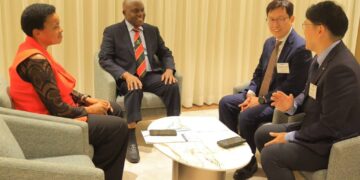









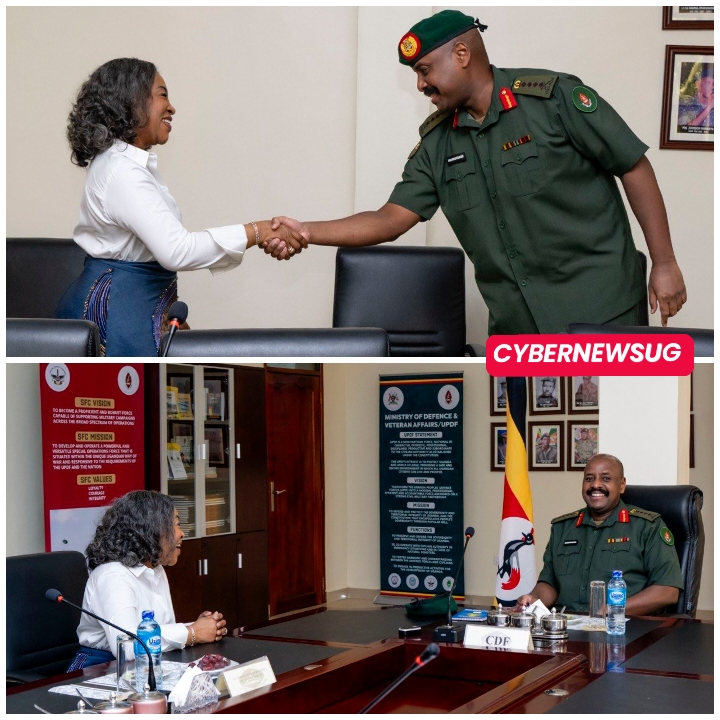
Uganda’s Chief of Defence Forces, Gen. Muhoozi Kainerugaba, has reaffirmed the country’s commitment to the Commonwealth following a meeting with its Secretary-General, Shirley Ayorkor Botchwey.
KAMPALA, Uganda — Uganda’s Chief of Defence Forces (CDF), Gen. Muhoozi Kainerugaba, has met Commonwealth Secretary-General Shirley Ayorkor Botchwey, reaffirming Uganda’s commitment to the international organisation and its activities.
In a statement shared after the meeting, Muhoozi described it as an honour to meet Botchwey and emphasised the importance Uganda attaches to its membership of the Commonwealth of Nations.
He cited Uganda’s historical links, use of the English language and close ties with the United Kingdom as factors underpinning the country’s relationship with the organisation.
“The Commonwealth of Nations is an international association we are deeply proud to be a part of as a country,” Muhoozi said in his statement.
He added that Uganda would continue to support the organisation’s activities and initiatives.
The statement did not provide details about the meeting’s location, date, agenda or whether the two officials discussed specific security, diplomatic or economic matters. It also did not indicate whether any agreements or formal commitments were reached.
Nevertheless, the meeting highlights Uganda’s stated interest in maintaining its engagement with the Commonwealth, a multilateral association that brings together countries with varied historical backgrounds and a shared commitment to cooperation in areas including governance, development, education and international relations.
Meeting held during Commonwealth Secretary-General’s Uganda visit
The meeting took place at the Special Forces Command headquarters in Entebbe during Botchwey’s official visit to Uganda from October 7 to 9, 2026, according to a report published by Kampala Post. The report said the engagement focused on the Commonwealth and Uganda’s participation in its forthcoming Heads of Government Meeting.
Botchwey’s visit included engagements with senior government officials and other national stakeholders. The Commonwealth Secretariat said the visit was intended to deepen dialogue on shared values, resilience-building and sustainable development, as well as explore ways the organisation could support stronger institutions in Uganda.
The meeting with Muhoozi formed part of these wider engagements between the Commonwealth leadership and Ugandan institutions.
According to the published account, Botchwey encouraged Uganda to participate fully in the upcoming Commonwealth Heads of Government Meeting (CHOGM), scheduled for November 1–4, 2026, in Antigua and Barbuda. The report also said she thanked Muhoozi for hosting her and her delegation.
The account did not provide a detailed transcript of the discussions, and no specific military cooperation agreement was identified. The meeting should therefore be understood as an engagement during the Secretary-General’s official visit, rather than evidence of a new defence pact.
Muhoozi highlights Uganda’s Commonwealth ties
In his statement, Muhoozi framed Uganda’s membership of the Commonwealth as a source of national pride. He pointed to historical connections, English-language use and close relations with the United Kingdom as reasons Uganda naturally belongs to the association.
His remarks reflect the historical origins of Uganda’s membership. The Commonwealth’s official history records that Uganda joined the organisation on October 9, 1962, the same day the country attained independence from Britain.
However, the modern Commonwealth is not limited to countries with British colonial histories. It is a voluntary association of independent and sovereign states, bringing together members from different regions, political systems and economic circumstances.
Its activities include cooperation on development, governance, education, trade, climate resilience and youth empowerment. The organisation provides a platform for member countries to share experience and coordinate responses to common challenges.
Muhoozi’s pledge that Uganda would continue supporting the Commonwealth’s endeavours signals an intention to maintain that engagement. The statement did not identify particular programmes Uganda would prioritise or announce additional financial or policy commitments.
Who is Shirley Ayorkor Botchwey?
International profile

Botchwey assumed office as Commonwealth Secretary-General on April 1, 2025, after being selected by Commonwealth leaders at their 2024 meeting in Apia, Samoa. Before her appointment, she served as Ghana’s Minister for Foreign Affairs and Regional Integration from 2017 to January 2025. She became the first African woman to lead the Commonwealth Secretariat.
As Secretary-General, Botchwey is responsible for promoting the Commonwealth’s values, representing the organisation internationally and overseeing the work of its Secretariat.
Her priorities include strengthening cooperation among member countries, expanding trade and investment, supporting inclusive economic growth and addressing shared challenges such as climate change, inequality and debt.
Her visit to Uganda offered an opportunity to discuss how the organisation can support the country’s development priorities while encouraging continued participation in Commonwealth initiatives.
Uganda’s role in the Commonwealth
Uganda has been a Commonwealth member since independence in 1962. Its membership provides access to a multilateral network through which governments can exchange expertise, develop partnerships and participate in international discussions on shared priorities.
The organisation comprises 56 independent countries across Africa, Asia, Europe, the Caribbean, the Americas and the Pacific. Its members include both developed and developing economies, with cooperation spanning economic development, democratic institutions, education, youth affairs and environmental protection.
For Uganda, the relationship has practical as well as historical significance. Commonwealth programmes can offer opportunities for professional development, technical assistance and the exchange of experience between public institutions.
The Commonwealth Secretariat also lists Uganda among countries involved in initiatives addressing sustainable development and climate-related challenges. Its work in the country has included support for skills development in natural-resource management and participation in the Commonwealth Blue Charter initiative on marine plastic pollution.
The benefits of membership, however, depend on how effectively individual countries use these opportunities. Diplomatic engagement must be followed by concrete programmes, appropriate institutional coordination and measurable results if it is to produce lasting economic and social gains.
CHOGM 2026 and the importance of continued engagement
The meeting between Muhoozi and Botchwey came ahead of the 2026 Commonwealth Heads of Government Meeting in Antigua and Barbuda, scheduled for November 1–4.
CHOGM brings together leaders of member countries to discuss common priorities, review cooperation and determine the organisation’s strategic direction.
Uganda’s participation provides an opportunity to engage other governments on development, investment, trade, institutional capacity and international cooperation.
During her visit, Botchwey also met Uganda’s Foreign Affairs Minister, Ambassador Adonia Ayebare. Uganda’s Ministry of Foreign Affairs reported that their discussions included preparations for CHOGM and opportunities to attract investment into Uganda’s bankable projects.
These engagements demonstrate the broader scope of the Secretary-General’s visit beyond the meeting with the CDF. They also highlight the potential for Uganda to use its Commonwealth relationships to pursue economic and institutional objectives.
Nevertheless, Muhoozi’s statement did not specify what Uganda intends to contribute to particular CHOGM initiatives or whether the meeting resulted in any new commitments. Those questions remain open pending further official details.
Diplomatic significance of the meeting
The engagement illustrates how international organisations maintain contact with different branches of government during official visits.
Although the Commonwealth is not a military alliance, meetings with senior security officials can form part of broader diplomatic outreach, particularly where governments are discussing national resilience, institutional cooperation and international engagement.
Muhoozi’s position as Chief of Defence Forces places him at the head of Uganda’s military establishment. His meeting with the Commonwealth Secretary-General therefore brought together a senior Ugandan security official and the head of a major multilateral organisation.
However, the available account does not establish that the two discussed military operations, intelligence sharing or defence agreements. Any suggestion that the meeting produced such arrangements would require additional evidence.
The clearest stated message from Muhoozi was Uganda’s continued support for the Commonwealth and its activities.
Conclusion
Gen. Muhoozi Kainerugaba’s meeting with Commonwealth Secretary-General Shirley Ayorkor Botchwey underscores Uganda’s stated commitment to maintaining its relationship with the 56-member organisation.
His remarks highlighted the country’s historical ties, use of English and relationship with the United Kingdom, while reaffirming support for the Commonwealth’s wider activities.
With CHOGM 2026 approaching, the immediate challenge for Uganda is to turn diplomatic engagement into practical cooperation that supports development, investment, institutional capacity and stronger international partnerships.
The meeting is one part of a wider series of engagements during Botchwey’s official visit. Its longer-term significance will depend on the priorities agreed upon, the programmes pursued and the outcomes that Uganda and the Commonwealth can demonstrate.
Source: