




















By Karim Were
Uganda’s President urges African defence leaders to view military security alongside economic strength, political cohesion, regional integration and emerging non-traditional threats.
KAMPALA, Uganda — President Yoweri Museveni has called on African defence and security leaders to recognise the close relationship between national security and economic development, arguing that strong defence institutions depend on strong economies and greater political and regional cooperation.
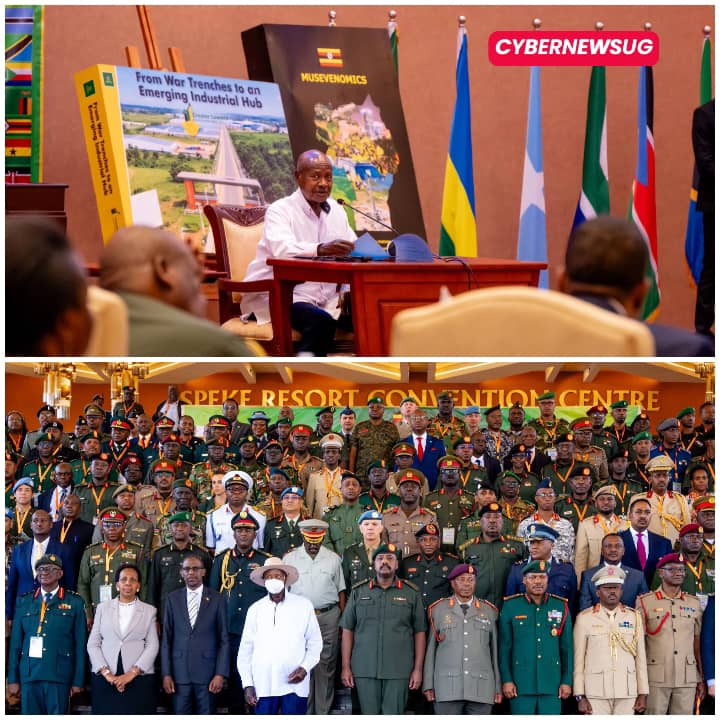
Museveni made the remarks while closing the inaugural African Conference of Chiefs of Defence Forces on Military Operations Other Than War at Speke Resort Munyonyo in Kampala, where defence chiefs, intelligence chiefs and force commanders from across Africa gathered to discuss changing security challenges and the evolving role of military institutions.
The President told the participating defence leaders that security could not be considered separately from economic prosperity and political stability.
“Security cannot be separated from a strong economy, political cohesion and strategic cooperation,” Museveni said.
His message placed economic transformation and regional integration alongside conventional defence priorities, reflecting the growing debate across Africa over how armed forces should respond to threats that extend beyond traditional military conflicts.
Museveni: Strong defence requires a strong economy
Museveni argued that a country cannot sustain a strong and secure defence force without first building a productive and resilient economy.
“A country cannot have a strong and safe defence force without a strong economy,” he said.
The President pointed to commercial agriculture, industry, services and information and communications technology as key sectors through which African countries can create wealth and strengthen their economic foundations.
His argument links defence capacity to the ability of governments to generate domestic resources, create employment, expand productive activity and invest in public institutions.
For African countries, where governments frequently face competing demands for resources, the relationship between economic development and defence spending remains particularly significant.
Museveni’s remarks suggested that military strength should not be viewed only in terms of personnel, weapons or equipment, but also in terms of the broader economic capacity of a country.
A productive economy can provide governments with greater fiscal space to support security institutions, while economic weakness can make countries more vulnerable to instability, external shocks and other security pressures.
AfCFTA and regional integration
The President also called for African countries to expand markets through regional integration and the African Continental Free Trade Area (AfCFTA).
He argued that creating larger markets would help African economies generate wealth and strengthen their ability to support national development.
The emphasis on market integration is significant because many African economies face the challenge of relatively small domestic markets, fragmented trade systems and barriers to movement of goods and services.
AfCFTA was established to promote greater intra-African trade and economic integration by creating a continent-wide framework for trade in goods and services.
Museveni linked this economic agenda directly to security, suggesting that stronger commercial ties between African countries can contribute to stability and cooperation.
The argument reflects a broader view of security in which economic opportunity, regional cooperation and political cohesion can complement the work of defence and security institutions.
Rather than treating military operations as isolated from development, the approach places them within a wider national and continental strategy.
Defence forces urged to adapt to emerging threats
Museveni also challenged African defence forces to adapt to emerging and non-traditional security threats.
Modern security challenges increasingly extend beyond conventional armed conflict and may involve terrorism, cyber threats, organised crime, trafficking, instability linked to weak institutions, humanitarian emergencies and other forms of insecurity.
While the President did not provide a detailed list of the threats discussed at the conference, his call for adaptation highlighted the changing responsibilities facing defence institutions.
“Our defence forces must also adapt to emerging and non-traditional security threats and contribute to peace and national development,” Museveni said.
The statement points to an expanding understanding of the role of military institutions.
In many African countries, armed forces are involved not only in territorial defence but also in peace-support operations, disaster response, protection of strategic infrastructure and other activities intended to support national and regional stability.
The conference’s focus on Military Operations Other Than War provided a platform for African defence leaders to consider these wider responsibilities and the operational demands associated with them.
Security and prosperity are interconnected
Museveni summed up his argument by stressing that security and economic prosperity should be pursued together.
“Security and prosperity go together,” he said.
The principle has implications for both national governments and regional organisations.
A secure environment can encourage investment, trade and economic activity, while economic development can help address some of the conditions that contribute to instability.
For policymakers, the challenge is therefore to avoid treating defence, economic development and regional cooperation as separate policy areas.
The President’s remarks encouraged defence leaders to consider how military institutions can contribute to wider national development while maintaining their core security responsibilities.
African defence leaders gather in Kampala
The inaugural conference brought together defence chiefs, intelligence chiefs and force commanders from African countries.
Museveni thanked the visiting officials for travelling to Uganda and participating in the conference.
“I thank all the visiting Defence Chiefs, Intelligence Chiefs and Force Commanders for coming to Uganda and participating in this important conference,” he said.
He also wished the delegates a good stay in Uganda.
The gathering provided an opportunity for senior military and security officials to exchange views on military operations conducted outside conventional warfare and to consider how defence institutions can respond to changing security environments.
The conference also positioned Uganda as a venue for high-level discussions on continental security and military cooperation.
Hosting such a meeting gives Uganda an opportunity to engage directly with senior defence officials from other African states while strengthening professional and strategic relationships among military institutions.
Military cooperation and continental security
The conference comes at a time when African countries are facing a diverse range of security challenges that frequently cross national borders.
Conflicts and instability in one country can have consequences for neighbouring states through refugee movements, disruption of trade, armed groups, trafficking and other forms of cross-border insecurity.
Such challenges make cooperation among defence and security institutions increasingly important.
Strategic cooperation can include information sharing, joint training, peace-support operations, coordinated responses to transnational threats and professional exchanges among military institutions.
Museveni’s reference to political cohesion also highlights another dimension of continental security.
Political instability can weaken institutions and create conditions in which security challenges become more difficult to manage. Conversely, stable political institutions can provide a stronger framework for addressing security threats through established legal and administrative systems.
A broader role for defence institutions
The President’s remarks also point toward an evolving debate about the role of African armed forces in national development.
Military institutions traditionally focus on defending national territory and responding to armed threats. However, many African countries have increasingly relied on their defence forces to support civilian authorities during emergencies and other national challenges.
The broader role brings both opportunities and responsibilities.
Where defence institutions participate in development-related activities, there is a need for clear mandates, institutional accountability and coordination with civilian authorities.
The emphasis should remain on strengthening national resilience while respecting the respective responsibilities of military and civilian institutions.
Museveni’s call for defence forces to contribute to peace and national development therefore places emphasis on adapting military capabilities to changing circumstances without losing sight of their primary security responsibilities.
Economic transformation as part of national security
The President’s focus on agriculture, industry, services and ICT also underlines Uganda’s wider economic-development priorities.
Commercial agriculture can increase production and household incomes, while industrialisation can create jobs and add value to locally produced raw materials.
The services sector can expand economic opportunities, particularly in areas such as finance, tourism, transport, logistics and professional services.
ICT, meanwhile, has become increasingly important to modern economies and public institutions, while also creating new areas of vulnerability through cyber threats.
The combination of economic development and technological advancement therefore has direct relevance to national security.
As African economies become more digitally connected, defence and security institutions are expected to develop the expertise and systems necessary to respond to emerging threats while supporting a secure environment for economic activity.
Regional markets and strategic cooperation
Museveni’s emphasis on AfCFTA also placed economic integration within the broader security conversation.
Greater regional trade can deepen economic interdependence among African countries and create incentives for cooperation.
For businesses, larger markets can support investment and expansion. For governments, regional integration can create opportunities to improve infrastructure, trade links and economic resilience.
The success of these initiatives, however, depends on continued efforts to address practical barriers to trade and movement across borders.
The President’s comments therefore framed continental integration not merely as an economic objective but as part of a wider strategy for African stability and prosperity.
Broader implications for Africa
The discussions at the Kampala conference reflect the increasingly complex nature of security policy in Africa.
Defence forces are operating in an environment where threats may emerge from conventional armed conflict, terrorism, cyber insecurity, organised criminal networks, political instability and other non-traditional sources.
At the same time, governments are under pressure to deliver economic growth, employment, infrastructure and social services.
This creates a need for coordinated national strategies in which defence and security policies are aligned with economic and development objectives.
Museveni’s closing remarks presented that relationship as fundamental: economic strength provides part of the foundation for national security, while security creates conditions in which economies can grow.
The emphasis on cooperation also points to the importance of continental and regional mechanisms in addressing threats that cannot be contained within national borders.
Conclusion
The inaugural African Conference of Chiefs of Defence Forces on Military Operations Other Than War concluded in Kampala with a call for African defence institutions to take a broader view of security.
Museveni urged defence leaders to recognise that military strength cannot be separated from economic capacity, political cohesion and strategic cooperation.
His call for investment in commercial agriculture, industry, services and ICT, together with wider markets through AfCFTA and regional integration, placed economic transformation at the centre of the security discussion.
The President also urged defence forces to adapt to emerging and non-traditional threats and contribute to peace and national development.
As African countries confront increasingly interconnected security and economic challenges, the message from the Kampala conference was that defence policy cannot operate in isolation. Sustainable security, according to the argument presented at the meeting, requires countries to build both capable institutions and resilient economies while strengthening cooperation across the continent.
Source: