















UGANDA President Yoweri Kaguta Museveni has begun another five-year term at the helm of Uganda, pledging to consolidate what his government describes as gains made over decades while pushing the country towards greater economic transformation.
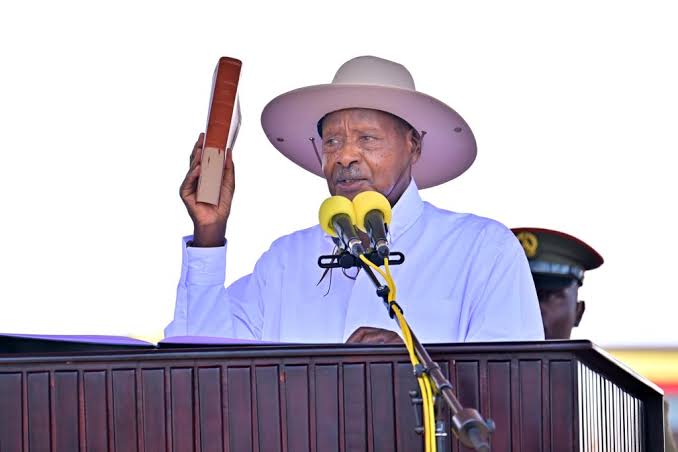
Museveni, who has been in power since 1986, was declared the winner of the January 2026 presidential election by the Electoral Commission, extending his leadership into a fifth decade. He was sworn in for the 2026–2031 term at Kololo Ceremonial Grounds in Kampala on May 12, 2026.
His latest term comes at a significant moment for Uganda, with the government seeking to move the economy further up the development ladder, expand industrialisation, increase household incomes and strengthen investment in infrastructure and productive sectors.
A leadership built around stability
Museveni and the ruling National Resistance Movement (NRM) have consistently presented peace and political stability as some of the major achievements of their administration.
The President has repeatedly argued that stability created the foundation for investment, infrastructure development and economic growth. The State House has similarly highlighted peace and stability as a central part of the NRM government’s record.
Over the years, the government has invested heavily in roads, electricity, telecommunications, education, health infrastructure and other public services. Supporters of Museveni’s leadership credit these investments, alongside economic reforms, with contributing to Uganda’s transformation from the instability of previous decades.
The NRM’s current political message is centred on “Protecting the Gains”, with the party’s 2026–2031 manifesto setting out its priorities for the new term. The government says its broader objective is to drive Uganda towards higher middle-income status.
The new administration
Museveni’s new term officially moved into implementation following the formation of a new Cabinet.
On June 29, the President chaired the first Cabinet meeting of the 2026–2031 administration, marking the beginning of implementation of the government’s programme for the new term. Cabinet ministers had earlier undergone an induction retreat at the National Leadership Institute in Kyankwanzi to familiarise them with government priorities and the administration’s strategic direction.
The use of leadership retreats at Kyankwanzi has become an important feature of the NRM administration. The sessions have traditionally been used to discuss government priorities, party ideology, economic policy and other national issues while seeking greater coordination among NRM leaders.
Economic transformation takes centre stage
One of the defining themes of Museveni’s current leadership is the push to transform Uganda from a predominantly agricultural economy into a more industrial and commercially productive one.
The administration has promoted commercial agriculture, agro-processing, manufacturing, oil and gas, tourism and infrastructure as important drivers of economic growth.
The country’s oil industry is now approaching a particularly important stage. On September 2, 2026, Uganda officially named its blended crude oil grade “Pearl Sweet” as the country prepares for commercial oil production. The project is expected to become an important source of export earnings and government revenue.
Uganda’s recoverable oil reserves are estimated at about 1.65 billion barrels, with production expected to eventually reach around 230,000 barrels per day. The oil will be transported through the East African Crude Oil Pipeline to Tanzania’s Indian Ocean port of Tanga.
For Museveni’s government, the oil sector represents more than an energy project. It is being positioned as part of the broader economic transformation strategy intended to increase investment, create employment and generate revenue for national development.
Museveni’s political longevity
Museveni’s leadership has also been defined by its extraordinary longevity.
He came to power in January 1986 after the National Resistance Army captured Kampala, following years of armed conflict. He has since remained the country’s dominant political figure and has led the NRM through successive elections.
His continued rule has, however, generated debate over political competition, democratic institutions and the question of succession.
International observers and opposition groups have raised concerns over Uganda’s political environment, including restrictions affecting opposition activities, civil society and media freedom. Freedom House, for example, has criticised the country’s democratic environment and the treatment of political opposition.
Museveni’s government has rejected allegations that it deliberately undermines democratic institutions and maintains that its policies are aimed at preserving stability, security and national development.
The contrast between the government’s emphasis on stability and its critics’ concerns over political freedoms remains one of the central debates surrounding Museveni’s leadership.
The succession question
Museveni’s long tenure has inevitably brought succession to the centre of Uganda’s political conversation.
The issue gained renewed attention in August 2026 after Gen Muhoozi Kainerugaba, the President’s son and Uganda’s military chief, publicly expressed his intention to contest for the presidency in 2031. Reuters reported that Kainerugaba announced his intention to run and has long been viewed as a possible successor to his father.
The development has added another dimension to discussions about Uganda’s political future.
For the NRM, maintaining continuity while preparing a new generation of leaders will be an important challenge. For the opposition, the focus remains on building a credible alternative capable of competing effectively against the ruling establishment.
The road ahead
As Museveni enters the 2026–2031 term, the success of his leadership will increasingly be measured by whether the government’s ambitious economic and development targets translate into tangible improvements in the lives of ordinary Ugandans.
Among the key issues will be job creation, household incomes, agricultural productivity, industrialisation, public-sector efficiency, education, healthcare and the management of expected oil revenues.
The government has also continued to emphasise wealth creation and the need for households to participate in productive economic activities rather than depending solely on subsistence production.
The Office of the President says regional leadership retreats are being undertaken to accelerate implementation of the 2026–2031 manifesto, signalling an effort to move from campaign promises to measurable government programmes.
A legacy still being written
After more than four decades in power, Museveni’s legacy remains a subject of both praise and criticism.
Supporters point to the relative stability of the country, infrastructure development, economic expansion and the government’s long-term development programmes. Critics, meanwhile, question the concentration of political power, the state of democratic competition and the lack of a clear institutional succession framework.
His new term therefore represents both a continuation and a test of the political model he has built since 1986.
With the NRM government now beginning implementation of its 2026–2031 programme, the central question will be whether Museveni can convert the political continuity that has characterised his leadership into deeper economic transformation and improved living standards for Ugandans.
**Source:Be Blessed