

















BY Karim Were
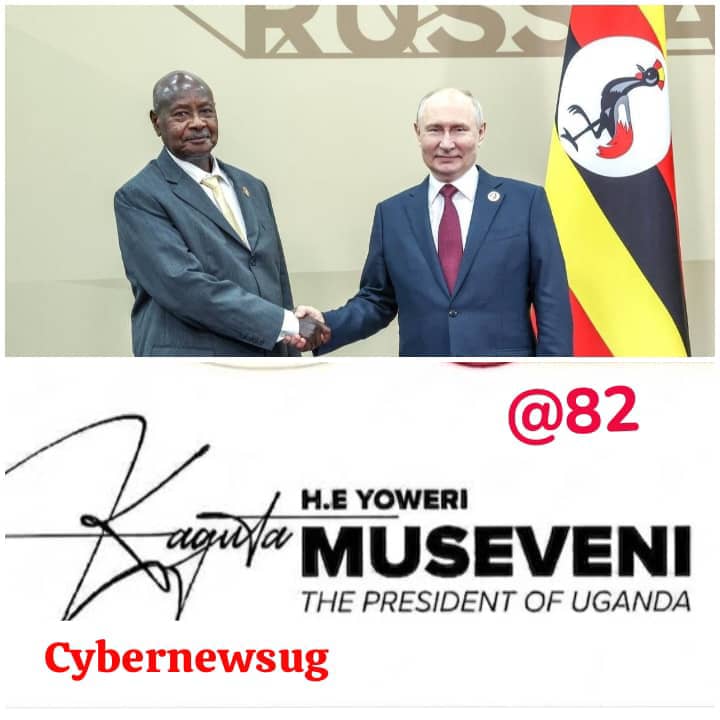
KAMPALA, Uganda — The Embassy of the Russian Federation in the Republic of Uganda has extended its “sincere and heartfelt congratulations” to President Yoweri Kaguta Museveni on the occasion of his birthday, in a message highlighting the diplomatic ties between Russia and Uganda.
The birthday message places the Russian mission among the international diplomatic representations acknowledging Museveni’s long political career and continued leadership of Uganda.
The embassy’s statement, as issued for the occasion, conveys its congratulations directly to the Ugandan president and reflects the broader diplomatic relationship between Moscow and Kampala, which has developed across political, economic, educational and humanitarian areas.
President Museveni, who was born on September 15, 1944, has been Uganda’s president since 1986. His birthday comes as Uganda and Russia continue to maintain political dialogue and cooperation on a range of international and bilateral issues.
Russian embassy sends birthday greetings
In its message, the Embassy of the Russian Federation in Uganda said it wished to extend its “sincere and heartfelt congratulations” to Museveni on his birthday.
The message is a diplomatic gesture that reflects the established practice of foreign missions recognising significant occasions involving the leadership of their host countries.
While the statement itself is brief, it comes against the backdrop of longstanding relations between Uganda and Russia, formerly the Soviet Union.
The two countries established diplomatic relations in 1962, shortly after Uganda gained independence. According to Russia’s Foreign Ministry, the Soviet Union supported Uganda’s development through technical and economic assistance, while Soviet specialists worked in areas including medicine and education.
Russia says more than 4,000 Ugandan citizens received their education in the Soviet Union, reflecting one of the longstanding humanitarian dimensions of the relationship.
The Russian Foreign Ministry has described the relationship as one involving political dialogue as well as inter-parliamentary and inter-party contacts. Moscow and Kampala have also maintained engagement through multilateral institutions.
A relationship dating back more than six decades
Uganda and Russia have maintained diplomatic relations for more than six decades.
The relationship began during the Cold War period, when newly independent African states were developing diplomatic and economic partnerships with countries beyond their former colonial powers.
Over subsequent decades, the relationship evolved from Soviet-era cooperation into a broader Uganda-Russia partnership.
Russia’s Foreign Ministry has previously said Soviet assistance contributed to Uganda’s industrial development and personnel training. Russian officials have also pointed to the role of Soviet teachers and medical specialists who worked in Uganda.
Education remains an important historical component of the relationship.
Thousands of Ugandans have studied in Russia and the former Soviet Union, creating a network of graduates with links to Russian institutions and society.
The two governments have also continued discussions on areas such as trade, energy, mining, agriculture, science, education, healthcare and technology.
Political dialogue remains active
The birthday message comes at a time when political contacts between Uganda and Russia remain active.
Russian Foreign Minister Sergey Lavrov has previously held talks with Ugandan officials, including President Museveni and then Foreign Minister Abubaker Jeje Odongo.
The Russian Foreign Ministry has described Uganda as an important partner in Africa and has welcomed Kampala’s participation in Russia-Africa engagement.
During a meeting with Ugandan officials in June 2025, Lavrov said Moscow attached considerable importance to cooperation with Uganda and highlighted expanding contacts in several sectors.
Russia has also welcomed Uganda’s position as a BRICS partner country. Uganda became a BRICS partner state on January 1, 2025, according to Russia’s Foreign Ministry.
The development has provided another multilateral platform through which Uganda can engage with Russia and other emerging economies.
Museveni’s role in Uganda’s foreign policy
Museveni has maintained a foreign policy that seeks to preserve Uganda’s relationships with a wide range of international partners.
Uganda has continued to cooperate with Western countries while also strengthening relations with Russia, China, India and other emerging powers.
Kampala’s approach has often emphasised national interests, economic cooperation and strategic partnerships rather than exclusive alignment with a single geopolitical bloc.
This approach has allowed Uganda to participate in different international groupings and maintain diplomatic contacts with countries that have competing interests on some global issues.
Russia has in turn described Uganda as pursuing what Moscow considers a “balanced and pragmatic” approach to international affairs.
The two countries have also interacted through the United Nations and other multilateral institutions.
Cooperation beyond politics
Although political relations receive considerable attention, Uganda-Russia cooperation extends beyond government-to-government diplomacy.
Economic cooperation has been identified by both sides as an area with potential for expansion.
Russia has previously highlighted joint projects and discussions involving energy and mining, while agriculture, science, healthcare, education and digital technologies have also featured in bilateral engagement.
The two countries have additionally maintained cultural and humanitarian links.
The historical presence of Soviet-trained Ugandan professionals remains one of the clearest examples of the long-term people-to-people dimension of the relationship.
Russian officials have repeatedly referred to the contribution made by Soviet specialists to Uganda’s development, particularly during the early decades following independence.
Russia-Africa partnership
The birthday message also comes within a wider period of increased Russian diplomatic engagement with African countries.
Moscow has sought to deepen relations with African states through the Russia-Africa Partnership Forum and other bilateral and multilateral mechanisms.
Uganda has participated in Russia-Africa summits and ministerial-level engagements.
At the 2023 Russia-Africa Summit in St Petersburg, Museveni was among the African leaders who addressed issues affecting the continent’s economic development and global position.
Russian officials have subsequently referred to Uganda’s participation in Russia-Africa initiatives and its role in discussions concerning trade, investment, education, healthcare, agriculture and infrastructure.
The relationship is therefore not limited to the personal ties between national leaders. It forms part of a wider diplomatic engagement between Russia and African states.
Economic interests remain important
For Uganda, relations with Russia can provide opportunities for trade, investment, technology transfer, education and access to alternative international markets.
For Russia, closer relations with Uganda offer an avenue for strengthening its economic and diplomatic presence in East Africa.
The potential for cooperation in agriculture is particularly relevant to Uganda because the country is seeking to increase agricultural productivity, value addition and access to international markets.
Energy and mining are also strategically important sectors, although the extent and implementation of individual projects can vary and should be assessed separately rather than assumed from diplomatic statements.
The two governments have continued to express interest in expanding practical cooperation, but diplomatic goodwill does not automatically translate into completed projects.
The effectiveness of the partnership will ultimately depend on investment, trade volumes, implementation of agreements and tangible benefits to citizens and businesses in both countries.
A diplomatic message with broader significance
The Russian embassy’s birthday greeting is primarily a ceremonial diplomatic message, but it also provides an opportunity to consider the wider relationship between Uganda and Russia.
Diplomatic birthday messages are generally expressions of goodwill rather than policy announcements. The embassy’s statement should therefore not be interpreted as announcing a new agreement, investment commitment or change in foreign policy unless either government separately confirms such a development.
Its significance lies instead in the continued public expression of cordial relations between the two governments.
For Uganda, maintaining diplomatic relations with multiple international partners remains an important element of its foreign policy.
For Russia, relationships with African governments have become increasingly important as Moscow seeks to strengthen political, economic and diplomatic partnerships across the continent.
Uganda’s wider diplomatic balancing act
Uganda’s relationship with Russia exists alongside its longstanding ties with the United States, United Kingdom, European Union, China, India and other international partners.
This diplomatic balancing act reflects the broader transformation of international relations, particularly as African countries seek greater room to pursue independent economic and foreign-policy priorities.
Uganda has repeatedly participated in international forums where countries debate questions involving development, trade, security and global governance.
Its engagement with Russia should therefore be viewed as one component of a broader foreign-policy strategy rather than as evidence that Uganda’s international partnerships are exclusively oriented toward Moscow.
What the message means for bilateral relations
The Russian embassy’s birthday message does not announce a new bilateral initiative, but it reinforces the public tone of friendship that has characterised official relations between Moscow and Kampala.
The history of diplomatic relations, educational exchanges, political consultations and economic discussions provides the foundation for continued engagement.
At the same time, the future depth of the relationship will depend on practical cooperation.
Areas such as trade, investment, education, agriculture, healthcare, energy, science and technology offer opportunities for both countries to translate diplomatic goodwill into measurable outcomes.
For Uganda, the key consideration will be whether such partnerships contribute to national development, employment, technology transfer and improved opportunities for citizens.
For Russia, deeper cooperation would strengthen its presence in an important East African country and reinforce its broader engagement with the African continent.
Conclusion
The Embassy of the Russian Federation in Uganda has extended its sincere and heartfelt congratulations to President Yoweri Kaguta Museveni on his birthday, reaffirming the cordial diplomatic atmosphere surrounding relations between Moscow and Kampala.
The message comes against a relationship that dates back to Uganda’s first years of independence and has evolved from Soviet-era cooperation into a modern partnership encompassing political dialogue, education, trade, investment and multilateral engagement.
Uganda and Russia continue to explore areas of mutual interest while maintaining contact through bilateral and international platforms.
As Museveni marks another birthday, the Russian embassy’s gesture serves as a reminder of the longstanding diplomatic links between the two countries. The broader test for that relationship, however, will remain its ability to turn expressions of friendship into practical cooperation that delivers tangible benefits for both Ugandans and Russians. Ministry material.
**Source: