

























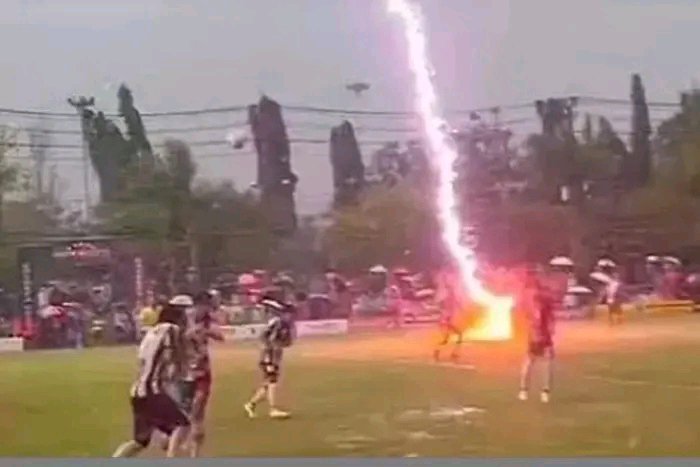
SUNGAI GOLOK, Thailand — A local football match in southern Thailand ended in tragedy on Tuesday after a lightning strike hit the pitch at Santiphap Stadium, killing one player and injuring 12 others during a Golok FA Cup fixture involving teams from Thailand and Malaysia.
The victim, identified as 24-year-old Sofwan Awae, suffered critical injuries when lightning struck near a group of players during the match between SAMCOLTS and Abu x Nong Sirin in Sungai Golok, a town in Narathiwat Province near the Malaysian border.
Despite the swift response of emergency teams and attempts by fellow players to revive him on the field, Awae later died in hospital, according to local police.
Authorities said 12 other players, including a Malaysian citizen, sustained injuries and were transported to nearby medical facilities for treatment.
The incident has renewed concerns about the dangers posed by severe weather during outdoor sporting events in Thailand, a country that records hundreds of lightning-related injuries and deaths each year.
Tragedy strikes during amateur tournament
Witnesses described scenes of panic and confusion as dark storm clouds gathered over Santiphap Stadium shortly before the lightning bolt struck.
Videos circulating on social media captured the dramatic moment when a flash of lightning hit the pitch, followed by a loud explosion that sent players, officials and spectators scrambling for safety.
Footage showed teammates wearing black-and-white striped jerseys rushing toward Awae, who collapsed after the strike. Several players turned him onto his back and attempted cardiopulmonary resuscitation (CPR) while waiting for emergency medical personnel to arrive.
Match officials immediately suspended the game as emergency responders entered the field.
Police later confirmed that the lightning strike occurred during the Golok FA Cup, an amateur football competition that brings together teams from both Thailand and neighbouring Malaysia.
The tournament fixture involved SAMCOLTS and Abu x Nong Sirin, two clubs that regularly participate in regional competitions.
Investigators have not released further details about whether weather warnings had been issued before the match began.
Victim identified as rising football talent
Awae, who played as a winger for SAMCOLTS, had recently joined Yala FC, a club competing in Thailand’s third division.
Friends and teammates described him as a talented and dedicated footballer whose career was beginning to gain momentum.
In a statement released after his death, Yala FC expressed condolences to Awae’s family and paid tribute to the young athlete.
The club described him as one of its promising players and said his death represented a devastating loss for the football community in southern Thailand.
Supporters, teammates and football officials shared messages of sympathy on social media, with many expressing shock over the sudden tragedy.
Local football associations have also extended condolences to Awae’s family while wishing a speedy recovery to those injured in the incident.
Injuries and emergency response
Police confirmed that 12 players suffered injuries of varying severity in the lightning strike.
Among those injured was a Malaysian national who had travelled to Thailand for the tournament.
Emergency medical teams responded within minutes, transporting victims to nearby hospitals for treatment and observation.
Authorities have not publicly disclosed the exact nature of the injuries sustained by the survivors, although officials indicated that most were receiving appropriate medical care.
Health experts note that lightning strikes can cause cardiac arrest, severe burns, neurological damage and long-term complications, even in cases where victims initially appear unharmed.
Medical specialists often recommend prolonged observation for survivors because symptoms may emerge hours or days after the incident.
Lightning dangers in Thailand
Thailand experiences frequent thunderstorms, particularly during the monsoon season, making lightning one of the country’s most significant weather-related hazards.
According to figures from Thailand’s Department of Disease Control, at least 283 people were struck by lightning between 2020 and 2024, with many of those incidents resulting in fatalities.
The country’s tropical climate, combined with high humidity and seasonal storms, increases the risk of lightning strikes, especially in rural areas and open spaces such as farms, football pitches and construction sites.
Meteorologists warn that sporting events held outdoors are particularly vulnerable during periods of unstable weather.
Lightning can strike several kilometres away from the centre of a storm, meaning that individuals may still face danger even if rainfall has not yet begun.
Experts advise event organisers to suspend outdoor activities immediately when thunder is heard or lightning is visible.
International sports federations, including football governing bodies, have established protocols requiring matches to be halted when dangerous weather conditions develop.
Questions over weather safety protocols
The tragedy has sparked renewed debate over safety measures at amateur sporting events across Southeast Asia.
While professional leagues often employ advanced weather-monitoring systems and strict emergency procedures, smaller competitions may lack the resources needed to detect approaching storms and evacuate participants quickly.
Sports safety experts say organisers should establish clear guidelines for postponing matches during severe weather.
These measures typically include monitoring weather forecasts, designating emergency shelters and training officials to recognise lightning risks.
Several countries have adopted the “30-30 rule,” which recommends suspending outdoor activities if the time between a lightning flash and the sound of thunder is less than 30 seconds.
Matches should only resume at least 30 minutes after the last thunderclap.
It remains unclear whether such protocols were in place during Tuesday’s fixture in Sungai Golok.
Local authorities have not announced whether an investigation will examine the safety arrangements surrounding the match.
Regional impact and international concern
The incident has resonated beyond Thailand because the Golok FA Cup attracts participants from neighbouring Malaysia and serves as an important platform for amateur football in the border region.
Football remains one of the most popular sports in Southeast Asia, with thousands of local tournaments taking place each year.
The cross-border nature of the competition means that organisers from both countries may face pressure to review safety standards for future events.
The tragedy also occurred on the same day that severe thunderstorms in India’s eastern state of Jharkhand reportedly killed at least 14 people, most of them farm workers caught in open fields.
The two incidents underscore the broader risks posed by extreme weather across Asia, where climate scientists have warned that changing weather patterns may increase the frequency and intensity of storms.
Although no direct link has been established between climate change and Tuesday’s lightning strike in Thailand, experts say rising global temperatures are contributing to more unpredictable weather conditions in many parts of the world.
Remembering Sofwan Awae
For teammates and supporters, the focus remains on mourning the loss of a young footballer whose life ended unexpectedly on the pitch.
Awae’s death has left a profound impact on the football community in southern Thailand, where local clubs often function as important social institutions that bring communities together.
Messages of condolence continued to pour in on Wednesday as friends remembered him not only as an athlete but also as a teammate and member of the community.
As authorities continue to assess the circumstances surrounding the incident, questions remain about how amateur sports organisations can better protect players from weather-related dangers.
The tragedy at Santiphap Stadium serves as a stark reminder of the unpredictable power of nature and the importance of emergency preparedness at sporting events.
For many in southern Thailand, the death of Sofwan Awae will be remembered as one of the darkest moments in the history of the Golok FA Cup and a painful lesson about the risks posed by severe weather.