













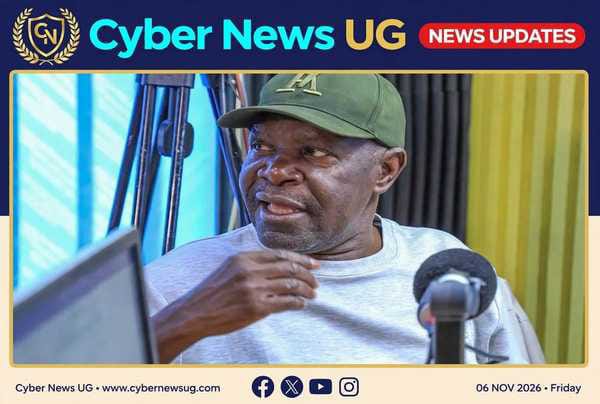
By Cybernewsug | News Desk
Uganda’s Chief of Defence Forces, Gen Muhoozi Kainerugaba, has issued a seven-day ultimatum to eastern Uganda older persons’ representative Ofwono Opondo, demanding a public apology amid growing tensions over comments surrounding retired General Peter Elwelu’s surrender.
Uganda’s Chief of Defence Forces (CDF), Gen Muhoozi Kainerugaba, has given Member of Parliament Ofwono Opondo seven days to apologise to him “on his knees”, in a series of strongly worded posts on social media that have attracted attention to tensions between the senior military commander and the former government spokesperson.
Kainerugaba issued the ultimatum on Thursday, November 5, 2026, through his account on X, where he also accused Opondo of repeatedly insulting him.
“I hear Ofwono Opondo has a death wish. I’m giving him exactly 7 days to apologize on his knees to me,” Muhoozi wrote.
In a separate post, the army chief added: “I have never found O.O. good at anything, apart from insulting people. He has been insulting me and I will teach him who I am.”
The remarks have raised questions about the growing public disagreement between the two figures, particularly given Kainerugaba’s position as head of Uganda’s armed forces and Opondo’s role as an elected legislator.
The ultimatum comes amid a wider public debate over the circumstances surrounding the surrender of retired Lieutenant General Peter Elwelu, a former deputy army chief, who recently came under the spotlight following allegations of involvement in activities that security authorities say threatened stability in the Teso sub-region.
However, although the timing of Muhoozi’s posts has drawn attention to Opondo’s comments about Elwelu, the army chief did not explicitly mention the former general in the quoted ultimatum.
Dispute follows comments about Peter Elwelu’s surrender
The disagreement comes against the backdrop of the recent detention of retired Lt Gen Peter Elwelu, who previously served as Deputy Chief of Defence Forces before leaving active military service.
Elwelu’s detention became public on November 2, 2026, after the UPDF announced that security forces had apprehended him over allegations of involvement in subversive activities and plans to destabilise the Teso sub-region.
The military also alleged that security personnel had recovered 15 firearms, military uniforms and two pickup trucks linked to the former senior officer. These allegations have not yet been established in court.
However, accounts surrounding how Elwelu entered security custody have differed.
While the military initially described the development as an arrest, people close to the retired general told the media that he had voluntarily contacted security personnel and surrendered at his office in Soroti City.
The conflicting accounts prompted political and public discussion about whether Elwelu had been arrested following a security operation or had reached an understanding with military authorities before presenting himself.
On November 3, The Pearl Times published an article reporting Opondo’s suggestion that Elwelu’s surrender could have been part of a negotiated truce between the former deputy army chief and the military leadership.
Opondo reportedly compared the situation to the return of former intelligence chief Gen David Sejusa, who left Uganda in 2013 following disagreements with the government before eventually returning in 2016.
“I can confirm [that he surrendered — and was not arrested as reported]. A truce actually, although some of the tin-heads would like to portray otherwise,” Opondo was quoted as saying.
He further described the developments as resembling an arrangement involving another UPDF general who had previously left Uganda and attracted international media attention.
However, Opondo’s suggestion of a negotiated understanding was not an officially confirmed account of the circumstances surrounding Elwelu’s surrender.
UPDF rejects claims of a negotiated surrender deal
The military subsequently rejected suggestions that Elwelu had voluntarily surrendered under a negotiated arrangement or received personal safety guarantees from President Yoweri Museveni.
On Thursday, November 5, Col Chris Magezi, the Acting Director of Defence Public Information, disputed reports suggesting that the President had assured Elwelu of his personal safety in exchange for surrendering.
Magezi said security forces had closed in on the former general, leaving him with no viable alternative but to give himself up peacefully.
“He gave himself up peacefully because the security forces had closed in on him. There were no viable alternative courses of action at his disposal,” Magezi said.
The army also maintained that Elwelu would be held accountable for the allegations against him before the UPDF General Court Martial.
Magezi insisted that the President had not offered the former deputy army chief any special guarantees.
“At no point did the President and the Commander-in-Chief, General Yoweri Kaguta Museveni, offer Elwelu assurances for his personal safety,” he said.
The military’s position therefore differs from the suggestion attributed to Opondo that the surrender could have followed a negotiated truce.
The circumstances remain contested, with the army maintaining that security forces had cornered Elwelu while relatives and associates have offered a different account of how he presented himself to authorities.
Teso leaders seek intervention over Elwelu’s detention
Elwelu’s detention has also attracted attention from political and cultural leaders in eastern Uganda, particularly in the Teso sub-region, where concerns have emerged over the allegations against the retired general.
On November 4, legislators under the Teso Parliamentary Group reportedly held an emergency meeting in Kampala and appealed to President Museveni and Gen Muhoozi to intervene in the matter.
The lawmakers called for fairness and caution, arguing that the developments had unsettled residents in the region.
They also urged the public to remain calm as authorities investigated the allegations.
Cultural leaders subsequently sought the President’s intervention.
According to Nile Post, Teso cultural leader Emorimor Paul Sande Emolot, Teso Queen Juliet Akaliait Among and Kumam Paramount Chief Raphael Ateker Otaya met Museveni at State House, Entebbe, on November 5.
During the meeting, Emorimor reportedly appealed to the President to facilitate dialogue between Muhoozi and Elwelu if their differences could be resolved through personal intervention.
“If there is any misunderstanding between your two sons, Gen Muhoozi and Peter Elwelu, we urge you to sit them down for a dialogue for the sake of peace, harmony and mutual understanding,” Emorimor told Museveni.
The President reportedly urged the cultural leaders to allow security agencies to complete their investigations before he intervened.
The engagement demonstrates the extent to which Elwelu’s detention has become a matter of regional concern beyond the military establishment.
Opondo’s departure from New Vision column adds to political attention
Muhoozi’s ultimatum also comes just days after Opondo publicly confirmed that he had stopped writing his regular opinion column for New Vision newspaper following an editorial disagreement.
On November 2, the former government spokesperson dismissed social media reports suggesting that the newspaper had banned him because of his critical commentary about the army chief and his political supporters.
Opondo maintained that the decision to stop contributing was entirely his own.
“The decision to not write in the last two weekends is entirely my own after I disagreed with a fickle editorial slant,” he wrote.
His explanation followed speculation that his increasingly critical views about Muhoozi and the Patriotic League of Uganda (PLU) had created disagreements with the newspaper’s management.
Government critic Kakwenza Rukirabashaija had alleged that New Vision dropped Opondo because of his criticism of the military commander and his political allies.
However, Opondo rejected claims that he had been banned, saying his departure resulted from differences over the newspaper’s editorial direction.
The former government spokesperson’s decision attracted attention because of his increasingly outspoken commentary on Uganda’s political succession debate and the activities of Muhoozi’s supporters.
Opondo has questioned Muhoozi’s political ambitions
Opondo has previously used his newspaper column and public appearances to question the growing political campaign promoting Muhoozi as a possible successor to his father, President Museveni.
In an October 5, 2026, New Vision opinion article titled Like or hate him: Gen Kahinda Otafiire serves it deliciously hot, Opondo defended retired Gen Kahinda Otafiire following his criticism of the country’s security leadership.
He also questioned the assumptions surrounding Muhoozi’s reported ambitions to contest the 2031 presidential election.
Opondo argued that those promoting the army chief’s political ambitions should not interpret the silence of some Ugandans as automatic support.
He also cautioned against arrogance among individuals campaigning for Muhoozi’s political future.
On October 24, 2026, Opondo reportedly reiterated some of his concerns during an appearance on Capital FM’s Capital Gang programme.
He questioned why some Cabinet ministers were endorsing Muhoozi for the presidency when Museveni had only recently secured another term.
He described the endorsements as a vote of no confidence in the sitting President and warned that premature succession discussions could create political uncertainty and undermine investor confidence.
Opondo further argued that Uganda’s next leader should demonstrate tolerance, embrace dialogue and respect differing political opinions.
These positions have placed him among the more outspoken public figures questioning the political activities surrounding the army chief.
However, the exact extent to which his broader political criticism contributed to Muhoozi’s latest ultimatum has not been independently established.
What Muhoozi’s ultimatum means for public debate
The latest exchange has renewed attention to the relationship between Uganda’s military leadership, political figures and public criticism.
As Chief of Defence Forces, Muhoozi occupies one of the country’s most influential security positions. Opondo, meanwhile, is an elected representative of older persons in eastern Uganda and a former government spokesperson.
Their disagreement therefore extends beyond a personal exchange on social media, raising broader questions about how public officials and senior state authorities respond to criticism.
The demand that an elected legislator apologise on his knees has also drawn attention because of the difference in the public responsibilities held by the two individuals.
Political disagreements involving senior government officials and military commanders can attract considerable public interest, particularly when they touch on national leadership, security institutions and succession politics.
The exchange also comes at a time when the handling of Elwelu’s case has generated competing accounts and calls for transparency from political and cultural leaders.
The military has maintained that Elwelu will answer for the allegations against him through the General Court Martial, while regional leaders have called for fairness and calm.
These developments make clear the importance of allowing investigations and judicial processes to establish the facts rather than relying on public exchanges to determine responsibility.
No public response from Opondo reported
As of November 6, 2026, the available reports detailing Muhoozi’s seven-day ultimatum had not documented a response from Opondo accepting the demand, rejecting it or indicating whether he intended to apologise.
It also remained unclear whether Muhoozi intended to pursue any formal action if the legislator failed to comply with the ultimatum.
The army chief’s posts did not specify the particular statements he wanted Opondo to apologise for, although the ultimatum emerged amid the public disagreement over Elwelu’s surrender and Opondo’s broader criticism of Muhoozi.
The seven-day deadline is now likely to keep the disagreement in the public spotlight as Ugandans follow developments involving the two figures.
Beyond the personal disagreement, the episode highlights the importance of accountability, institutional responsibility and respect for differing opinions in public life.
As the debate continues, the circumstances surrounding Elwelu’s detention and the military’s handling of the allegations against him remain matters requiring clear and transparent answers.