
























By Karim Were
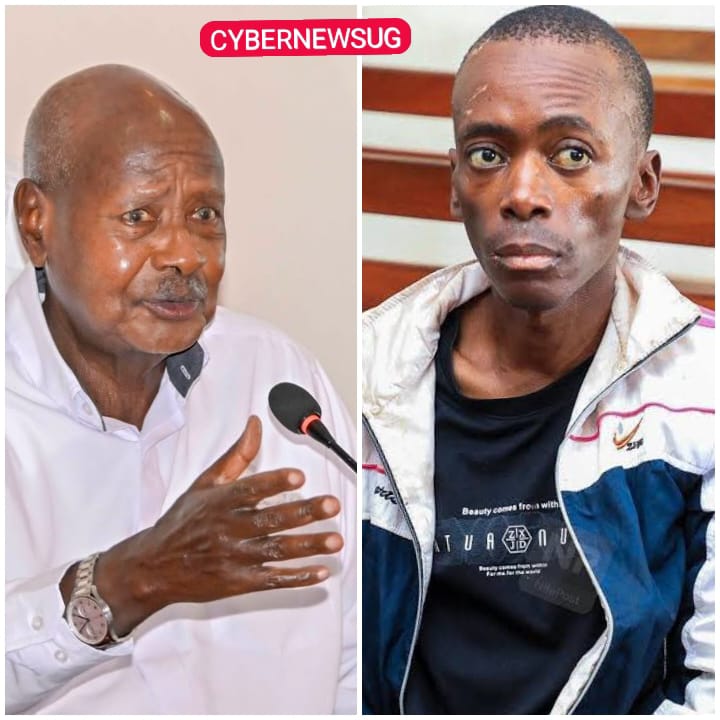
President Museveni has questioned why the public has not received clear updates on Christopher Okello Onyum’s appeal after his conviction and death sentence over the killing of four toddlers in Ggaba.
President Yoweri Museveni has raised concerns over the apparent delay in the appeal of Christopher Okello Onyum, who was convicted and sentenced to death for the murder of four toddlers at the Ggaba Early Childhood Development Centre in Kampala.
Museveni recalled that he had pushed for the trial to be conducted publicly in the same community where the killings occurred, arguing that the justice process should remain visible to the public. He has now questioned why information about the subsequent appeal has become less visible.
“You all remember Okello ONYUMU, that boy who killed children in Ggaba road Kansanga. I begged the system to go and hold a public trial in the same area the case was committed. It was held and after I heard that there was an appeal, now the case has disappeared. Why don’t you people always appear to show the public that Justice has been served?” Museveni said.
However, available court records and reports indicate that the case has not disappeared. Rather, Onyum’s appeal against his conviction and death sentence remains before the Court of Appeal and, according to publicly available reporting, had not been resolved by the time of the latest reports reviewed for this story.
The distinction is important because an appeal is a normal part of the criminal justice process. A conviction by the High Court does not automatically become final when an accused person files an appeal. The appellate court must consider the grounds raised before determining whether to uphold, overturn or vary the lower court’s decision.
Ggaba killings and the public trial
The case arose from the April 2, 2026 killings at the Ggaba Early Childhood Development Centre in Makindye Division, Kampala.
Christopher Okello Onyum was accused of killing four young children at the facility. The victims were identified in court records and media reports as Gideon Eteku, Keisha Agenorwoth Otim, Sseruyange Ignatius and Odeke Ryan.
The killings generated widespread public outrage and renewed debate about the protection of children, criminal investigations, mental-health evidence in murder trials and the pace of Uganda’s justice system.
Instead of conducting the proceedings exclusively within the conventional High Court setting, the Judiciary established a mobile High Court at Ggaba Community Church grounds, close to the location of the killings.
The judgment records that the mobile court was convened at the Ggaba Community Church grounds in Ggaba Trading Zone, Ggaba Parish, Makindye Division, Kampala. Justice Alice Komuhangi Khauka presided over the proceedings.
The arrangement attracted considerable public attention because residents and members of the victims’ communities could follow proceedings much closer to where the tragedy had occurred.
The public nature of the proceedings also gave the case unusual visibility, with journalists extensively reporting testimony from prosecution witnesses, defence arguments and the eventual judgment.
Museveni’s latest comments therefore revive a question that has surrounded the case from the beginning: whether the justice system can maintain the same level of public communication after a high-profile trial moves from the High Court to the appellate stage.
High Court convicted Onyum on four murder counts
On April 30, 2026, Justice Khauka convicted Onyum on four counts of murder.
The High Court rejected his defence that he was legally insane at the time of the killings. The court’s judgment found that the prosecution had established the elements necessary for murder and that the evidence demonstrated the requisite criminal responsibility.
The judgment further classified the case among the rare cases warranting the maximum sentence, taking into account factors including the vulnerability of the victims and the circumstances surrounding the offences.
Onyum was subsequently sentenced to death on each of the four counts.
The court also informed him of his right to appeal to the Court of Appeal within the prescribed period.
The conviction marked the conclusion of the High Court stage, but it did not end the legal process.
Appeal filed in May and June
Records reviewed by Uganda Radio Network and other media outlets show that Onyum formally began the appeal process after his conviction.
According to court records cited by URN, he filed a notice of appeal on May 6, 2026, indicating that he intended to challenge both his conviction and sentence. He later filed a memorandum of appeal on June 12. (Uganda Radionetwork)
The appeal was registered as Criminal Appeal No. 288 of 2026 before the Court of Appeal.
Onyum’s appeal raises three principal grounds.
First, he argues that the trial judge failed to properly evaluate the evidence and consequently reached an incorrect conclusion.
Second, he challenges the treatment of medical evidence concerning his mental condition.
Third, he argues that the death sentence imposed by the High Court was harsh and excessive and should either be set aside or varied. (New Vision)
The appeal therefore challenges both the finding of guilt and the punishment imposed by the High Court.
Through the appeal, Onyum is asking the appellate court to reconsider the High Court’s decision and grant the relief available under the law.
Why the appeal may appear to have “disappeared”
Museveni’s remarks reflect a concern that has also been raised publicly: the contrast between the speed of the original trial and the slower pace of the appeal.
The High Court proceedings were concluded within weeks. The conviction and death sentence came on April 30, less than a month after the April 2 killings.
By contrast, a report published by Daily Monitor in August noted that the appeal had been pending before the Court of Appeal for more than three months. The report examined why a case that moved rapidly through the High Court had not received the same pace at the appellate level.
That difference can create the impression among members of the public that a case has gone quiet or disappeared.
Legally, however, the absence of a publicly announced appellate decision does not mean that proceedings have ended or that the case has been abandoned.
An appeal involves a separate judicial stage. The appellate court has to consider the record of proceedings, the judgment, the grounds of appeal and the responses from the prosecution before making its determination.
The Court of Appeal may ultimately uphold the conviction and sentence, overturn the conviction, order a retrial, vary the sentence or issue another legally appropriate order depending on its assessment of the case.
Until such a decision is made, the High Court conviction remains subject to appellate review.
The mental-health issue
One of the central issues in the case was Onyum’s mental state.
During the trial, the defence raised an insanity argument. The High Court considered the evidence and rejected the defence.
A detailed legal analysis published by Daily Monitor reported that the court examined Onyum’s conduct before and during the killings, including evidence concerning his movements and actions. (Monitor)
The issue is significant because criminal responsibility and mental illness are not necessarily the same legal question.
A person may have a history of mental-health difficulties without automatically meeting the legal threshold for an insanity defence. Courts must assess the evidence according to the applicable legal standards and determine whether the accused understood the nature and consequences of the conduct at the relevant time.
The appellate court will therefore have an opportunity to consider Onyum’s argument that the High Court did not properly evaluate the medical evidence relating to his mental status.
It is important to distinguish this claim from an established finding: the High Court rejected the insanity defence. The appeal challenges that conclusion; it does not mean that the appellate court has already accepted it.
Evidence presented during the trial
The High Court heard extensive evidence concerning the circumstances surrounding the killings.
Prosecution witnesses included police officers, forensic investigators, medical personnel and people who had interacted with Onyum before and after the incident.
CCTV evidence was also presented to the court. Police analyst Emmanuel Odongo testified about movements associated with the vehicle used by Onyum before and around the time of the killings. The evidence was used by prosecutors to reconstruct movements between areas including Kyanja, Nakawa, Kampala and Ggaba.
Investigators also presented digital evidence concerning searches allegedly conducted before the attack. According to testimony reported during the trial, investigators examined phones, computers and other electronic devices recovered during the investigation.
The prosecution argued that this evidence helped establish planning and preparation.
The defence, however, was entitled to challenge the prosecution’s interpretation of that evidence and present its own case.
That adversarial process formed part of the trial record that is now relevant to the appeal.
Public interest remains high
The Ggaba case has remained one of the most closely followed criminal cases in Uganda in 2026 because of the age of the victims and the circumstances of their deaths.
The mobile court also created an unusual connection between the judicial process and the community affected by the crime.
For supporters of the arrangement, conducting proceedings near the crime scene demonstrated that justice could be brought closer to citizens rather than requiring everyone affected to travel to the traditional court premises.
The model also attracted attention because of the potential benefits of improving public understanding of court proceedings.
But the case equally demonstrated the challenges of conducting highly sensitive criminal proceedings in a public environment.
The proceedings drew large crowds and intense media attention. At one point during the trial, a Uganda Prisons vehicle transporting Onyum was involved in an accident near the temporary court premises, injuring a journalist. The incident underscored the extraordinary public interest surrounding the proceedings.
Museveni’s call raises broader justice questions
Museveni’s latest comments go beyond the individual case.
His central concern is whether Ugandans receive sufficient information about the progress of major criminal cases after highly publicised trials conclude.
For families of victims, the end of a trial is not necessarily the end of their search for closure. An appeal can prolong uncertainty, particularly when the original case received extensive public attention.
At the same time, the accused person’s constitutional and legal right to appeal must be respected.
The challenge for the justice system is therefore twofold: ensuring appeals are processed within a reasonable time while also communicating clearly enough with the public to prevent misunderstanding about the status of cases.
Greater public information does not require courts to compromise judicial independence or prejudge an appeal. It can instead involve routine communication about procedural milestones, such as whether the record has been prepared, whether submissions have been filed, whether a hearing date has been allocated and whether judgment has been delivered.
Such communication could help distinguish between a case that is genuinely stalled and one that is progressing through ordinary appellate procedures.
Justice and the right to appeal
The demand for swift justice must also be balanced against the principle of due process.
Onyum has been convicted by the High Court, but he has exercised his right to challenge that conviction.
That right is an important part of the judicial system, particularly in a case carrying the death penalty.
The public may have strong views about the severity of the crimes and the punishment imposed. However, the Court of Appeal must determine the matter on the law and evidence rather than public pressure.
This means that calls for transparency should not be confused with calls for a predetermined outcome.
The families of the four children deserve justice, while the appellant is entitled to have his appeal considered according to the law.
Both principles can operate at the same time.
What happens next?
The key question is now when the Court of Appeal will hear and determine Onyum’s challenge.
As of the latest reliable public reporting reviewed for this article, no appellate judgment overturning or upholding the High Court decision had been reported.
That means the case should not be described as having “disappeared.” It is more accurately described as an appeal that has remained pending after the High Court conviction.
Museveni’s comments nevertheless highlight a legitimate public-interest issue: how can the justice system keep citizens informed when high-profile cases move into lengthy appellate proceedings?
The Ggaba case began with a tragedy that shocked the country, moved through an unusually visible community-based High Court trial and then entered a less visible appellate phase.
The next judicial decision will ultimately determine whether the conviction and death sentences stand, change or are overturned.
Until then, the most accurate account is that Christopher Okello Onyum remains convicted by the High Court and that his appeal before the Court of Appeal remains unresolved.
The broader lesson from the case may be that justice must not only be done, but its progress must also be communicated clearly enough for the public to understand where a case stands—without compromising the independence of the courts or the rights of any party before them.
Source: President Museveni