























By Staff Reporter
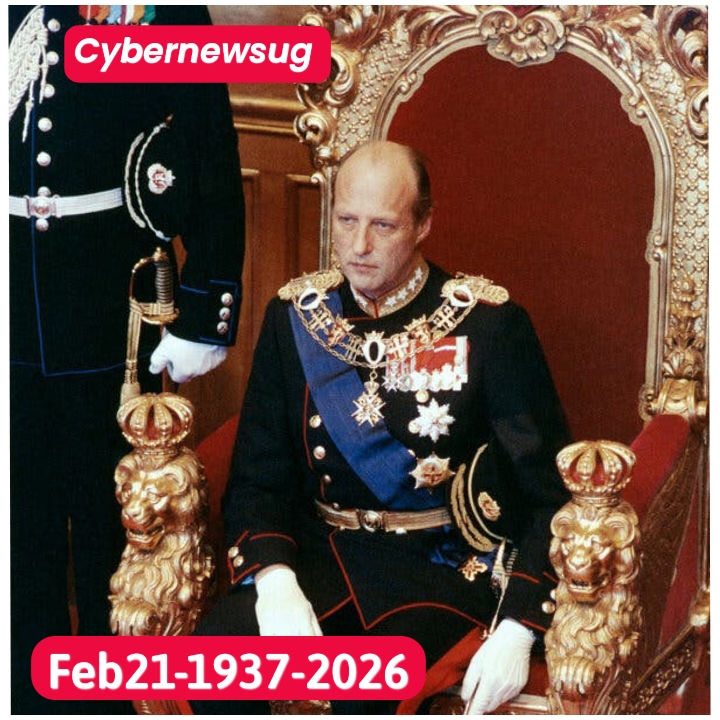
OSLO, Norway —Norway’s King Harald V has died at the age of 89, bringing to an end more than three decades of his reign and prompting national mourning across the Scandinavian country.
The Norwegian Royal Palace announced that the King died peacefully at Oslo University Hospital Rikshospitalet at 6:35am on Friday, August 28, 2026.
Harald, who had been Norway’s monarch since 1991, was the country’s longest-serving living head of state and Europe’s oldest reigning monarch at the time of his death.
His death was followed by the automatic succession of his son, Crown Prince Haakon, who becomes King Haakon VIII.
#Nation mourns popular monarch
The death of the King has prompted an outpouring of grief across Norway, with government officials and members of the public paying tribute to a monarch who was widely regarded as a unifying figure.
Norwegian Prime Minister Jonas Gahr Støre described the death as a moment of national mourning and expressed gratitude for Harald’s decades of service.
A whole nation is in mourning,” Støre said, praising the late King for his warmth, humour and faith in the Norwegian people.
The Norwegian government said an extraordinary meeting of the Council of State would be held at the Royal Palace with the new King.
The Norwegian Armed Forces also announced a national tribute. A 21-round mourning gun salute was scheduled to be fired from nine saluting stations across the country, while military units were to observe a minute of silence.
Norway’s Chief of Defence, Gen Eirik Kristoffersen, described Harald as a role model and source of inspiration, praising his commitment to the armed forces.
#Health concerns preceded death
King Harald had been receiving medical treatment in Oslo before his death.
The Royal Palace had announced earlier in August that the King’s condition had deteriorated and that he was being treated for a serious bacterial infection.
He had also faced health problems in recent years, including treatment involving his heart and the installation of a pacemaker.
Despite recurring health challenges, Harald continued to carry out his constitutional and ceremonial responsibilities and had maintained a public commitment to remaining on the throne.
#A reign of more than three decades
Harald became King in January 1991 following the death of his father, King Olav V.
His reign spanned a period of significant social, economic and political change in Norway.
The monarch played a largely ceremonial role under Norway’s constitutional system, while elected politicians and Parliament exercised political authority.
Nevertheless, Harald became an important national symbol and was widely associated with openness, equality and public service.
His reign also saw the Norwegian monarchy adapt to changing attitudes towards the institution, with Harald presenting a more accessible and modern image of the royal family.
One of the defining moments of his reign came after the terrorist attacks of July 22, 2011, when Norway experienced its deadliest peacetime attack in modern history.
Harald’s response during the period of national grief helped reinforce his reputation as a symbolic figure of national unity.
#Childhood shaped by war
Harald was born on February 21, 1937, at Skaugum in Asker, Norway.
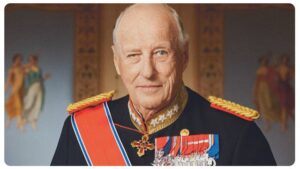
He was only three years old when Nazi Germany invaded Norway during the Second World War.
The Norwegian royal family was forced into exile, and the young prince spent several years in the United States with his mother, Crown Princess Märtha, and his sisters.
He later returned to Norway and eventually prepared for a life of public service and royal duties.
His experiences during the war became an important part of his personal history and contributed to his understanding of Norway’s modern national identity.
#Marriage to Queen Sonja
Harald’s personal life also played a significant role in the modernization of the Norwegian monarchy.
He married Sonja Haraldsen, a commoner, in 1968 after a long relationship that had initially faced opposition because of her non-royal background.
Queen Sonja became his partner in public life and supported him throughout his reign.
The couple had two children, Crown Prince Haakon and Princess Märtha Louise.
#Succession begins
Following Harald’s death, the Norwegian monarchy has entered a new era under his son, King Haakon VIII.
Haakon, 53, had already taken on many responsibilities on behalf of his father during periods when the King was unable to perform official duties.
His succession is expected to provide continuity for the Norwegian monarchy while also marking a generational transition.
The new King inherits a constitutional institution that has remained popular but, like other European monarchies, has faced questions about its future relevance and public role.
#Legacy of a modern monarch
Harald’s supporters are likely to remember him for the way he brought the monarchy closer to ordinary Norwegians.
He was known for his interest in sailing and represented Norway at three Olympic Games as a competitive sailor before becoming king.
His public speeches frequently emphasised inclusion, tolerance and the importance of accepting differences within Norwegian society.
Prime Minister Støre said Harald’s ability to bring people together was among his most important qualities.
The King’s death also comes at a challenging period for the wider Norwegian royal family, which has faced intense public scrutiny over several controversies in recent years.
#Tributes from abroad
Tributes have also begun arriving from foreign leaders and other European royal families.
Britain’s King Charles III expressed sorrow over the death of his cousin, while other European monarchs paid tribute to Harald’s long service and his role in strengthening relations among Nordic and European countries.
The death marks the end of an era for Norway.
For more than 35 years, Harald served as a constant presence through periods of prosperity, national tragedy and social change. His successor, King Haakon VIII, now faces the task of carrying the institution into a new generation while preserving the traditions that have sustained Norway’s modern monarchy.
As flags are lowered and Norwegians gather to remember their late monarch, the country begins a period of mourning for a King who spent his life in public service.
**Source:🇺🇬 Be Blessed