

























By Karim Were | Cybernewsug
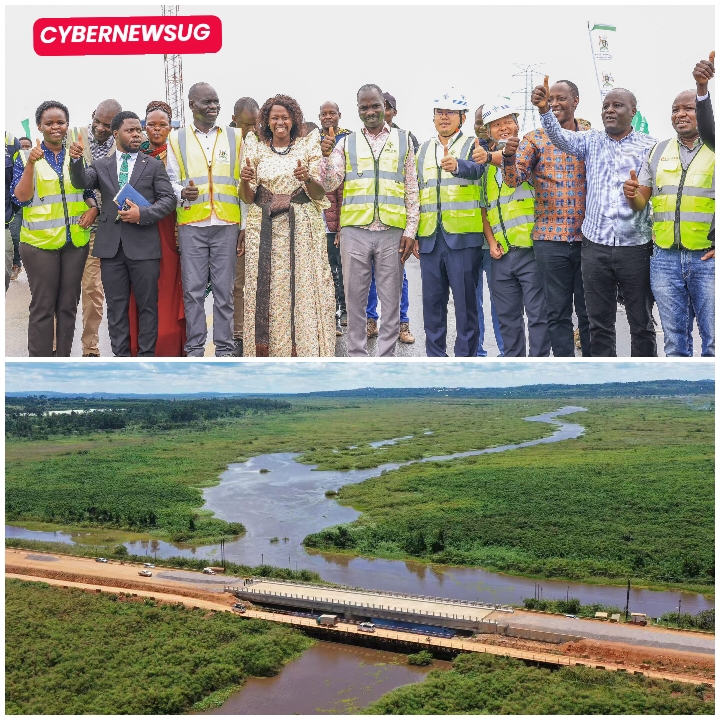
MPIGI, Uganda — The government has commissioned the reconstructed Katonga Bridge on the Kampala–Masaka Highway, marking a major milestone in efforts to restore a key transport corridor disrupted by severe flooding in May 2023.
The bridge was commissioned on Saturday, October 17, 2026, by Works and Transport Minister Fred Byamukama, accompanied by State Minister for Tourism, Wildlife and Antiquities Susan Nakawuki Nsambu.
The reconstruction forms part of a UGX 191 billion Katonga Corridor project intended to restore transport connectivity and provide a more resilient crossing at River Katonga, where floods severely damaged the previous bridge.
The new structure is designed for a service life of 120 years, according to information presented at the commissioning. Its elevated design is intended to reduce vulnerability to flooding and improve the reliability of the highway.
The restored crossing is particularly important for motorists, passenger transport operators, traders and freight companies using the highway to travel between Kampala, Masaka and southwestern Uganda.
The Kampala–Masaka route also serves regional traffic moving towards neighbouring countries, making the bridge’s restoration significant for trade, tourism and the movement of people and goods.
The commissioning follows the reopening of the reconstructed bridge to normal traffic earlier in October, with Saturday’s event formally marking the completion and handover of the infrastructure.
#A key transport link restored
Katonga Bridge occupies an important position on one of Uganda’s major highway connections between the capital and the country’s southwestern districts.
The road carries private vehicles, passenger buses, taxis and commercial trucks transporting agricultural produce, manufactured goods and other commodities. Any prolonged interruption along the route can affect travel schedules, business operations and the cost of moving goods.
The destruction of the original bridge in May 2023 exposed the vulnerability of this transport link to extreme weather and flooding.
Its reconstruction was therefore not simply a matter of replacing damaged infrastructure. It also required a new structure designed to respond better to the river’s behaviour and the possibility of future high water levels.
The completed project is expected to improve the reliability of movement along the corridor by restoring a direct crossing at Katonga and reducing dependence on the diversions that became necessary after the floods.
For residents and businesses operating along the route, dependable transport infrastructure is essential for accessing markets, schools, health facilities, tourism destinations and other services.
#Shs191 billion investment in the corridor
The reconstruction was undertaken by China Communications Construction Company (CCCC) in partnership with the Ministry of Works and Transport.
According to reporting on the commissioning, the UGX 191 billion project included construction of the replacement bridge, which was raised three metres above the previous structure and expanded to a width of 80 metres. The works also included improvements intended to strengthen the surrounding transport corridor.
The investment reflects the scale of the challenge involved in restoring a strategic highway crossing after severe flood damage.
Bridge construction requires consideration of river flows, foundation stability, structural loads, drainage and the volume of traffic expected to use the crossing. These factors are particularly important where a previous structure has been compromised by flooding.
The design life of 120 years cited during the commissioning represents a long-term engineering target. Achieving that lifespan will depend on construction quality, appropriate maintenance, routine inspections and the management of environmental risks over time.
The government will therefore need to ensure that the bridge is maintained throughout its operational life, with any emerging defects identified and addressed promptly.
Floods that disrupted a national highway
#Floods that disrupted a national highway
The original Katonga Bridge was severely damaged by flooding in May 2023, when rising water levels along River Katonga disrupted traffic on the Kampala–Masaka Highway.
In a statement issued on May 13, 2023, the Ministry of Water and Environment said rainfall in the area had reached 512 millimetres, compared with a long-term average of 200 millimetres for the March-to-May period.
The ministry reported that the river’s water level rose suddenly by more than two metres on May 11, 2023, contributing to flooding along the highway.
Preliminary findings pointed to a possible upstream damming effect associated with blocked culverts along a road in Kalungu District. The ministry said further technical investigations would examine the river’s hydrology and hydraulics to help prevent similar incidents.
The flooding caused significant disruption to road transport and affected communities around the river. It also highlighted the consequences that extreme weather can have on infrastructure, particularly where a single bridge serves as a major link between regions.
Following the damage, motorists faced diversions while authorities worked to restore access. Parliament subsequently discussed the disruption and the difficulties faced by traders and transport operators using alternative routes.
In July 2024, the Ministry of Works and Transport told Parliament that studies of the river’s behaviour and meteorological conditions were necessary to guide the design of a replacement structure capable of withstanding future challenges.
The decision to reconstruct the bridge was therefore part of a wider effort to restore the highway while addressing concerns about the resilience of the crossing.
#What the reconstruction means for businesses
The restored bridge is expected to support commercial activity by improving the reliability of transport along the Kampala–Masaka corridor.
For traders, transport companies and manufacturers, road infrastructure is a key component of operating costs. Delays and diversions can increase fuel consumption, vehicle operating expenses and delivery times.
Agricultural producers also depend on reliable roads to move produce to urban markets and distribution centres. Interruptions can complicate the movement of perishable goods and make transport planning more difficult.
The bridge’s restoration should help businesses plan journeys along the direct route more reliably, although the extent of any reduction in transport costs or travel times will depend on traffic conditions and the state of the wider road network.
The project also demonstrates the importance of maintaining alternative transport arrangements when major infrastructure fails. Temporary crossings and diversions can help sustain movement during reconstruction, but they cannot always provide the same capacity or convenience as a fully restored highway.
For government planners, the experience offers an opportunity to strengthen infrastructure risk assessments and ensure that critical road links are designed with changing weather patterns and local environmental conditions in mind.
#Tourism and regional connectivity
State Minister for Tourism Susan Kawuki, who attended the commissioning, highlighted the bridge’s importance to tourism, saying the restored crossing would improve access to national parks and tourist destinations in western Uganda.
The route is relevant to visitors travelling from Kampala towards destinations in southwestern and western Uganda. Reliable road connections can make it easier for tourists, tour operators and hospitality businesses to organise travel.
The restoration could also benefit communities whose livelihoods depend partly on tourism, including accommodation providers, guides, transport operators and traders supplying visitors.
However, the bridge is one component of a much wider tourism network. The quality of connecting roads, visitor services, destination management and road safety will continue to influence how easily travellers reach tourism sites.
Its broader contribution will therefore depend on the condition of the surrounding road network and the ability of businesses to take advantage of improved connectivity.
#Engineering standards and long-term maintenance
The stated 120-year design life places a long-term responsibility on the agencies overseeing the bridge and the engineers involved in its construction.
At the commissioning, Byamukama stressed the need for the structure to meet the expected durability standards and warned against defects arising from poor workmanship.
A design-life estimate does not mean that a bridge can operate for more than a century without maintenance. Regular inspections, drainage management, protection against erosion and timely repairs remain essential to structural safety.
Authorities will also need to monitor the river and surrounding environment, particularly during periods of heavy rainfall, to identify potential threats to the bridge and its approaches.
The experience of the 2023 floods underlines the importance of combining engineering solutions with effective monitoring and maintenance systems. Even a well-designed structure must be supported by sound management throughout its service life.
Public accountability will also be important. Clear information about project costs, completion standards, maintenance responsibilities and inspection arrangements can help citizens understand how the investment is being protected.
## Motorists urged to prioritise safety
The commissioning has been accompanied by reminders for motorists to exercise caution when using the highway.
Ahead of the ceremony, traffic police spokesperson Michael Kananura urged road users to remain patient, follow instructions from officers deployed at the site, maintain lane discipline and avoid improper overtaking or attempting to bypass other vehicles. Traffic was also scheduled to be temporarily halted for approximately 20 minutes during the commissioning ceremony.
Although the bridge has been restored, motorists must continue to observe speed limits, keep safe following distances and avoid dangerous manoeuvres.
Commercial drivers and passenger transport operators have a particular responsibility to protect passengers and other road users, especially along busy highways carrying a mixture of heavy trucks, buses and smaller vehicles.
Road safety will remain an important consideration as normal traffic continues along the corridor.
#A milestone for Uganda’s transport network
The commissioning of Katonga Bridge marks a significant stage in the recovery of a transport route that was disrupted for more than three years after the 2023 flooding.
The UGX 191 billion investment provides a replacement crossing intended to improve resilience and restore direct movement along the Kampala–Masaka Highway.
Its long-term success will depend on the quality of the completed works, regular maintenance, effective flood-risk management and responsible road use.
For motorists, traders, tourism operators and communities across central and southwestern Uganda, the restored bridge offers renewed access along a vital transport connection.
The challenge now is to ensure that the infrastructure delivers lasting value, withstands future environmental pressures and remains safe and dependable for the generations expected to use it.
Source: