

















By Karim Were
Ssemwanga, Busizoori, Sserunkuma and Hyeroba take up new responsibilities as the military changes command at the Reserve Forces and three infantry divisions
The Uganda Peoples’ Defence Forces (UPDF) has reshuffled several senior commanders, making changes to the leadership of the Reserve Forces, Land Forces and the 3rd and 4th Infantry Divisions.
The changes, announced on August 15, 2026, by Col Chris Magezi, the Acting Director of Defence Public Information, took immediate effect. The appointments affected four senior officers and came as the UPDF prepared for the retirement of Lt Gen Charles Otema Awany, who had been serving as Commander of the Reserve Forces. (Monitor)
Under the changes, Maj Gen Joseph Musoke Ssemwanga was appointed Commander of the Reserve Forces, replacing Lt Gen Otema Awany.
Maj Gen Felix Busizoori, who had been commanding the 4th Infantry Division, was appointed Deputy Commander of the Land Forces, taking over from Maj Gen Ssemwanga.
Maj Gen Wilberforce Sserunkuma, previously commander of the 3rd Infantry Division, was transferred to the 4th Infantry Division as its new commander.
Brig Gen Michael Walaka Hyeroba was appointed commander of the 3rd Infantry Division, replacing Maj Gen Sserunkuma. (Monitor)
The reshuffle represents a significant adjustment to the UPDF’s senior field-command structure, with the affected formations playing roles in national defence and security operations in different parts of Uganda.
Ssemwanga moves to Reserve Forces
Maj Gen Joseph Ssemwanga moved from his position as Deputy Commander of the Land Forces to become Commander of the Reserve Forces.
His appointment followed the planned retirement of Lt Gen Charles Otema Awany.
The Reserve Forces form part of the UPDF’s broader military structure and are responsible for functions associated with reserve personnel and related military responsibilities.
The change therefore placed Ssemwanga in a senior position at a time when the UPDF was reorganising parts of its command structure.
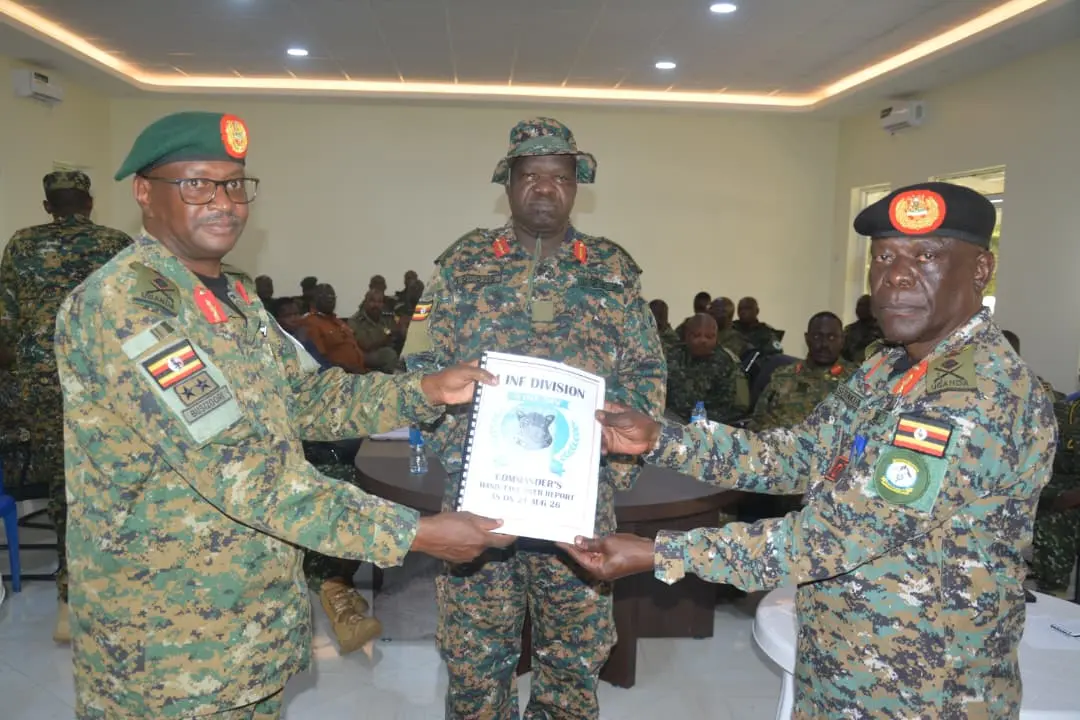
UPDF records subsequently confirmed that Ssemwanga assumed his new role, while Maj Gen Felix Busizoori formally took over his former position as Deputy Commander Land Forces. (UPDF)
At the handover ceremony at Land Force Headquarters in Bombo, Deputy Chief of Defence Forces and Inspector General of the UPDF Lt Gen Sam Okiding described transfers and appointments as a normal part of military service.
“Transfers are normal. We are trained people and we understand that,” Okiding said, according to the UPDF.
He urged Busizoori to work with the existing Land Forces command structure and build on the work undertaken by his predecessor. (UPDF)
Busizoori takes Land Forces deputy role
Maj Gen Felix Busizoori moved from command of the 4th Infantry Division to become Deputy Commander of the Land Forces.
The appointment placed him within the senior leadership structure responsible for the UPDF’s land operations.
At his handover, Busizoori thanked the military leadership for entrusting him with the new responsibility and acknowledged the importance of the position in supporting the Commander Land Force.
“Our mission demands nothing but excellence,” Busizoori said, adding that the Land Forces would continue to train rigorously and support one another.
The handover was attended by senior UPDF officers, including commanders from divisions, formations and joint services. (UPDF)
Busizoori’s previous assignment had been as commander of the 4th Infantry Division, where he had responsibility for a broad area of northern Uganda.
During his tenure, the division was involved in security and community-related activities, including operations in the wider border areas.
The UPDF has said his period in command also included efforts to strengthen civil-military relations and address security challenges affecting communities in northern Uganda. (UPDF)
Sserunkuma takes over 4th Infantry Division
Maj Gen Wilberforce Sserunkuma was transferred from the 3rd Infantry Division to command the 4th Infantry Division.
He formally assumed office at the division headquarters in Gulu, taking over from Busizoori.
The 4th Infantry Division’s area of responsibility includes parts of northern Uganda and areas along the country’s borders with South Sudan and the Democratic Republic of Congo.
During the change-of-command ceremony, Lt Gen Okiding tasked Sserunkuma with strengthening security along Uganda’s borders and building on the work of his predecessor. (UPDF)
Sserunkuma pledged continuity rather than an abrupt change in approach.
He said he intended to build on the structures established during Busizoori’s tenure, including cooperation between the military and civilian communities.
His appointment was therefore accompanied by an emphasis on continuity, professional leadership and community engagement.
The commander also encouraged local leaders and communities to work with the military in addressing security concerns.
Focus on border security
The change at the 4th Infantry Division came as the UPDF continued to focus on security along Uganda’s northern and northwestern borders.
The division’s area of responsibility includes areas bordering South Sudan and the Democratic Republic of Congo, where instability and cross-border security concerns have periodically affected communities.
Lt Gen Okiding’s instructions to the new commander therefore placed border security among the key responsibilities of the new command.
New Vision reported that the 4th Infantry Division has responsibility for several administrative areas in West Acholi and the wider West Nile region. (New Vision)
The border environment presents complex security demands because military operations can intersect with local community relations, cross-border movement, trade and regional political developments.
For the UPDF, maintaining security in these areas requires not only military preparedness but also cooperation with civilian authorities and communities.
Hyeroba takes command in northeastern Uganda
Brig Gen Michael Walaka Hyeroba was appointed commander of the 3rd Infantry Division, succeeding Maj Gen Sserunkuma.
The change of command took place at the division headquarters in Moroto and was presided over by Lt Gen Okiding.
The 3rd Infantry Division has responsibility for security operations in parts of northeastern Uganda, including areas covering Karamoja and neighbouring regions.
Hyeroba previously served as Deputy Commander of the 1st Infantry Division before his appointment.
During the handover, Okiding commended Sserunkuma for his service and welcomed Hyeroba to the new assignment.
“I am proud that you have left the Division clean with no scratch,” Okiding told Sserunkuma, while wishing him well in his new assignment.
Hyeroba pledged to build on the foundation established by his predecessor and called for cooperation among commanders, officers, soldiers, local leaders and communities.
That emphasis reflects the importance of maintaining relationships between security institutions and civilians in areas where military operations have historically been closely connected to local security and development concerns.
Continuity highlighted in military handovers
One feature of the appointments has been the emphasis on continuity.
Rather than presenting the changes as a complete departure from previous command policies, UPDF officials have repeatedly urged incoming commanders to preserve effective programmes while addressing emerging security challenges.
At the 4th Infantry Division, Okiding urged senior officers to mentor junior personnel and support institutional development.
At the same time, incoming commanders were encouraged to work with existing structures and personnel rather than operate in isolation.
The approach is consistent with military institutions’ need to maintain operational continuity when commanders change.
Command changes can affect strategic direction, but day-to-day military operations also depend heavily on established systems, trained personnel and institutional experience.
Busizoori’s record in northern Uganda
The transition at the 4th Infantry Division also provided an opportunity for officials to assess Busizoori’s period in command.
According to the UPDF, he contributed to security operations and community-development initiatives in the region.
The force credited his command with contributing to efforts against the CODECO militia in eastern Democratic Republic of Congo under Operation Mlinzi wa Wanyonge and reducing cross-border incursions from South Sudan. (UPDF)
The UPDF also said the division oversaw construction projects and initiatives aimed at improving relations between soldiers and surrounding communities.
Among those cited was the rehabilitation of 45 boreholes for communities as part of activities marking the 45th Tarehe Sita celebrations.
These claims are statements from the UPDF and should be understood as the military’s account of achievements during Busizoori’s tenure.
Security and community relations
The appointments also highlight the continuing importance of civil-military relations in Uganda’s security environment.
Military commanders operating in areas such as northern Uganda and Karamoja interact with communities affected by a range of security, economic and social challenges.
Effective cooperation between security forces, local governments and communities can assist in identifying emerging threats and resolving disputes before they escalate.
At the 4th Infantry Division, local leaders praised Busizoori for what they described as improved relations between the military and civilian population.
Sserunkuma subsequently pledged to maintain an open-door approach and work with local leaders.
Similarly, Hyeroba called for cooperation from civilian authorities and communities as he began his assignment in the 3rd Infantry Division.
Why the appointments matter
The changes affect formations operating in strategically important areas of Uganda.
The Reserve Forces command is responsible for an important component of the UPDF’s overall force structure, while the Land Forces command oversees the army’s principal ground component.
The 3rd and 4th Infantry Divisions, meanwhile, operate in regions where border security, community relations and regional instability remain important considerations.
Consequently, leadership changes in these formations can have implications for operational priorities, coordination and relations with civilian authorities.
However, the appointments should not automatically be interpreted as evidence of a new security threat or a major change in national defence policy.
The official information available describes them primarily as command appointments and transfers, with several changes linked to the retirement of Lt Gen Otema Awany.
Broader UPDF command structure
The reshuffle took place under the leadership of Gen Muhoozi Kainerugaba, the UPDF Chief of Defence Forces.
The UPDF’s current leadership structure lists Lt Gen Samuel Okiding as Deputy Chief of Defence Forces and Inspector of Defence Forces, Lt Gen Kayanja Muhanga as Commander Land Force and Maj Gen Joseph Musoke Ssemwanga as Commander Reserve Force. (UPDF)
The changes illustrate how the military’s command structure is periodically adjusted through appointments, transfers and retirements.
Such changes are part of the management of a professional armed force and allow officers to assume different responsibilities during their careers.
For the affected commanders, the new assignments also place different demands on their leadership, from reserve-force management to land-force coordination and divisional command.
What comes next
The immediate focus for the newly appointed commanders is expected to be continuity in their respective formations.
For Ssemwanga, the task is to lead the Reserve Forces following Otema Awany’s retirement.
Busizoori assumes a senior role within Land Forces, where he is expected to work with the existing command structure.
Sserunkuma takes responsibility for the 4th Infantry Division and its border-security mandate, while Hyeroba assumes command of the 3rd Infantry Division in northeastern Uganda.
Their performance will ultimately be assessed through the security, discipline, professionalism and institutional objectives assigned to their respective formations.
Conclusion
The UPDF’s August 2026 reshuffle has introduced new commanders to four important positions within the military’s senior command structure.
Maj Gen Joseph Ssemwanga moved to command the Reserve Forces, Maj Gen Felix Busizoori became Deputy Commander Land Forces, Maj Gen Wilberforce Sserunkuma took charge of the 4th Infantry Division, and Brig Gen Michael Hyeroba became commander of the 3rd Infantry Division. (Monitor)
The changes came as the UPDF prepared for the retirement of Lt Gen Charles Otema Awany and were implemented immediately.
Beyond the movement of individual officers, the appointments place renewed emphasis on continuity, border security, professional development and cooperation between the military and civilian authorities.
As the new commanders settle into their respective assignments, their ability to maintain operational readiness while strengthening institutional and community relationships will remain central to the UPDF’s security responsibilities.
Source: