
























By Karim Were
New transport capacity is expected to improve police mobility, visibility and response to emergencies as Uganda expands policing services closer to communities.
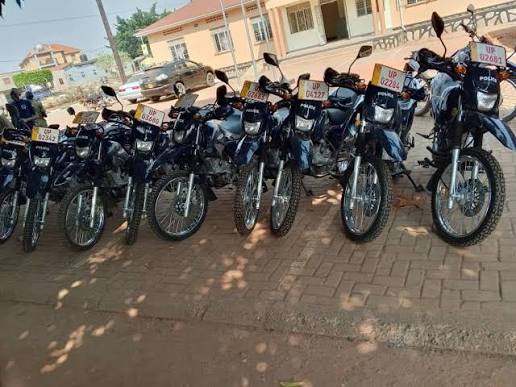
The Uganda Police Force (UPF) is deploying motorcycles as part of efforts to operationalize its Sub-County Policing Model, a strategy designed to bring police services closer to communities and improve the speed with which officers respond to crime and other emergencies.
The deployment of motorcycles is intended to address one of the key logistical requirements of the model: ensuring that police personnel stationed at sub-county level have reliable and flexible transport for patrols, community engagement and emergency response.
Advertisement keep the date, VOYAGERS KOKORONGO


The Sub-County Policing Model seeks to decentralise policing from major urban centres and district headquarters to sub-counties, municipal divisions and town councils. Under the plan, local police stations are expected to have personnel, transport and communication facilities necessary to provide basic policing services within their areas of responsibility.
According to the UPF, the model was adopted following strategic guidance given by President Yoweri Museveni at the 25th Annual Police Council meeting in November 2019. The President later issued Executive Order No. 03 of 2023, directing that the police should strengthen its presence beyond Kampala and other major urban centres.
Motorcycles at the centre of local police mobility
Motorcycles are particularly important to the model because they can provide officers with faster access to communities, including areas where conventional police vehicles may be difficult or expensive to deploy.
Unlike patrol vehicles, motorcycles can navigate narrow roads, rural tracks and congested areas with greater flexibility. Their use can also allow officers to cover several communities within a sub-county without relying entirely on larger vehicles.
The UPF’s implementation framework provides for transport and communication equipment at sub-county police stations. In a January 2025 briefing, the force said the model involved deploying 18 personnel at each sub-county, including an officer in charge, general-duty officers, criminal investigations personnel, crime intelligence officers, a Child and Family Protection Unit officer and a community liaison officer.
Advertisment

The same framework provided for three motorcycles, portable radios, a VHF base radio and a counter telephone for each operationalised sub-county station.
The exact transport allocation has varied across different implementation documents and phases. A parliamentary committee report on the 2025/26 budget described the minimum requirement as two motorcycles per police station, while earlier UPF plans and statements have referred to three or four motorcycles depending on the phase and operational requirements.
This variation underscores that motorcycle deployment is part of a wider logistical programme rather than a standalone initiative.
Bringing policing closer to rural communities
The main objective of the Sub-County Policing Model is to make policing more accessible at the local level.
For years, policing resources have been concentrated around cities, municipalities and larger trading centres. The UPF has argued that this arrangement left some rural communities with limited access to police services, particularly when residents needed immediate assistance.
The force has also linked the decentralisation programme to changes in the geography of crime. As surveillance and security infrastructure have increased in some urban areas, police have reported concerns that criminal activity can shift towards rural and peri-urban communities.
The Sub-County Policing Model is therefore intended to establish a more consistent police presence where people live and conduct their daily economic activities.
The UPF says the strategy should improve emergency response, crime prevention, community engagement and intelligence gathering. It is also expected to support the protection of government programmes operating at community level, including the Parish Development Model and Emyooga.
Progress in implementation
The deployment of motorcycles follows several years of planning and phased implementation.
In January 2025, the UPF reported that the model had been operationalised in eight policing regions covering 49 districts and 591 sub-counties. At that stage, the force reported 1,231 motorcycles and 10,006 personnel assigned to those areas.
The regions listed by police included North West Nile, Rwizi, Kiira, Rwenzori East, Sipi, Greater Masaka, Greater Bushenyi and Albertine.
The UPF had earlier projected that the model would eventually cover all 2,190 sub-counties, municipal divisions and town councils in the country.
More recent government and justice-sector assessments indicate that implementation has continued, although logistical and staffing gaps remain.
A 2025 report from the Justice, Law and Order Sector said police presence had been established in 1,231 of Uganda’s 2,190 sub-counties, equivalent to about 56 percent. It also identified inadequate accommodation, motorcycles, counter phones and radio communication as continuing challenges to full implementation.
The Auditor General similarly reported that the model requires significant transport resources. Its assessment noted that a model based on 18 officers and three motorcycles per sub-county would require about 6,570 motorcycles for 2,190 sub-counties.
These figures demonstrate why motorcycle deployment remains an important component of the wider rollout.
Expected impact on emergency response
One of the most immediate benefits expected from motorcycle deployment is faster response to emergencies.
In rural communities, the distance between a police station and the scene of an incident can affect response times. Poor road conditions, traffic and limited availability of patrol vehicles can further delay officers.
Motorcycles can provide an alternative means of reaching affected communities, particularly where roads are narrow or impassable for conventional vehicles.
The UPF has previously said the Sub-County Policing Model is intended to provide “quick response to incidences and real-time attention to security matters” affecting local communities.
This could be particularly important in cases involving theft, domestic violence, road accidents, disputes, missing persons and other incidents requiring timely police intervention.
However, motorcycles alone cannot guarantee faster response. Their effectiveness will depend on fuel availability, maintenance, road conditions, trained personnel, communication systems and the availability of officers to respond when an emergency is reported.
Supporting community policing
The motorcycle deployment also has implications for community policing.
Community policing relies heavily on regular interaction between police officers and residents. Officers need to be able to move around their areas of responsibility, meet local leaders, visit communities and gather information about emerging security concerns.
A more mobile police presence could make it easier for officers to maintain contact with residents rather than remaining largely at police stations.
The model also provides for community liaison officers, whose role is expected to strengthen communication between police and local communities.
This is significant because crime prevention depends not only on responding after an offence has occurred but also on gathering information and identifying risks before they develop into serious incidents.
The UPF has described the model as being based on community-oriented policing and intended to improve intelligence gathering and crime prevention.
A broader restructuring of Uganda’s policing system
The motorcycle deployment should therefore be viewed within a larger restructuring of territorial policing.
The UPF began studying the Sub-County Policing Model several years ago, with the intention of consolidating police resources at sub-county level rather than maintaining a large number of small posts with limited personnel and equipment.
In a 2022 statement, the force said the model was intended to establish at least one police station per sub-county, deploy personnel, introduce motorcycle squads, provide communication facilities and strengthen community-level policing.
The restructuring has not been without concerns.
Earlier consultations raised fears among some local leaders and communities that closing or merging smaller police posts could increase the distance residents have to travel to access police services. The UPF responded that the model was designed to consolidate resources while maintaining local policing and improving overall capacity.
This makes the deployment of motorcycles particularly significant. If smaller police facilities are consolidated, transport becomes essential to ensure that the larger sub-county station can still provide effective coverage across the entire area.
Funding remains a major challenge
The scale of the programme means that transport is only one part of the financial challenge.
Police stations require buildings, staff accommodation, communication equipment, motorcycles, fuel, maintenance and personnel. Sustaining these facilities also requires recurrent funding after the initial equipment has been provided.
A parliamentary report on the 2025/26 budget indicated that the UPF had allocated funds for construction of model police stations and acquisition of motorcycles and communication equipment, but also identified a substantial financing gap for nationwide implementation.
The Office of the Prime Minister previously reported that government was seeking substantial resources to support the implementation of the model across the country. It said the programme was intended to establish police stations with 18 personnel, motorcycles, communication equipment and publicly known counter telephone numbers.
The financial requirement reflects the fact that creating a functioning police presence at every sub-county involves much more than deploying officers.
Staffing and operational capacity
Staffing is another issue that will determine whether the model achieves its intended objectives.
The Auditor General reported that the force had deployed 25,263 personnel across 1,231 sub-counties, giving an average of about 12 officers per sub-county, below the model’s proposed staffing level of 18. The report said additional personnel undergoing training were expected to help reduce the staffing gap.
This means that motorcycle deployment must be accompanied by adequate staffing.
A motorcycle is useful only when trained officers are available to operate it, fuel is available and the vehicle is maintained. Communication equipment is similarly important because mobility without reliable communication may not produce the desired improvement in emergency response.
The road ahead
For Uganda, the success of the Sub-County Policing Model will ultimately be measured by whether residents experience more accessible and responsive police services.
Motorcycle deployment represents an important operational step because it addresses one of the practical challenges of taking policing closer to communities.
If supported by adequate staffing, communication systems, fuel, maintenance and appropriate infrastructure, the motorcycles could increase patrol coverage and enable officers to respond more quickly to incidents.
The broader objective, however, is not simply to put more police motorcycles on rural roads. It is to establish a sustainable policing structure in which communities can access police services without travelling long distances to district headquarters or major urban centres.
As the UPF continues to roll out the model, the balance between resources, staffing and geographical coverage will remain critical. The force’s own assessments show that significant gaps still exist, particularly in transport, accommodation and communications.
For communities, the practical test will be whether the new arrangements translate into faster emergency response, greater police visibility, improved crime prevention and stronger cooperation between law enforcement officers and residents.
The deployment of motorcycles is therefore best understood as one component of a much larger transformation of Uganda’s territorial policing system—one aimed at making police services more visible, mobile and accessible at the level where citizens interact most directly with government.
**Source